
2026 Nail Sticker Trends: Design and Finish Opportunities for Beauty Brands
For beauty brands planning 2026 launches, nail sticker opportunities are expected to center on expressive finishes, wearable personalization, coordinated collections, and application formats that fit different consumer routines. The strongest programs will pair trend-led artwork with repeatable color and finish control, clear application instructions, suitable backing and adhesive choices, and production checks aligned with the intended market. Buyers evaluating a custom nail stickers manufacturer should assess design flexibility, sampling discipline, material documentation, packaging readiness, and the ability to connect nail decals with complementary products such as custom press-on nails, salon false nails, gel nail tabs, and fake toe nails.
Design directions shaping the next generation of nail decals
High-impact finishes with more controlled wearability
Metallic accents, chrome-inspired surfaces, pearlescent effects, translucent layers, and fine shimmer offer a way to make a small-format product feel distinctive. In 2026 assortments, the commercial opportunity is not simply to make every nail highly reflective. It is to combine a statement finish with practical placement: a single foil motif, a narrow metallic outline, a translucent overlay, or a small group of accents can bring visual interest without making the full set difficult to coordinate with everyday outfits.
Brands should treat finish names as design descriptions rather than substitutes for production specifications. “Chrome,” “pearl,” and “holographic” may refer to different visual effects across suppliers. During sampling, compare the actual appearance under consistent lighting, check the color against approved references, and confirm whether the effect is printed, applied as a film, or produced through another construction. These details influence artwork limits, minimum order quantities, unit cost, and the consistency that can be achieved across repeat orders.
Personalized graphics, micro-art, and mix-and-match sets
Small motifs, initials, symbols, fine-line florals, playful icons, and abstract shapes support personalization without requiring a fully bespoke design for every buyer. A modular collection can offer several coordinated sheets or nail looks that share a color palette but vary in motif density. This gives retailers more merchandising options while helping brand owners control the number of distinct artworks and inventory commitments.
Legibility is a key design constraint at nail scale. A graphic that appears clear on a desktop proof may lose fine detail after resizing, printing, cutting, or application to a curved nail surface. Buyers should review production-size proofs rather than judging artwork only from enlarged images. It is also useful to test the intended motif placement on different nail shapes and lengths, especially when the same artwork is expected to work across short, medium, and long styles.
Translucency, negative space, and coordinated nail wardrobes
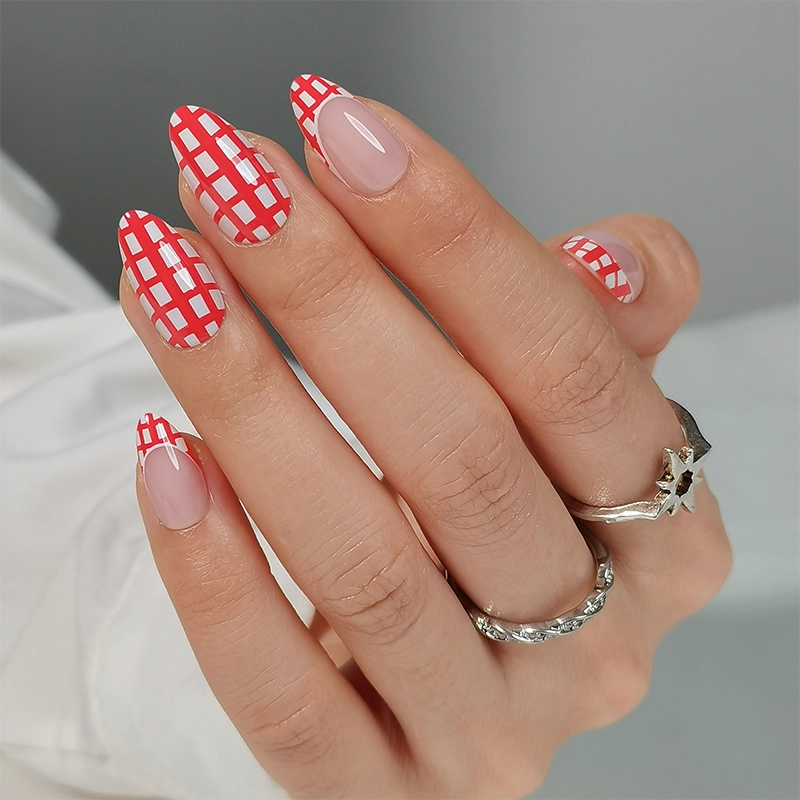
Sheer bases, fine outlines, and negative-space compositions can make nail art feel lighter and more adaptable. These approaches suit consumers who want a visible design without a dense, full-coverage look. They also create collection-building opportunities: a brand can coordinate a decal sheet with a solid-color press-on set, a matching pedicure design, or a complementary accent style, then merchandise the products as a complete nail wardrobe.
Coordination should be planned at the palette and finish level, not just through similar names or themes. A blush shade in a decal print may not visually match a blush press-on nail if the base material, opacity, or finish differs. Establish shared color references and evaluate samples side by side. For collections spanning decals and artificial nails, specify which elements must match precisely and which may be intentionally complementary.
Turning trend concepts into commercially workable collections
Match the format to the buyer and application routine
Before approving artwork, decide who will use the product and how it will be applied. Nail stickers may be positioned as direct-to-nail decoration, as an embellishment for press-on nails, or as part of a broader at-home manicure assortment. Each use case affects the preferred sticker size, flexibility, adhesive behavior, instruction format, and package contents. A product designed for a smooth artificial nail may not perform identically on a natural nail with a different surface condition.
Application claims should reflect the actual product construction and testing. If the assortment includes gel nail tabs or sticker press on nails, keep product instructions specific to that format rather than implying that every adhesive or decoration is interchangeable. Buyers should also review how users will remove the product and whether the package gives clear, appropriate directions. The U.S. Food and Drug Administration provides an overview of nail care products and FDA oversight; brands should assess the applicable requirements for the product, claims, and markets in which it will be sold.
Use a structured design-to-production review
A practical development process separates creative approval from production approval. First, confirm the concept, color direction, dimensions, and intended use. Next, review a production-representative sample for print clarity, cut accuracy, finish appearance, backing release, and placement. Finally, confirm that the approved sample, packaging artwork, product description, and purchase order refer to the same revision. This reduces the risk of a visually attractive prototype becoming a commercially inconsistent repeat order.
Color management deserves particular attention when the product contains several finishes or is sold as a coordinated collection. Buyers can request documented color references, agreed tolerances where suitable, and clear approval records for each artwork revision. A physical master sample is valuable for comparison, but it should be stored and handled consistently because lighting, aging, and display conditions can affect visual judgment. When a product has multiple sizes or shapes, approve representative samples across the range rather than assuming that one sample proves every size.
Compare design routes before committing to a launch
The table below is a qualitative procurement comparison, not a market-share forecast. It helps project owners compare the likely design and operational trade-offs of common nail-art directions. Final performance depends on the specific construction, artwork, manufacturing process, and intended application.
| Design route | Visual opportunity | Key production or merchandising check | Potential assortment role |
|---|---|---|---|
| Metallic or chrome-inspired accents | High contrast and a High Quality-looking focal point | Confirm finish consistency, artwork detail, and appearance under retail lighting | Statement sets, seasonal capsules, accent designs |
| Micro-art and personalized motifs | Distinctive expression in a compact format | Check legibility at final size and placement across nail shapes | Giftable styles, themed ranges, personalization options |
| Sheer and negative-space artwork | Light, flexible styling that can complement multiple base colors | Assess opacity, edge visibility, and performance on the intended surface | Everyday collections and mix-and-match designs |
| Coordinated decal and press-on sets | A complete manicure or pedicure styling story | Align color references, finish expectations, sizing, and package instructions | Cross-sell bundles and broader nail wardrobes |
Supplier evaluation, quality controls, and portfolio planning
Assess documentation and process control, not just sample appeal
A polished sample is only one part of supplier qualification. Buyers should ask how artwork revisions are controlled, how incoming materials are identified, what in-process checks apply, and how finished goods are inspected before shipment. The quality system should be appropriate to the product and the supplier’s actual scope. For organizations making cosmetic products, ISO 22716 guidelines on good manufacturing practices for cosmetics provide a recognized reference for cosmetic GMP; the standard should not be treated as automatic proof that every sticker supplier is certified or that every product falls within its scope.
Material and market requirements also need to be reviewed in context. Buyers should identify the destination countries, product classification, intended user, packaging claims, and any relevant material restrictions before finalizing specifications. The European Chemicals Agency explains the framework and responsibilities under REACH. This is a starting point for market assessment, not a substitute for product-specific regulatory review or qualified advice.
Plan children’s products with an age-appropriate risk review
Kids nails press on and children’s nail-art products may require additional care in design, packaging, labeling, and marketing. The appropriate obligations depend on the product’s classification, intended age group, construction, and sales market. Small components and detachable accessories should be considered in a product risk review rather than treated as a minor packaging detail. The U.S. Consumer Product Safety Commission describes requirements and guidance for small parts in toys and children’s products; brands should confirm applicability to their specific product and obtain market-specific compliance review.
For every audience, clear instructions and product identification support a better customer experience and more reliable retail operations. Packaging should make the product format understandable, distinguish components that serve different purposes, and avoid claims that have not been substantiated. For children’s ranges, review the full experience—from the physical components to the wording and presentation—before approving a launch.
Build the assortment around complementary products
A nail-art program can extend beyond a single sticker sheet. Brands may organize launches around custom press-on nails, salon false nails, fake toe nails, gel nail tabs, and sticker press on nails, giving customers options for different styles and application preferences. These categories can share a visual theme while retaining distinct specifications, instructions, sizing, and packaging. A consistent collection architecture helps retailers tell a clearer product story and can support cross-selling without blurring the differences between product types.
Our relevant product categories include custom press on nails, press on nails, salon false nails, kids nails press on, fake toe nails, gel nail tabs, and sticker press on nails. For a project, buyers can define the target consumer, preferred design direction, finish references, approximate assortment scope, and destination markets before requesting a development discussion. Because no company-specific manufacturing credentials or certifications are provided here, procurement teams should verify capabilities, documentation, sample quality, lead times, and compliance evidence directly during supplier qualification.
Contact us to discuss your 2026 nail-art brief and explore product options for building a coordinated, market-ready collection.
Frequently Asked Questions
Which nail sticker finishes are worth considering for a 2026 collection?
Metallic and chrome-inspired accents, pearlescent effects, translucent layers, fine shimmer, and negative-space designs offer distinct visual directions. Buyers should compare production samples under consistent lighting and confirm how each finish is constructed.
How can a brand make nail sticker artwork work across different nail shapes?
Review artwork at final production size and test placement on representative nail shapes and lengths. Fine details can become unclear after resizing or application, so production-size proofs and physical samples are more useful than enlarged digital artwork alone.
What should buyers check when evaluating a nail sticker supplier?
Assess artwork revision control, sample quality, color and finish consistency, cut accuracy, backing release, inspection practices, packaging readiness, material documentation, lead times, and evidence relevant to the intended markets.
Can nail stickers be sold together with press-on nails?
Yes. Brands can build coordinated collections that pair decals with custom press-on nails or other artificial nail products. They should align color references and finish expectations while keeping product specifications and application instructions clear for each format.
What should brands consider when developing nail products for children?
Review the intended age group, product classification, components, packaging, labeling, marketing, and destination-market requirements. Assess detachable or small components as part of a product risk review and verify applicable rules with qualified compliance support.
What documents or standards should buyers review for nail product development?
The relevant review depends on product scope and sales market. Buyers can examine supplier process documentation and investigate applicable frameworks, including ISO 22716 for cosmetic GMP where relevant and REACH obligations for products placed on the EU market. These references do not replace product-specific compliance assessment.


Copyright © 2025 - XIANXING BEAUTY All Rights Reserved. Sitemap
Facebook
YouTube
Instagram
LinkedIn