
How to Audit a press on toenails manufacturer for Quality
Auditing a press on toenails manufacturer requires more than reviewing product photos or comparing unit prices. Buyers should verify material safety, anatomical fit, adhesion performance, coating durability, dimensional consistency, production traceability, regulatory documentation, packaging accuracy, sampling speed, capacity, and order fulfillment controls. A reliable supplier must demonstrate that its artificial toenail products can be reproduced at commercial scale while meeting the brand’s specifications for shape, size, color, comfort, application, and shelf presentation. This guide provides a structured quality audit for retailers, beauty brands, salons, distributors, importers, and private-label project owners.
Building a Quality Audit Framework for Artificial Toenail Suppliers
Begin with product specifications and intended use
Quality begins with a written product brief. The brief should define the target consumer, application method, expected wear period, toe-size range, curvature, thickness, surface finish, design complexity, packaging format, and included accessories. A product intended for home use may require flexible sizing, simple instructions, and adhesive tabs, while a salon-oriented line may prioritize precise fit, professional presentation, stronger adhesive systems, and a wider range of shapes.
Buyers should request a technical specification sheet rather than relying on verbal assurances. The document should identify the substrate material, decorative layers, topcoat, adhesive or gel tab type, recommended storage conditions, packaging components, and inspection criteria. For children’s products, the project should also address age suitability, small-part considerations, labeling, and supervision requirements in the destination market. Clear specifications prevent a common procurement failure: approving a visually attractive sample that cannot be reproduced consistently in mass production.
Examine material safety and chemical documentation
Material evaluation should cover the artificial nail body, colorants, decorative elements, UV coating, adhesive, tabs, and packaging inks that may contact the user. Ask the supplier for current test reports and declarations that match the actual product composition and factory output. Documents should show the tested product name, model or batch reference, laboratory identity, test date, applicable standard, and result. Generic certificates with no connection to the ordered SKU provide limited assurance.
For international programs, buyers should understand the difference between a supplier declaration, a laboratory report, and a legally applicable market requirement. The U.S. Food and Drug Administration cosmetics laws and regulations explain the regulatory framework for cosmetic products in the United States, while European chemical compliance may involve obligations under REACH. RoHS may apply to restricted substances in electrical and electronic equipment rather than ordinary nail products, so its relevance should be confirmed by product scope instead of assumed. A competent supplier can explain which documents apply and which do not.
Audit the factory, not only the finished sample
A finished sample represents one production moment. A factory audit evaluates whether the supplier can repeat that result. Review incoming-material inspection, mold or sizing controls, printing and decoration processes, UV-curing parameters, adhesive-tab assembly, packing-line verification, finished-goods inspection, rejected-product handling, and batch traceability. The audit should identify who is responsible for each control, how often checks occur, and what happens when results fall outside tolerance.
Manufacturing discipline is especially important for custom press on nails because small changes in curvature, thickness, or edge finishing can affect comfort and adhesion. A supplier should maintain approved master samples, controlled artwork files, color references, packaging specifications, and signed pre-production samples. Change-control records are also valuable: if a resin, coating, adhesive, supplier, or production location changes, the buyer should be notified and the product should be revalidated where necessary.
Testing Fit, Wear Performance, and Batch Consistency
Evaluate dimensional accuracy and anatomical fit
Toenail products must follow the natural variation of the big toe, second toe, and smaller toes. An audit should compare the approved size chart with actual measurements from multiple production pieces. Check length, width, apex position, sidewall shape, curvature, thickness, and edge smoothness. Measurements should be taken across several sizes and cavities rather than from one representative piece.
Fit testing should include users with different nail widths and curvature profiles. A strong evaluation records whether the product sits flush at the cuticle, leaves excessive side gaps, presses on surrounding skin, or creates a visible step at the free edge. The buyer should also inspect removal behavior. Products that fit well but require excessive force to remove can create a poor consumer experience and increase complaint risk.
Measure adhesion and wear behavior under realistic conditions
Adhesive performance depends on nail preparation, moisture, pressure, temperature, activity, and application technique. A credible supplier should provide application instructions and a defined internal test method. The buyer can create a verification protocol covering clean and dry natural nails, application pressure, initial bond time, walking or daily-use simulation, exposure to water, and removal. Results should be recorded by size and adhesive type.
Do not treat a claimed wear duration as a universal guarantee. Wear claims should be linked to stated conditions and supported by repeatable testing. Compare gel nail tabs, liquid adhesive systems, and sticker press on nails according to the project’s user profile. A distributor targeting quick-change beauty products may value easy removal, while a salon program may require stronger retention and a more secure professional application process.
Inspect appearance, coating, and decoration durability
Visual inspection should cover color uniformity, print registration, glitter distribution, French tips, metallic effects, embedded decorations, and topcoat clarity. Inspect the product under consistent lighting and compare it with the approved color standard. Common defects include pinholes, bubbles, dust particles, incomplete curing, uneven gloss, sharp edges, lifting decoration, and inconsistent design placement.
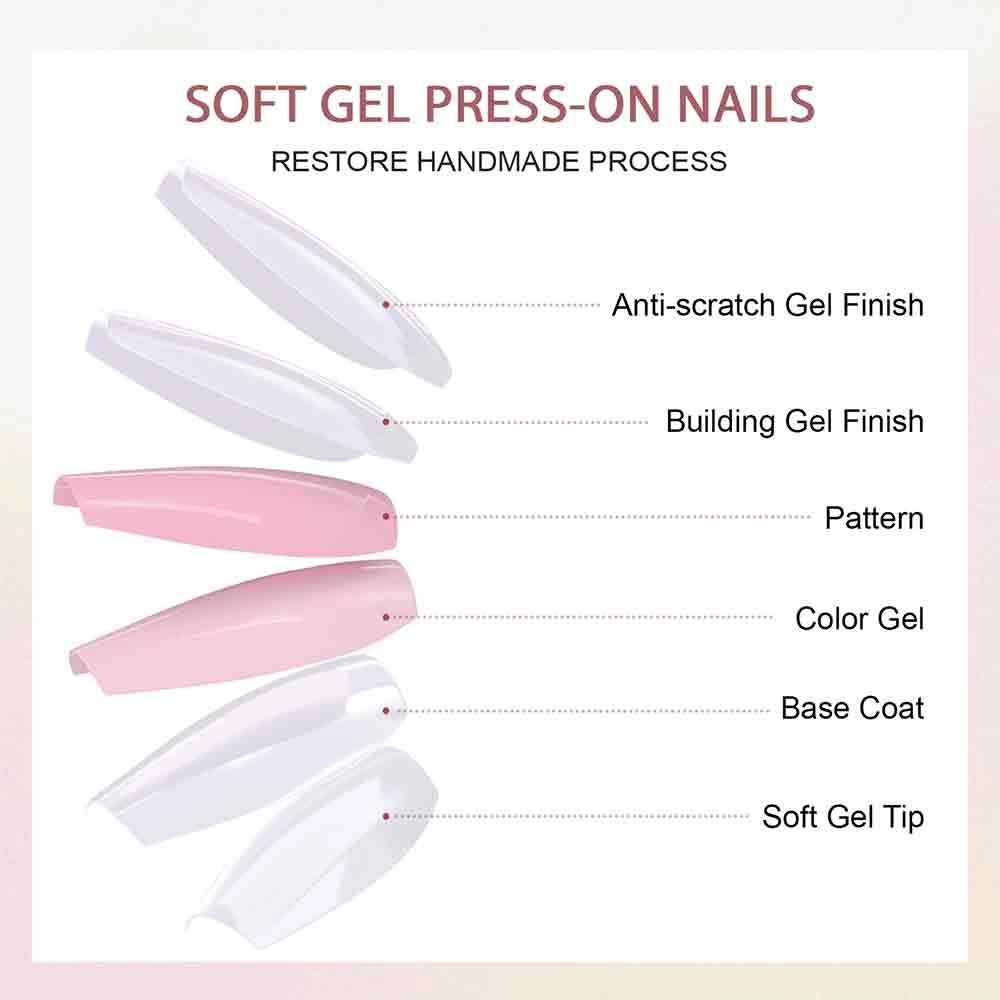
UV coating can improve surface protection, gloss, and resistance to routine abrasion, but it must be applied and cured consistently. Audit records should show coating process controls and inspection results. Samples should undergo rub, flex, and light handling checks appropriate to the product design. Highly decorated salon false nails may require additional packaging protection because contact between pieces can cause scratching or transfer during shipment.
| Audit area | Evidence to request | Warning signal | Commercial impact |
|---|---|---|---|
| Materials and chemicals | SKU-specific reports, declarations, SDS or MSDS, composition information | Undated generic documents or mismatched product names | Regulatory delays, recalls, and rejected shipments |
| Fit and dimensions | Controlled size chart, tolerance records, multi-piece measurements | Only one sample is measured | Returns, poor comfort, and low repurchase rates |
| Adhesion | Defined test method, application instructions, repeat results | Unqualified wear-time promises | Consumer complaints and inconsistent reviews |
| Decoration and coating | Approved color standard, curing controls, visual inspection records | Color variation between batches | Brand inconsistency and retailer disputes |
| Production control | Batch records, inspection plan, corrective-action reports | No traceability after shipment | Slow complaint investigation and costly replacements |
| Packaging and logistics | Drop-test approach, carton specifications, packing checklist | Unverified packaging changes | Transit damage and retail presentation failures |
Verifying Compliance, Documentation, and Commercial Reliability
Review quality-management practices and corrective action
Quality management should be assessed as a working system rather than a certificate collection. The ISO 9001 quality management standard emphasizes controlled processes, customer requirements, performance evaluation, and continual improvement. Certification can be useful, but buyers should still ask how nonconforming products are isolated, how root causes are identified, and how corrective actions are verified.
Request examples of anonymized inspection forms, nonconformance reports, and corrective-action records. Strong evidence includes documented containment, root-cause analysis, action ownership, completion dates, and effectiveness checks. The supplier should also explain how customer complaints are escalated and how affected batches are traced. These controls reduce the risk that a recurring defect will be hidden by reworking or selective shipment.
Validate capacity, lead time, and business continuity
Production capacity must be matched to the buyer’s forecast, not presented as an isolated maximum number. Confirm daily output by product category, number of production lines, staffing model, peak-season capacity, raw-material availability, and subcontracting policy. If external processes are used for printing, packaging, or decoration, those partners should be included in the quality-control review.
Lead time should be separated into artwork approval, sample development, pre-production confirmation, manufacturing, inspection, packaging, and export preparation. A supplier promising a short delivery window without defining these stages may create planning risk. Buyers should also ask about backup equipment, alternative material sources, inventory policies, and communication procedures during supply interruptions. These details are central to landed-cost planning and retail launch timing.
Use a staged approval process before placing a large order
A practical procurement sequence is document review, factory assessment, prototype approval, pilot order, pre-shipment inspection, and post-delivery performance review. The pilot should represent the final material, artwork, adhesive, packaging, and assembly method. Establish acceptance criteria before production begins, including allowable cosmetic defects, dimensional tolerances, carton counts, barcode accuracy, and labeling requirements.
For brands selling across several regions, the compliance file should be organized by SKU and destination market. The World Health Organization guidance on quality assurance illustrates the broader principle that documented procedures, defined responsibilities, and evidence-based controls support consistent product quality. Although press-on toenails are not medicines, the same audit logic—traceability, documented controls, verification, and corrective action—helps buyers build a defensible supplier-qualification process.
Why Xianxing Beauty Fits Custom Nail Procurement Programs
Integrated OEM and ODM capability
Xianxing Beauty was founded in 2012 and focuses on OEM and ODM customized nail production for brands, distributors, salons, and retail programs. Our 20,000-square-meter factory supports structured development and production for press-on nail collections, including fake toe nails, custom press on nails, salon false nails, kids nails press on, gel nail tabs, and sticker press on nails.
Our team supports small-scale customization across materials, sizes, nail shapes, designs, and packaging. This flexibility is valuable for buyers testing a new collection, building seasonal assortments, or validating demand before committing to a high-volume launch. It also allows brand owners to align the product architecture with their target market instead of choosing from a fixed catalog.
Capacity and development speed for commercial launches
Our manufacturing operation produces up to 300,000 pieces of press on nails daily and launches more than 100 new products every month. These capabilities help buyers manage both core replenishment programs and fast-moving design updates. Nail samples can be provided within 3 days, while orders are generally completed within 7–14 days, subject to product complexity, approval timing, order quantity, and packaging requirements.
Fast sampling is most valuable when it is paired with controlled specifications. Buyers should still confirm the approved sample, artwork version, size assortment, adhesive configuration, packaging dieline, and inspection requirements before mass production. Our OEM and ODM workflow is designed to connect those development details with the final manufacturing program.
Material features and supporting documentation
Our press-on nail products are designed to be lightweight and breathable, with non-toxic and odorless product characteristics and UV coating intended to improve protection, durability, and visual finish. Product documentation includes ROHS, REACH, and MSDS certifications or reports as applicable to the relevant product and market. Buyers should request the current SKU-specific compliance file during qualification and confirm destination-market labeling and import requirements.
Xianxing Beauty’s vision is to become the world’s leading press on nails manufacturer by combining design responsiveness, manufacturing scale, customization, and quality-focused service. For a procurement team, the practical evaluation remains the same: review samples, verify documents, inspect production controls, define acceptance criteria, and assess whether the supplier can deliver consistent quality at the required volume.
To discuss custom press-on toenails, private-label collections, or OEM and ODM development, contact Xianxing Beauty at [email protected] or visit the official Xianxing Beauty website.
Frequently Asked Questions
What documents should buyers request from an artificial toenail supplier?
Buyers should request SKU-specific material information, laboratory test reports, declarations, SDS or MSDS documents, applicable REACH or RoHS evidence, product specifications, inspection records, and packaging details. Each document should identify the relevant product, date, test scope, and issuing organization.
How can a buyer verify the fit of press-on toenails before mass production?
The buyer should compare multiple production pieces with the approved size chart and measure length, width, curvature, thickness, apex position, and edge finish. Fit testing should include users with different toe widths and curvature profiles to identify side gaps, pressure points, and cuticle misalignment.
How should adhesion performance be tested?
Create a defined test covering natural-nail preparation, application pressure, initial bond time, daily-use simulation, water exposure, and removal. Compare the results of gel nail tabs, liquid adhesive systems, or sticker press on nails under the conditions relevant to the target customer, and avoid treating an unsupported wear-time claim as a guarantee.
Why is a factory audit important when the product sample looks acceptable?
A sample shows only one production result, while a factory audit evaluates repeatability. Buyers should review incoming-material inspection, sizing controls, decoration, UV curing, adhesive assembly, packing verification, finished-goods inspection, batch traceability, change control, and corrective-action procedures.
What should be included in a pilot order for custom nail products?
The pilot order should use the final material, artwork, adhesive, packaging, and assembly method. Acceptance criteria should be agreed before production and should cover cosmetic defects, dimensional tolerances, carton quantities, barcode accuracy, labeling, and shipment condition.
What production capabilities does Xianxing Beauty offer?
Founded in 2012, Xianxing Beauty operates a 20,000-square-meter factory, produces up to 300,000 pieces of press on nails daily, launches more than 100 new products monthly, supports small-scale customization, provides samples within 3 days, and generally completes orders within 7–14 days depending on project requirements.




Copyright © 2025 - XIANXING BEAUTY All Rights Reserved. Sitemap
Facebook
YouTube
Instagram
LinkedIn