
Top customization requests and feasibility for Custom 3D press-on nails
- How Three-Dimensional Nail Customization Is Evaluated
- Visual complexity versus manufacturing control
- Wearability, weight, and nail-bed comfort
- Compliance and material documentation
- Top Buyer Requests and Their Commercial Feasibility
- Raised motifs, charms, and textured surfaces
- Custom colors, finishes, and branded artwork
- Size systems, shapes, and complete assortment architecture
- Packaging, accessories, and retail presentation
- Production Planning for a Scalable Nail Collection
- Sampling, approvals, and change control
- Minimum order quantity, labor, and landed cost
- Quality assurance and performance testing
- Why Xianxing Beauty Fits Custom Development Programs
- OEM and ODM capacity for varied order profiles
- Fast sampling and controlled execution
- Documentation and global market readiness
- Frequently Asked Questions
Custom 3D press-on nails combine a reusable or disposable nail tip with dimensional decoration, layered color, molded elements, texture, and branded presentation. For B2B buyers, feasibility depends on more than visual appeal: the design must balance adhesion, comfort, weight, curing or coating requirements, packaging protection, regulatory documentation, minimum order quantity, and repeat-production consistency. The most commercially practical programs use lightweight relief details, controlled thickness, standard tip structures, validated size ranges, and packaging that prevents deformation during transportation. Xianxing Beauty supports OEM and ODM development for press on nails, including material selection, nail shapes, sizing, artwork, packaging, salon false nails, kids nails press on, fake toe nails, gel nail tabs, and sticker press on nails.
How Three-Dimensional Nail Customization Is Evaluated
Visual complexity versus manufacturing control
The first procurement question is not whether a decoration can be made once, but whether it can be reproduced across thousands of units with consistent placement, color, height, and adhesion. Flat printing, chrome effects, decals, micro-glitter, and shallow embossed patterns are usually easier to scale than tall charms, large hand-built flowers, or irregular structures that create variation between pieces. A supplier should convert the reference artwork into a production specification covering decoration height, attachment method, color references, nail position, acceptable tolerance, and inspection criteria.
Designers should also distinguish between molded relief, 3D gel architecture, attached accessories, and layered surface art. Each method affects tooling, labor, curing, durability, and packaging. A low-profile molded accent may be appropriate for a mass retail collection, while hand-applied sculpting may be reserved for a High Quality capsule with a higher selling price. This distinction helps buyers align the design with target retail price, expected order volume, and acceptable manufacturing variance.
Wearability, weight, and nail-bed comfort
A dimensional feature adds mass and can change the center of gravity of the artificial tip. If the decoration is concentrated near the free edge, the product may feel heavy or catch on clothing. If it is placed close to the cuticle area, the design may interfere with fit or create pressure during application. Practical development therefore evaluates the complete assembled nail rather than the ornament alone.
Lightweight resin, controlled gel volume, smooth edges, and a balanced profile support a better user experience. Buyers should request wear trials on different nail-bed widths, including short, curved, and flatter natural nails. The test should record application ease, lifting at the sidewalls, decoration retention, surface scratching, and removal condition. For children’s ranges, rounded shapes, low-profile decoration, age-appropriate artwork, and clear use instructions are especially important.
Compliance and material documentation
Product classification and obligations vary by market, claims, packaging, adhesives, and included accessories. In the United States, the U.S. Food and Drug Administration guidance on cosmetics explains that manufacturers and distributors are responsible for product safety and labeling, while most cosmetics are not preapproved before sale. Buyers should obtain ingredient or material information, safety documentation, batch traceability, and labeling support instead of relying only on a supplier’s marketing statement.
For European distribution, chemical and material review should consider the European Commission REACH Regulation information. Quality systems can also be structured with reference to ISO 22716 Good Manufacturing Practices for cosmetics, particularly for documented procedures, hygiene controls, batch records, and corrective actions. These references do not replace market-specific legal advice, but they provide a credible framework for supplier evaluation.
Top Buyer Requests and Their Commercial Feasibility
Raised motifs, charms, and textured surfaces
Raised flowers, bows, pearls, fruit, animals, metallic studs, jelly effects, and sculpted seasonal icons are among the most requested additions. They are feasible when the relief is proportionate to the nail surface and the attachment process is defined. Small, rounded elements generally have better durability than sharp protrusions. A design with multiple loose accessories may require additional manual assembly, inspection, and protective packaging, which can increase unit cost and lead time.
Buyers should ask whether the supplier can offer two versions: a commercial low-profile edition and a High Quality high-relief edition. This approach creates a tiered assortment without redesigning the entire collection. It also allows retailers to test demand before committing to labor-intensive decoration. The supplier should provide a physical sample because a digital rendering cannot accurately show thickness, gloss, flexibility, or the way a feature affects package closure.
Custom colors, finishes, and branded artwork
Color matching is highly feasible when the buyer supplies a reference standard, approved artwork, or a physical color chip. Digital screen colors alone can produce disputes because display settings differ. A professional approval process should identify the color system, base coat, top coat, gloss level, metallic particle size, and acceptable shade tolerance.
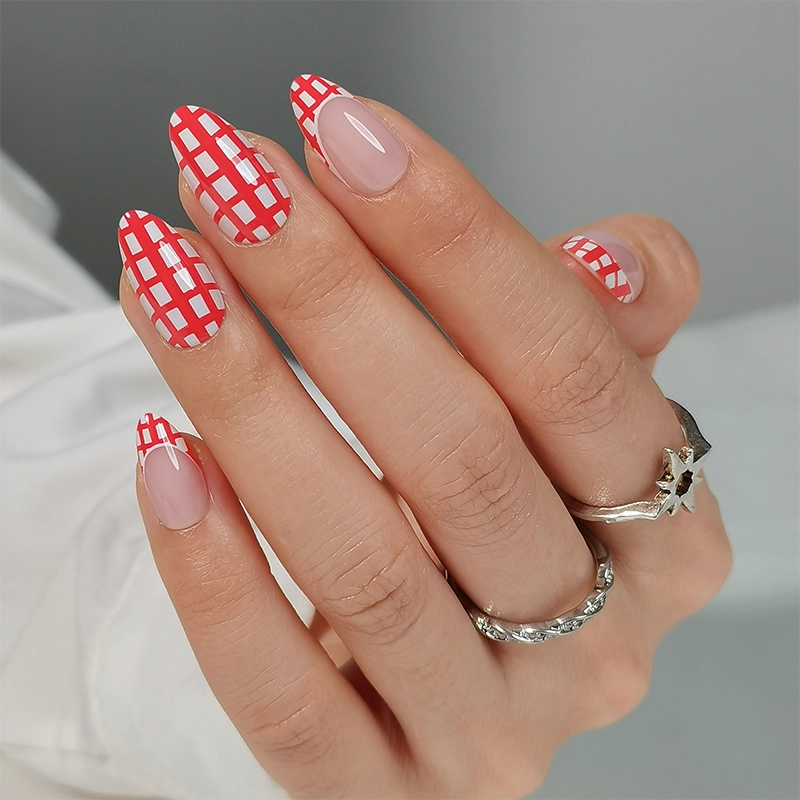
Common finish requests include cat-eye effects, mirror chrome, velvet matte, translucent jelly, aura gradients, marble, tortoiseshell, French tips, and reflective glitter. These effects can be combined with three-dimensional details, but excessive layering may reduce flexibility or make the surface uneven. For branded collections, logo placement should be tested at actual size. Tiny marks can lose clarity after coating, while large logos may dominate the design and reduce consumer appeal.
Size systems, shapes, and complete assortment architecture
Custom sizing is feasible, but it should be managed through a defined size chart rather than informal measurements. Buyers commonly request short square, medium almond, long coffin, stiletto, oval, squoval, and toe-tip formats. A supplier should confirm tip curvature, sidewall width, thickness profile, and the number of sizes in each kit.
Adding more sizes may improve the probability of a secure fit, but it also increases material use, sorting complexity, packaging dimensions, and inventory exposure. A practical launch may use a validated standard size range with several fit options, followed by special sizes after sales data is available. Separate products such as salon false nails and fake toe nails may require different curvature and application instructions, so they should not automatically share the same specification.
Packaging, accessories, and retail presentation
Packaging is a functional part of a dimensional nail program. Tall decorations need internal clearance, stable positioning, and protection against compression. A buyer should confirm whether the nail set is secured by a tray, insert, blister, paper card, or molded compartment, and whether the package can survive vibration and stacking during export.
Customization may include printed cartons, logo cards, instruction leaflets, QR codes, display hooks, nail files, wooden sticks, adhesive tabs, liquid glue, and storage cases. Gel nail tabs and sticker press on nails can support a quick-application positioning, while adhesive systems requiring longer wear need clearer preparation and removal guidance. Packaging copy should avoid unsupported claims such as guaranteed damage-free removal or universal fit.
| Customization request | Typical feasibility | Main production risk | Buyer validation step |
|---|---|---|---|
| Low-relief texture and printed artwork | High | Color or registration variation | Approve physical color and placement sample |
| Small molded charms or pearls | Medium to high | Detachment and package compression | Conduct wear, drop, and package tests |
| Large sculpted decorations | Medium | Weight, snagging, labor cost | Set a height, weight, and durability limit |
| Special nail shapes and custom sizing | High after tooling validation | Fit inconsistency and inventory complexity | Approve a measured size chart and trial set |
| Fully branded retail packaging | High | Artwork errors and delayed print approval | Use dielines, pre-production proof, and barcode checks |
Production Planning for a Scalable Nail Collection
Sampling, approvals, and change control
A clear development gate reduces expensive revisions. The buyer should first approve the design brief, then the digital rendering, then a physical sample, and finally a pre-production sample made with the intended materials and packaging. Each approval should record the artwork version, dimensions, colors, adhesive configuration, packaging components, and inspection standard.
Changes after tooling, printing, or bulk material purchasing can affect cost and schedule. Procurement teams should therefore consolidate feedback internally before sending revisions to the factory. A sample approval form should distinguish mandatory corrections from optional preferences. This prevents a project from entering production while marketing, design, and quality teams hold different expectations.
Minimum order quantity, labor, and landed cost
The unit price of a dimensional set is influenced by tip material, number of nails, decoration count, application method, manual assembly, coating layers, packaging, testing, and order volume. A low minimum order quantity may be commercially attractive for a pilot, but the unit cost can be higher because setup and labor are distributed across fewer sets. Conversely, a large order can lower the average cost but increases inventory risk if the design is trend-sensitive.
Buyers should compare landed cost rather than factory price alone. Freight volume, customs classification, inspection, rework, replacement units, packaging damage, and marketing samples all affect margin. A costed bill of materials and a documented tolerance policy make supplier quotations easier to compare across factories.
Quality assurance and performance testing
Quality control should cover incoming materials, tip dimensions, decoration placement, coating uniformity, adhesive accessories, print clarity, package count, and carton labeling. A sampling plan can be based on recognized quality practices such as ISO 2859-1 acceptance sampling, with the buyer and supplier agreeing on inspection levels and defect classifications.
Performance checks should reflect the intended use. Recommended evaluations include simulated application, flexing, surface abrasion, decoration pull testing, temperature and humidity exposure where relevant, package compression, and transit handling. Claims such as breathable, lightweight, non-toxic, odorless, or long-wearing should be supported by product specifications, test records, and appropriate market review. Buyers should also keep retained samples from each approved batch for comparison during repeat orders.
Why Xianxing Beauty Fits Custom Development Programs
OEM and ODM capacity for varied order profiles
Founded in 2012, Xianxing Beauty is a China press on nail manufacturer focused on OEM and ODM customized nail production. Our 20,000-square-meter factory produces up to 300,000 pieces of press on nails daily and launches more than 100 new products every month. This combination of development activity and manufacturing capacity helps brand owners move from trend research to a structured commercial assortment.
Our team supports small-scale customization as well as larger production programs. Buyers can request changes to materials, sizes, designs, nail shapes, and packaging, making the development path suitable for independent beauty brands, salon groups, distributors, e-commerce operators, and retail test launches. The relevant product range includes custom press on nails, everyday press on nails, salon false nails, kids nails press on, fake toe nails, gel nail tabs, and sticker press on nails.
Fast sampling and controlled execution
For qualified projects, nail samples can be provided within three days, while standard orders can be completed within seven to fourteen days after specifications and approvals are confirmed. These timeframes are valuable for seasonal collections, influencer campaigns, retail resets, and fast-moving online assortments, but the final schedule still depends on decoration complexity, packaging approval, material availability, and order quantity.
Our manufacturing process emphasizes lightweight and breathable-feeling nail structures, non-toxic and odorless product positioning, and UV coating designed to improve surface protection, durability, and appearance. Buyers should review the exact specification and documentation for each program because formulation, adhesive configuration, and market claims must be matched to the finished product.
Documentation and global market readiness
Xianxing Beauty products are supported by ROHS, REACH, and MSDS documentation and are developed to meet US and EU global cosmetics standards. These documents assist procurement and compliance teams during supplier qualification, although importers and brand owners remain responsible for confirming the requirements applicable to their selling markets, claims, labels, and packaging.
Our vision is to become the world’s leading press on nails manufacturer by combining design responsiveness, production scalability, quality discipline, and customer-focused OEM and ODM service. A buyer evaluating a dimensional nail collection can improve project results by sending reference artwork, target price, expected order quantity, preferred application system, packaging concept, destination market, and required delivery window at the quotation stage.
Contact Xianxing Beauty at [email protected] or visit our press-on nail manufacturing website to discuss samples, customization, packaging, and production planning.
Frequently Asked Questions
Which 3D nail decorations are easiest to scale for bulk production?
Low-profile molded relief, printed artwork, shallow textures, small rounded charms, pearls, and controlled layered effects are generally easier to reproduce consistently than tall, sharp, or heavily hand-sculpted decorations.
How can buyers reduce durability problems with dimensional nail art?
Buyers should control decoration height and weight, use rounded edges, validate the attachment method, test the complete assembled nail, and perform wear, flexing, pull, abrasion, and package-compression checks.
Can a supplier create custom nail shapes and sizing?
Yes. Custom sizing and shapes are feasible after curvature, sidewall width, thickness profile, and size-chart specifications are validated through physical samples and a trial production run.
What packaging is suitable for raised nail decorations?
Raised designs need internal clearance, stable positioning, and protection against compression. Trays, inserts, blister packs, paper cards, or molded compartments can be selected according to decoration height and the distribution channel.
What documents should B2B buyers request from a nail manufacturer?
Buyers should request material or ingredient information, safety documentation, batch traceability, quality records, packaging specifications, and relevant compliance documents such as ROHS, REACH, and MSDS where applicable.
How quickly can Xianxing Beauty provide samples and complete orders?
For qualified projects, Xianxing Beauty can provide nail samples within three days, and standard orders can be completed within seven to fourteen days after specifications and approvals are confirmed.


Copyright © 2025 - XIANXING BEAUTY All Rights Reserved. Sitemap
Facebook
YouTube
Instagram
LinkedIn