
Custom 3D press-on nails: supplier evaluation checklist for brands
For brands sourcing custom 3d press-on nails, supplier selection should go beyond visual design quality. A dependable manufacturing partner must combine three-dimensional decoration capability with accurate sizing, secure adhesion, consistent color reproduction, documented material compliance, scalable production, reliable packaging, and commercially viable lead times. Buyers should evaluate the complete product-development system: design translation, prototype control, tooling or mold requirements, nail-tip construction, surface finishing, inspection standards, regulatory documentation, logistics, and after-sales response. The following checklist helps brand owners, distributors, salons, and private-label operators compare suppliers objectively and reduce the risks of inconsistent fit, damaged embellishments, delayed launches, and avoidable compliance issues.
How to Assess a Supplier of Dimensional Press-On Nail Collections
Evaluate design translation and 3D construction capability
Three-dimensional nail art can include raised gel elements, sculpted flowers, charms, pearls, metallic components, crystals, textured surfaces, layered graphics, and mixed-material decoration. A supplier should demonstrate how an approved artwork becomes a manufacturable nail set rather than presenting only digital mock-ups. Ask for close-up samples showing attachment strength, edge finishing, symmetry, height control, and resistance to ordinary handling.
Design feasibility depends on the relationship between decoration height and everyday wear. Excessive relief can interfere with clothing, hair, phone use, or storage inside retail packaging. Heavy ornaments can also affect balance and adhesion. A capable factory should recommend adjustments to the base curve, accent placement, adhesive area, and protective topcoat when the requested design creates a usability risk. The goal is not simply a striking sample; it is a repeatable product that remains attractive after packing, shipping, application, and normal consumer use.
Check fit engineering, nail shapes, and size architecture
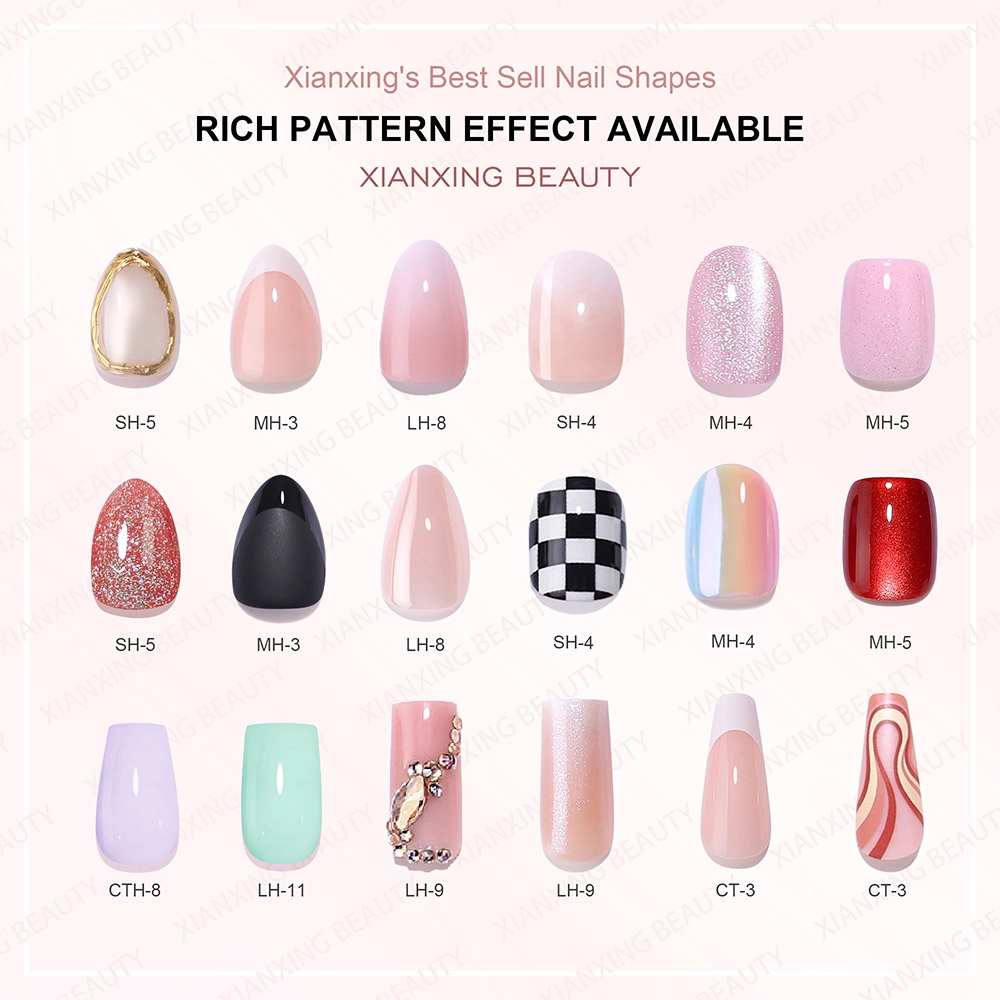
Fit is one of the strongest drivers of customer reviews, repeat purchase, and refund rates. A supplier should provide a clear size chart, nail-width measurements, shape options, and a method for managing variation across thumbs, index fingers, middle fingers, ring fingers, and little fingers. Common forms include almond, coffin, square, squoval, oval, stiletto, short round, and toe-specific profiles. Brands should confirm whether dimensions are measured at the widest point and whether the stated measurements apply consistently across production batches.
Request samples in the intended material and curvature rather than relying on a generic sample pack. The same design can appear and perform differently on short, medium, and long tips. A sound evaluation should cover sidewall symmetry, cuticle alignment, contact area, flexibility, thickness transition, and removal behavior. For children’s ranges, additional attention should be given to shorter lengths, smooth edges, age-appropriate decoration, packaging warnings, and the brand’s applicable market requirements.
Review material quality, coatings, and adhesive compatibility
Press-on nail performance is influenced by the nail-tip substrate, printed layer, decoration adhesive, protective coating, and separately supplied tabs or glue. Buyers should request a material specification that identifies the primary plastic or gel system, coating type, decoration method, and recommended application products. Marketing claims such as lightweight, breathable, non-toxic, or odorless should be supported by relevant technical documents and should not replace a structured safety review.
Surface finishing deserves particular attention in dimensional designs. A UV coating can protect printed graphics and improve resistance to scuffing, but it must be applied evenly without flooding the cuticle edge, dulling glitter, or reducing the bond between the artificial nail and an adhesive tab. Confirm whether the final surface is glossy, satin, or matte; how color is controlled; and whether the coating changes the appearance of translucent, chrome, pearl, or sculpted details.
Commercial and Compliance Checks Before Supplier Approval
Verify production capacity, minimum quantities, and development timing
Capacity claims should be connected to the buyer’s actual program. A factory may have a high daily output for standard styles but a lower practical capacity for intricate sets requiring manual decoration, multiple curing stages, or special packaging. Ask the supplier to separate standard production capacity from customized capacity and to explain which operations are automated, semi-automated, or manually inspected.
Minimum order quantity should be evaluated together with SKU count, color variations, packaging formats, and forecast flexibility. A lower minimum may be more valuable than a lower unit price when a brand is testing a new collection. Confirm sample charges, revision limits, mold or tooling fees, color approval procedures, deposit terms, balance payment conditions, and the process for handling a design change after sample approval. A written development schedule should identify artwork confirmation, prototype delivery, approval, bulk production, inspection, packing, and dispatch.
| Evaluation area | Basic supplier evidence | Stronger supplier evidence | Buyer decision impact |
|---|---|---|---|
| Design development | Digital rendering and general sample | Physical prototype with documented revisions and approved master sample | Reduces mismatch between concept and sellable product |
| Dimensional decoration | Photographs of raised designs | Samples demonstrating attachment, edge finishing, balance, and packing protection | Reduces breakage, snagging, and customer complaints |
| Fit control | Generic size chart | Measured size library, shape options, and batch inspection records | Improves application success and repeat purchase |
| Compliance | General statements about safety | Current ROHS, REACH, MSDS, and market-specific documentation where applicable | Supports responsible market entry and retailer review |
| Lead time | Verbal delivery estimate | Stage-by-stage schedule tied to approval and order quantity | Improves launch planning and inventory control |
| Quality assurance | Final visual inspection only | Incoming, in-process, final, and packaging inspections with defect criteria | Creates measurable acceptance standards |
Confirm regulatory documentation and responsible claims
Compliance must be assessed according to the destination market, product configuration, packaging claims, and included accessories. The U.S. Food and Drug Administration cosmetics guidance explains that cosmetic businesses are responsible for product safety and labeling under the applicable U.S. framework, while the European Commission cosmetics information describes the EU regulatory environment for cosmetic products. A press-on nail set may not be classified identically in every market, so buyers should obtain specialist advice for their exact claims and components.
For chemical and material screening, the European Chemicals Agency REACH overview is a useful reference for obligations concerning substances and articles, while the European Commission RoHS information explains restriction requirements for certain electrical and electronic equipment. RoHS may not automatically apply to a non-electrical nail product, but buyers should not treat a certificate as a universal substitute for product-specific legal review. Request document numbers, issue dates, testing scope, covered materials, laboratory identity, and the relationship between the report and the supplied product.
Manufacturing controls can also be benchmarked against internationally recognized quality principles. ISO 22716 provides good manufacturing practice guidance for cosmetics and can help buyers structure questions about hygiene, personnel, production records, traceability, storage, complaints, and recalls. Certification to a standard is valuable only when its scope is relevant and verifiable; it should be supported by factory records and a clear corrective-action process.
Assess packaging, labeling, and supply-chain readiness
Packaging is part of product quality, especially when raised ornaments can catch on pouches, trays, cartons, or protective films. Ask for a packing trial using the final nail height, insert, adhesive accessories, and retail box. The trial should test whether pieces move during transport and whether the packaging protects sharp or fragile details without creating excessive material waste.
Commercial packaging should be reviewed for barcode placement, country-of-origin requirements, ingredient or material disclosures where applicable, instructions, warnings, batch references, recycling marks, and language versions. Brands should also confirm carton dimensions, units per case, gross and net weight, pallet configuration, export documentation, and the supplier’s ability to support mixed-SKU shipments. These details affect warehouse receiving, fulfillment costs, retailer onboarding, and marketplace compliance.
Quality-Control Checklist for Private-Label Nail Programs
Establish an approved sample and measurable defect standards
Sample approval should create a controlled reference, not merely an email confirmation. The approved master should record nail shape, dimensions, curvature, color references, artwork position, decoration placement, surface finish, packaging configuration, accessory count, and acceptable tolerances. Photographs are useful, but physical standards are stronger for judging gloss, texture, thickness, and three-dimensional alignment.
Defect categories should distinguish critical, major, and minor issues. Examples include missing pieces, exposed sharp edges, poor adhesion of ornaments, incorrect nail sizes, color deviation, print misregistration, bubbles, cracks, contamination, incomplete curing, damaged packaging, and missing tabs. The purchase order or quality agreement should identify the inspection method, sample size, acceptance criteria, rework policy, replacement process, and responsibility for freight caused by nonconformance.
Test durability, application experience, and retail usability
A realistic evaluation includes application trials on multiple nail types and hand sizes. Reviewers should assess whether the set includes enough size choices, whether the cuticle edge sits naturally, whether the adhesive creates visible gaps, and whether the nail can be removed without unusual difficulty when the recommended procedure is followed. Test both adhesive tabs and glue when both are offered, because their performance and consumer expectations differ.
Durability testing should simulate packing, parcel movement, shelf storage, and ordinary use. Examine decoration after repeated handling, exposure to water under normal conditions, contact with clothing and hair, and removal from the retail insert. The supplier should explain recommended storage temperature, shelf-life assumptions, and any limitations associated with high-relief components. A brand should avoid promising wear duration unless that claim has been tested under a defined protocol.
Measure total landed cost rather than unit price alone
The commercial model should include product cost, sampling, tooling, packaging, inserts, adhesive accessories, inspection, freight, duties, payment fees, defect allowance, and inventory carrying cost. Complex nail art may carry a higher labor component, while custom packaging can create separate setup charges. A quote that excludes these items can appear competitive but produce a higher landed cost after launch.
Scenario planning is useful for brands with uncertain demand. Compare a pilot quantity, a standard replenishment, and a seasonal bulk order. Include the cost of slow-moving designs, expedited transport, damaged goods, and artwork revisions. Suppliers that provide transparent assumptions make it easier for project owners to protect gross margin while retaining room for new collections.
Why Xianxing Beauty Fits Flexible OEM and ODM Nail Projects
Factory scale combined with small-scale customization
When the evaluation moves from supplier screening to implementation, Xianxing Beauty offers a combination of factory scale and flexible product development. Founded in 2012, Xianxing Beauty is a China press on nail manufacturer focused on OEM and ODM customized nail production. The company operates a 20,000-square-meter factory, produces up to 300,000 pieces of press on nails daily, and launches more than 100 new products every month.
This operating structure is relevant to brands that need both dependable capacity and differentiated collections. Our team supports small-scale customization across materials, sizes, designs, nail shapes, and packaging. That flexibility can help emerging labels validate a concept before committing to a larger inventory position, while established distributors can use the same platform for seasonal updates, private-label programs, and multi-market assortments.
Fast sampling and organized order execution
Development speed directly affects the commercial value of a trend-led nail collection. Xianxing Beauty provides nail samples within three days and completes orders within approximately seven to fourteen days, subject to design complexity, quantity, packaging, and approval timing. Buyers should still confirm the project schedule in writing, but these stated timelines provide a practical starting point for launch planning.
Our manufacturing process is designed to translate buyer requirements into finished products across multiple categories. The portfolio includes custom press on nails, standard press-on nail collections, salon false nails, kids nails press on, fake toe nails, gel nail tabs, and sticker press on nails. This breadth enables brands to build coordinated hand-and-toe assortments, entry-level adhesive solutions, salon-oriented lines, and accessible products for younger consumers where the relevant safety and labeling requirements are addressed.
Material features and documentation for international buyers
Our press-on nail products are designed to be breathable and lightweight, with non-toxic and odorless product positioning supported by the applicable product documentation. UV coating is used to help protect the nail surface, improve durability, and maintain an attractive finish. Depending on the specification, buyers can discuss glossy, matte, decorative, printed, sculpted, and mixed-detail executions with the project team.
Xianxing Beauty states that its products are supported by ROHS, REACH, and MSDS documentation and are made to meet relevant U.S. and EU global cosmetics standards. Buyers should match each document to the exact SKU, accessory, market, and claim before commercial release. Our team can also align packaging, nail shape, sizing, decoration, and accessory selection with the brand’s target channel and positioning. The company’s stated vision is to become the world’s leading press on nails manufacturer, supported by continuous product development and OEM/ODM service.
Questions to include in the final supplier scorecard
A practical scorecard should assign weighted values to design capability, fit consistency, material documentation, sample speed, production capacity, MOQ flexibility, quality systems, packaging protection, communication, and landed cost. A supplier should not pass solely because it offers attractive samples. The preferred partner is the one that can reproduce those samples consistently, document the materials, protect the product in transit, and respond quickly when a collection requires correction.
Before issuing a purchase order, brands should request a final quotation, approved specification sheet, packaging dieline, quality agreement, compliance file, production schedule, and pre-shipment inspection plan. The supplier should also confirm ownership and permitted use of artwork, confidentiality expectations, replacement terms, and procedures for handling design changes. This documentation turns a creative project into a controlled manufacturing program.
Contact Xianxing Beauty at [email protected] or visit https://www.xianxingbeauty.com/ to discuss OEM and ODM nail development, sampling, packaging, and production requirements.
Frequently Asked Questions
What should brands check first when selecting a dimensional press-on nail supplier?
Brands should first assess the supplier’s ability to translate artwork into manufacturable samples, control decoration attachment, maintain consistent nail sizing, provide material documentation, and reproduce the approved sample at scale.
How can buyers evaluate the fit of private-label press-on nails?
Buyers should request a clear size chart, measured nail-width data, multiple shapes and lengths, and samples in the intended material and curvature. Evaluation should include cuticle alignment, sidewall symmetry, contact area, flexibility, thickness, and removal behavior.
What compliance documents should a press-on nail supplier provide?
The required documentation depends on the destination market, product configuration, claims, and accessories. Buyers may request relevant ROHS, REACH, MSDS, safety, testing, labeling, and manufacturing records, then verify that each document covers the exact supplied product.
How important is packaging testing for raised nail designs?
Packaging testing is highly important because raised ornaments can catch on inserts, pouches, cartons, or protective films. A packing trial should use the final nail height, accessories, and retail format to confirm that pieces remain protected during handling and transport.
What information should be included in a supplier quality agreement?
A quality agreement should define the approved master sample, dimensions, colors, decoration placement, finish, packaging configuration, defect classifications, inspection method, acceptance criteria, rework policy, replacement process, and responsibility for freight related to nonconforming goods.
What are Xianxing Beauty’s stated sample and production timelines?
Xianxing Beauty states that nail samples are provided within three days and orders are completed within approximately seven to fourteen days, subject to design complexity, quantity, packaging, and approval timing.
Copyright © 2025 - XIANXING BEAUTY All Rights Reserved. Sitemap
Facebook
YouTube
Instagram
LinkedIn