
Custom 3D Press on Nails Wholesale: Shapes, Sizes, Colors, and Nail Art Designs
Custom 3D press-on nails wholesale programs allow beauty brands, salons, distributors, and retailers to develop differentiated nail collections without investing in a full in-house production line. A successful program must align nail shape, size coverage, curvature, material, finish, color accuracy, raised decoration, adhesive compatibility, packaging, inspection standards, and order quantities. Buyers should evaluate not only visual design but also fit consistency, wear performance, application instructions, regulatory positioning, and total landed cost. This guide explains how to specify custom press-on nails, salon false nails, kids nail collections, fake toe nails, gel nail tabs, and sticker press-on nails for scalable commercial distribution.
How to Specify a Commercial Press-On Nail Collection
Choosing shapes that match customer demand
Nail shape is one of the most visible decisions in a private-label or retail nail collection. Common options include round, oval, squoval, square, coffin, ballerina, almond, stiletto, and tapered square. Round and oval profiles generally support a softer everyday appearance, while square and squoval styles are often selected for practical salon-inspired collections. Coffin, ballerina, almond, and stiletto silhouettes create stronger fashion positioning but require more precise sizing and alignment because the sidewalls and tips can expose fit inconsistencies.
Procurement teams should define the intended user before approving a shape. A mass-market everyday line may need short and medium lengths with forgiving sidewalls. A trend-led e-commerce collection may prioritize long sculptural forms and statement finishes. Salon false nails should provide a professional appearance across multiple natural nail beds, while kids nails press on products require shorter lengths, rounded edges, simpler application, and age-appropriate design decisions. The selected shape should also be tested against packaging dimensions, shipping protection, and the risk of tip breakage during fulfillment.
Building a reliable size and fit system
A size set is more than a sequence of numbered tips. It should account for nail width, apex position, sidewall geometry, curvature, length, and the relationship between the thumb and smaller fingers. A supplier should provide a standardized sizing chart, physical samples, and a size-try kit before bulk production. Buyers can then measure representative customer groups and determine whether a ten-piece, twelve-piece, or extended set offers the best balance between fit coverage and product cost.
Fit validation should include both direct application and removal testing. Each tip should sit close to the natural nail without excessive pressure, gaps, or overhang. A high arch may create lifting on flatter nail beds, while an overly flat tip may not bond properly to more curved nails. For international distribution, brands should avoid assuming that one sample group represents every market. Regional customer testing, online fit feedback, and return reasons can help identify whether the collection needs wider, narrower, shorter, or more flexible options.
Selecting materials, finishes, and application systems
Most commercial press-on nail programs use plastic nail tips or pre-decorated artificial nail components with finishes such as glossy, matte, satin, chrome, pearlescent, or translucent effects. Material selection influences flexibility, opacity, color depth, edge durability, and compatibility with adhesive products. Buyers should request information about the material specification and production controls rather than relying only on a finished sample.
Application accessories should be treated as part of the product system. Gel nail tabs offer a fast, low-commitment application route and are useful for temporary wear, event collections, and customers who prefer easier removal. Sticker press-on nails can support convenience-led retail positioning when the adhesive layer is evenly coated and protected from contamination. Liquid nail glue may offer a different wear profile, but instructions, storage conditions, and consumer warnings must be reviewed carefully. The U.S. Food and Drug Administration guidance on nail care products provides a useful regulatory reference for businesses assessing labeling and product safety responsibilities.
Designing 3D Nail Art for Scalable Wholesale Production
Balancing visual impact with production reliability
Three-dimensional nail art can include molded flowers, bows, pearls, rhinestones, metallic charms, raised gel patterns, textured lines, sculpted shells, animal motifs, and layered decorative elements. The design should be evaluated for more than appearance. Buyers need to understand the decoration height, attachment method, contact area, edge smoothness, weight, and resistance to handling. Excessively tall or sharply edged details can catch on clothing, interfere with packaging, or increase the likelihood of damage in transit.
Commercially viable artwork uses a hierarchy of detail. A collection may combine a few statement nails with simpler coordinating fingers, reducing production complexity while preserving a High Quality appearance. Repeating a controlled set of motifs also improves color matching, inspection efficiency, replenishment, and SKU management. For large orders, suppliers should approve a master sample, record the decoration position, and define acceptable tolerances for placement, surface finish, and component variation.
Color development and finish consistency
Color approval should use physical drawdowns or production-representative samples rather than digital screens alone. Screen brightness, photography, coating thickness, substrate opacity, and lighting conditions can create significant differences between artwork files and finished nails. A buyer should define the reference color, gloss level, special effects, and acceptable deviation before manufacturing begins.
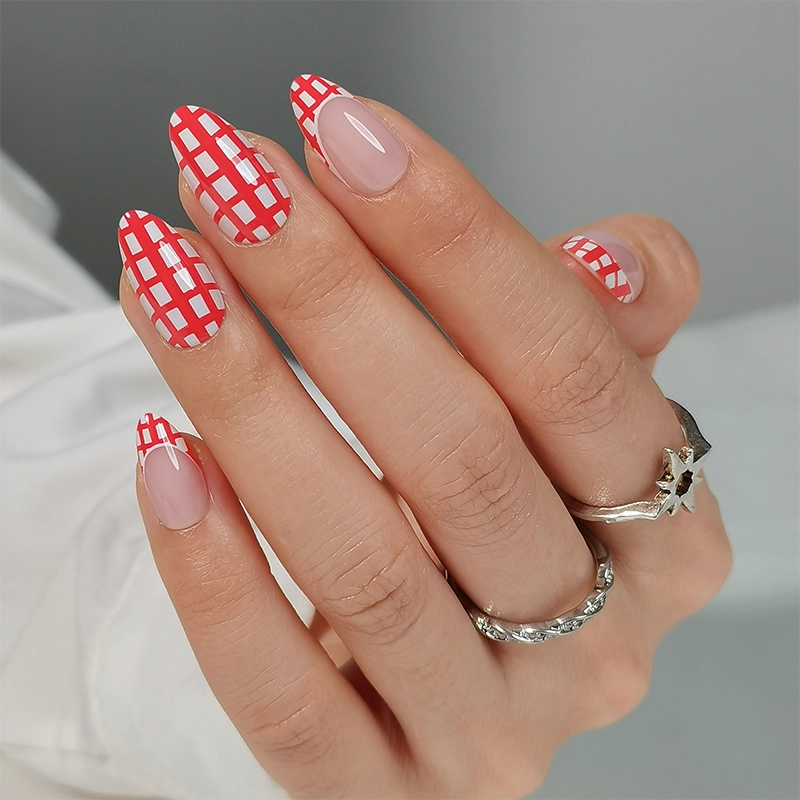
Popular commercial directions include nude palettes, milky white, French tips, translucent jelly effects, pastel colors, seasonal brights, deep reds, metallic chrome, cat-eye effects, and black-and-white graphic designs. Special finishes require additional controls because chrome, glitter, pearlescent pigments, and translucent layers can vary with base color and coating process. A supplier should retain an approved reference sample and compare production output under consistent lighting. This protects brand identity across repeat orders and reduces disputes caused by subjective color judgments.
Packaging, labeling, and retail presentation
Packaging must protect raised details while making the size set and application process easy to understand. Suitable formats include rigid boxes, molded trays, blister packs, envelopes, and reusable cases. For e-commerce, the package should resist compression and abrasion while keeping dimensional weight under control. For retail, the front panel should communicate the style, quantity, finish, application method, and key inclusions without making unsupported performance claims.
Instruction panels should explain nail preparation, sizing, adhesive application, pressure time, removal, storage, and basic precautions. If products are sold across borders, the importer or brand owner should review language requirements and consumer-product obligations in each destination. The European Union Cosmetics Regulation is relevant when a product or associated substance falls within the cosmetic category, but classification can depend on formulation, claims, and market use; professional regulatory review is therefore advisable.
Wholesale Quality Control, Costing, and Supplier Selection
Inspection checkpoints from sample to shipment
A dependable quality program begins before mass production. The technical file should include approved artwork, dimensions, size charts, material information, color references, decoration specifications, packaging dielines, labeling text, and inspection criteria. During production, checks should cover tip count, size assortment, shape symmetry, surface defects, color consistency, decoration adhesion, sharp edges, packaging accuracy, and barcode or label placement.
Sampling plans should be agreed in advance instead of being negotiated after a problem appears. Buyers may reference the principles of ISO 2859-1 sampling procedures when establishing lot-based inspection practices, while adapting the acceptance criteria to the product’s commercial risk. Critical defects, such as missing components or unsafe sharp projections, should be treated differently from minor cosmetic variations. Pre-shipment inspection is particularly important for custom collections because a single artwork or packaging error can affect an entire seasonal launch.
Comparing production methods and business impact
| Production approach | Typical advantage | Procurement limitation | Best commercial use |
|---|---|---|---|
| Standard ready-made tips | Faster purchasing and lower development effort | Limited differentiation and less control over sizing or artwork | Basic replenishment and price-sensitive retail |
| Custom printed designs | Strong control over branding, color, and pattern | Requires artwork approval and color validation | Private-label collections and seasonal launches |
| Raised 3D decoration | High Quality shelf appeal and stronger visual differentiation | Higher labor, packaging, inspection, and damage-control requirements | Gift sets, fashion capsules, and High Quality e-commerce |
| Accessory-led application kits | Improves convenience and supports different wear preferences | Requires adhesive compatibility and clearer instructions | Travel, events, subscription boxes, and beginner users |
Calculating total landed cost and launch risk
Unit price alone does not determine the commercial value of a wholesale nail program. The cost model should include sampling, tooling or molds where applicable, decoration labor, packaging, inserts, accessories, inspection, freight, duties, storage, platform fees, expected defects, and customer returns. A lower factory quotation can become more expensive if it produces inconsistent sizing, weak decoration adhesion, incomplete sets, or high replacement rates.
Minimum order quantity should be evaluated against forecast confidence and SKU complexity. A collection with multiple shapes, lengths, colors, finishes, and decoration layouts can create a large inventory commitment even when the quantity per design appears manageable. Buyers can reduce risk by launching a controlled number of hero designs, using coordinated color families, standardizing packaging components, and negotiating repeat-order terms based on approved specifications.
Why a Structured Custom Manufacturing Partner Matters
Product range alignment for different channels
Our product planning approach is designed around channel requirements rather than a single generic nail tip. Custom press on nails can be developed for beauty retailers, salon supply distributors, direct-to-consumer websites, subscription boxes, and promotional programs. Press on nails may be configured with different lengths, shapes, finishes, and application accessories, while salon false nails can emphasize professional presentation, consistent sizing, and dependable replenishment.
For family-oriented ranges, kids nails press on products should focus on shorter profiles, rounded edges, simple sizing, and clear application guidance. For pedicure categories, fake toe nails require dedicated shape development because toe nail widths, curvature, and visual proportions differ from fingernails. Gel nail tabs and sticker press on nails can be included as convenience-oriented accessories or complete application solutions, depending on the desired wear experience and retail positioning.
Technical coordination and approval discipline
Our manufacturing coordination process should connect design development with production feasibility. Artwork review considers decoration placement, color layering, tip geometry, packaging clearance, and inspection requirements before a final sample is approved. This reduces the risk of accepting a visually attractive concept that is difficult to assemble, vulnerable to transit damage, or inconsistent across repeated batches.
Corporate buyers should expect transparent sample stages, clear revision control, defined approval records, and documented specifications. A professional supplier should be able to explain which variables affect cost and lead time, including the number of colors, number of decorated nails per set, manual assembly requirements, packaging structure, accessory selection, and order quantity. This level of communication supports more accurate launch planning and reduces avoidable production changes.
Building long-term assortment value
Our product portfolio can support assortment architecture rather than isolated designs. A brand may launch a core collection of wearable neutrals, add seasonal colors, introduce High Quality 3D statement sets, and extend successful themes into matching toe products or children’s ranges. Shared packaging dimensions, coordinated naming, and repeatable size systems help distributors simplify merchandising and improve replenishment decisions.
Before placing a wholesale order, buyers should request a complete commercial sample set, confirm the size chart, test application and removal, review decoration durability, approve packaging artwork, and establish inspection standards. They should also verify applicable market requirements using authoritative resources such as ISO 9001 quality management principles and destination-market regulations. This disciplined process improves sell-through potential, protects customer experience, and gives the collection a stronger foundation for repeat business.
Frequently Asked Questions
What nail shapes are commonly available for custom wholesale collections?
Common options include round, oval, squoval, square, coffin, ballerina, almond, stiletto, and tapered square. The best choice depends on the target customer, intended length, fit requirements, packaging, and positioning of the collection.
How should buyers validate press-on nail sizing before a bulk order?
Buyers should request a standardized sizing chart, physical samples, and a size-try kit, then test representative customer groups. Validation should assess width, curvature, sidewall fit, apex position, length, gaps, pressure, and overhang.
What should be checked when sourcing raised 3D nail art?
Buyers should review decoration height, attachment method, contact area, edge smoothness, weight, packaging clearance, and resistance to handling. A master sample and defined tolerances for placement, surface finish, and component variation should be approved before production.
How can buyers control color consistency across repeat orders?
Color approval should use physical production-representative samples, defined gloss and finish references, consistent lighting, and an approved master sample. Special effects such as chrome, glitter, pearlescent, and translucent layers require additional control because substrate and coating conditions can change the result.
What accessories can be included in a wholesale press-on nail set?
Sets may include gel nail tabs, sticker press-on adhesives, liquid nail glue where appropriate, preparation wipes, mini files, wooden sticks, instructions, and storage packaging. The selected accessories should match the intended wear experience and include clear application and removal guidance.
How should the total cost of a custom nail program be calculated?
The cost model should include sampling, tooling or molds where applicable, decoration labor, packaging, inserts, accessories, inspection, freight, duties, storage, platform fees, expected defects, and customer returns rather than relying only on the factory unit price.



Copyright © 2025 - XIANXING BEAUTY All Rights Reserved. Sitemap
Facebook
YouTube
Instagram
LinkedIn