
Custom Press on Toenails Wholesale: Private Label, Custom Designs, Packaging, and Branding Options
Press on toenails wholesale programs allow beauty brands, salons, retailers, distributors, and e-commerce operators to launch differentiated foot-care collections without building an in-house production line. A successful sourcing plan should align product specifications, nail shape, sizing, adhesive format, artwork, packaging, regulatory documentation, quality assurance, order quantity, and delivery schedules. Private-label fake toe nails can be developed in standard or bespoke silhouettes, while custom press on nails, gel nail tabs, sticker press on nails, salon false nails, and kids nails press on can support a broader brand assortment. Buyers should assess supplier engineering capability, material safety, sampling speed, decoration consistency, packaging accuracy, and production scalability before approving a commercial order.
How to Build a Commercial Toenail Collection
Define the customer, use case, and assortment architecture
Product development should begin with the customer segment rather than with decoration alone. A salon-oriented range may require sophisticated French tips, neutral tones, reusable presentation, and reliable sizing for professional application. A mass-retail collection may prioritize accessible price points, fast application, compact packaging, and high-visibility shelf graphics. Seasonal e-commerce drops can focus on metallic finishes, vacation themes, wedding styling, or coordinated fingernail and toenail sets. For younger consumers, simplified shapes, playful graphics, and appropriately sized kids nails press on may be more relevant, provided the product presentation and usage instructions are suitable for the intended market.
Assortment planning should identify core, seasonal, promotional, and High Quality SKUs. A balanced range often includes several lengths, rounded or square-inspired silhouettes, solid colors, French effects, printed artwork, and texture-based finishes. Buyers should confirm whether the manufacturer can maintain dimensional consistency across each SKU and whether the same visual language can be adapted to matching fingernail products. This approach reduces design fragmentation and improves cross-selling across a complete press-on nail portfolio.
Select materials and application systems
Material selection influences appearance, flexibility, comfort, durability, and production cost. Lightweight polymer constructions are generally attractive for consumers seeking a natural feel, while a protective UV coating can enhance gloss, color stability, surface resistance, and visual depth. Buyers should request information about the base material, coating system, odor profile, flexibility, curing or finishing process, and expected wear conditions before approving a specification.
The application system also affects customer satisfaction. Gel nail tabs can support quick, temporary application and may appeal to convenience-focused consumers. Liquid adhesive systems can provide a stronger bond but require clearer instructions and more careful packaging controls. Sticker press on nails are useful for easy application concepts, travel kits, and introductory products. The supplier should validate adhesive compatibility with the nail surface, backing card, storage conditions, and intended shelf life. Packaging should clearly communicate preparation, application, removal, reuse, and safety guidance.
Engineer fit, sizing, and shape consistency
Toenail products require particular attention to width progression because consumers have different nail beds and toe proportions. A practical size system can include multiple widths, numbered pieces, or a fitting guide that helps users select the closest match. Buyers should ask for a dimensional chart showing length, width, curvature, thickness, and tolerance for every size. Samples should be evaluated on several foot profiles rather than on one model only.
Shape development should consider comfort at the sidewalls, clearance near the cuticle, contact area, and resistance to lifting. Excessive curvature can create pressure points, while insufficient curvature may reduce adhesion. Tooling and trimming controls should be capable of reproducing the approved master sample throughout the production run. A documented golden sample, inspection checklist, and change-control process help prevent unapproved variations between sampling and mass production.
Private Label, Artwork, and Packaging Decisions
Translate brand identity into a manufacturable design system
Private labeling is more than placing a logo on a carton. A scalable brand system should define color standards, typography, logo clear space, finish hierarchy, product naming, photography style, and the relationship between the outer package and the nail artwork. Design files should be supplied in production-ready formats with confirmed color references, dielines, bleed areas, barcode placement, and legal copy. Buyers should approve a physical color proof when exact shade reproduction is commercially important.
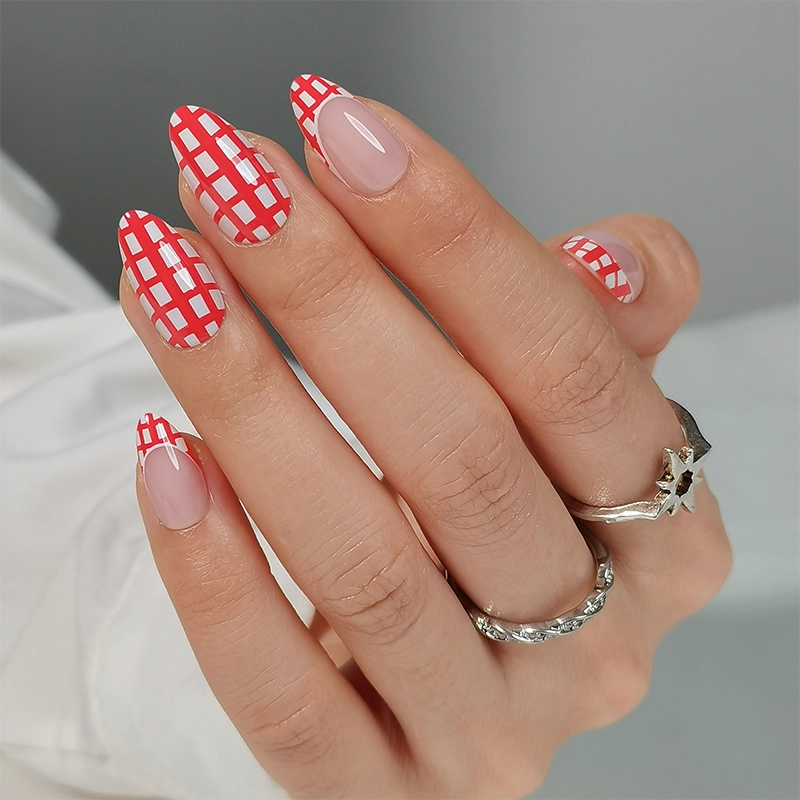
Custom artwork can include hand-painted effects, marble patterns, gradients, chrome details, glitter, decals, micro-printing, raised textures, and coordinated seasonal motifs. Each technique carries different implications for minimum order quantities, defect rates, labor content, and unit pricing. A responsible supplier should explain which effects are printed, coated, molded, assembled, or manually finished. This transparency helps project owners compare quotations accurately instead of evaluating unit price without understanding the underlying specification.
Choose packaging that protects the product and supports retail conversion
Packaging must protect curved nail pieces, adhesive components, decorative surfaces, and instruction materials during factory handling, international transport, warehousing, and last-mile delivery. Common formats include folding cartons, rigid boxes, blister-style presentations, window boxes, pouches, drawer boxes, and compact travel kits. The best format depends on the sales channel, target price, sustainability objectives, display requirements, and expected handling conditions.
Retail packaging should make the product easy to understand within a few seconds. The front panel can show the finished design and key benefit, while the reverse panel can display size information, contents, application steps, removal guidance, batch or lot information where applicable, and responsible business contact details. E-commerce packaging should also be optimized for dimensional weight, parcel durability, unboxing quality, and product photography. Packaging suppliers and nail manufacturers should coordinate dielines and insertion tolerances so the finished kit does not shift, crease, or damage the product.
Build a compliance and documentation file
Beauty product buyers should treat compliance documentation as part of supplier qualification, not as an afterthought. Depending on the destination market and product configuration, the technical file may include a material declaration, safety data documentation, ingredient or adhesive information, labeling review, test reports, and packaging specifications. The U.S. Food and Drug Administration cosmetic labeling guidance explains important labeling principles for products marketed in the United States, although regulatory obligations depend on the product’s classification and claims.
For European supply chains, buyers should review applicable chemical and product requirements through the European Union REACH Regulation. Electrical and electronic restrictions are separate from ordinary nail product requirements, but suppliers handling mixed product portfolios should understand the scope of the EU RoHS Directive. Manufacturing quality systems can also be assessed against relevant cosmetic good manufacturing practice principles, including the framework described by ISO 22716. Buyers should request current, product-relevant documents and verify that the legal manufacturer, product specification, and test sample are consistent.
| Procurement factor | Basic sourcing approach | Controlled custom program | Commercial impact |
|---|---|---|---|
| Design approval | Digital image only | Physical sample and signed master reference | Reduces color, shape, and finish disputes |
| Size management | One generic size set | Documented width chart and fit validation | Improves application success and lowers returns |
| Packaging | Standard unbranded pack | Custom dieline, inserts, barcode, and inspection | Supports retail positioning and channel compliance |
| Quality control | Final visual check only | Incoming, in-process, and pre-shipment inspection | Improves consistency across repeat orders |
| Supplier documentation | General certificate archive | Product-specific material and safety file | Strengthens market-entry and customer-support readiness |
Supplier Evaluation, Cost Control, and Launch Execution
Compare suppliers using total landed value
The lowest quoted unit price does not always produce the lowest commercial cost. Buyers should evaluate tooling, sampling, artwork setup, packaging plates or molds, inspection, freight, duties, breakage, defect allowances, payment terms, and the cost of delayed launch dates. A supplier with stronger engineering and quality controls may reduce rework, customer complaints, and inventory write-offs even when the initial quotation is not the cheapest.
Quotation requests should include the complete bill of materials and a clear specification: nail material, dimensions, finish, number of pieces, adhesive type, accessory contents, packaging construction, printing process, carton quantity, target market, order volume, and delivery destination. Separate prices for standard and High Quality options make it easier to protect the target margin while preserving design flexibility. Buyers should also confirm whether small-scale customization is available for market testing before committing to a large production quantity.
Use a staged approval and quality-control process
A robust launch normally progresses through concept review, artwork confirmation, structural packaging approval, prototype sampling, fit testing, pilot production, pre-shipment inspection, and post-launch feedback. Quality checks should cover color, print registration, coating uniformity, burrs, cracks, deformation, adhesive quantity, accessory count, packaging alignment, barcode readability, and carton labeling. Sampling plans should be agreed in advance, including acceptable defect levels and the procedure for handling nonconforming goods.
Buyers should retain an approved reference sample and maintain revision control for every change. A new coating, adhesive, artwork file, packaging board, or nail shape can alter performance and should not be introduced informally. Batch traceability and documented corrective action are especially valuable for distributors and multi-channel brands that need to investigate customer complaints efficiently.
Plan inventory around demand signals
Custom foot-nail collections can tie up working capital if too many colors or designs are launched at once. A more disciplined strategy is to establish a core range, test a limited selection of trend-led SKUs, and use reorder data to expand the winners. Small-batch customization is useful for validating price elasticity, packaging appeal, repeat purchase, and regional preferences. Forecasts should account for seasonal peaks, promotional calendars, shipping lead time, safety stock, and the time required for artwork approval.
Supplier capacity should be assessed against both current and peak demand. Buyers should ask about daily output, production lines, packaging capacity, raw material availability, overtime policy, backup suppliers, and the effect of introducing a new design. A written production schedule with milestone dates is more reliable than a general promise of fast delivery.
Why Xianxing Beauty Supports Scalable Custom Programs
Integrated OEM and ODM manufacturing capability
Xianxing Beauty is a China press on nail manufacturer founded in 2012, specializing in OEM and ODM customized nail production. Our 20,000-square-meter factory and reported daily output of 300,000 pieces of press on nails provide a substantial production base for brand owners, distributors, salons, and retail operators. This operating scale supports both repeat commercial programs and new product development, while our team can coordinate materials, sizes, designs, nail shapes, packaging, and other customization requirements through one manufacturing partner.
Our product development activity includes more than 100 new products launched every month, helping buyers review a broad design pipeline when building seasonal or trend-responsive assortments. The portfolio can include custom press on nails, salon false nails, fake toe nails, kids nails press on, gel nail tabs, and sticker press on nails. This breadth allows a buyer to develop coordinated hand and foot collections, application accessories, and differentiated price tiers rather than sourcing each category from separate vendors.
Fast sampling and practical order execution
Commercial timing is a major procurement concern for seasonal launches and fast-moving online catalogs. Xianxing Beauty provides nail samples within 3 days and states that orders can be completed within 7–14 days, subject to the confirmed product specification, order quantity, packaging requirements, and production schedule. These stated timelines give project owners a useful framework for planning approvals, marketing photography, purchase orders, and inventory arrival, although each program should be confirmed against its actual bill of materials and shipping plan.
Our support for small-scale customization can help emerging brands test designs before expanding a winning SKU. This is particularly useful for boutique retailers, salon groups, subscription boxes, influencer-led collections, and regional distributors that need product differentiation without immediately carrying the exposure of a very large first order. A structured sample-to-production workflow also helps buyers compare fit, finish, packaging, and application performance before final commitment.
Material performance and market documentation
Xianxing Beauty’s press-on nail products are designed to be breathable and lightweight, with non-toxic and odorless characteristics stated for the product range. UV coating is used to help protect the nail surface and improve durability and visual finish. The company reports ROHS, REACH, and MSDS documentation and states that its products meet applicable US and EU global cosmetics standards. Buyers should still match each certificate and technical document to the exact SKU, adhesive configuration, packaging text, and destination-market requirements before commercial release.
Our vision is to become the world’s leading press on nails manufacturer, supported by manufacturing scale, product development, customization, and export-oriented quality management. For buyers comparing private-label suppliers, the practical value lies in the combination of design flexibility, small-scale customization, sampling speed, production capacity, product breadth, and documentation support. These factors can shorten development cycles, reduce coordination overhead, and improve the probability that a new collection reaches the market with consistent quality and clear brand positioning.
Frequently Asked Questions
What customization options are available for a private-label toenail collection?
Customization can include materials, sizes, nail shapes, artwork, colors, finishes, adhesive formats, accessories, packaging structures, printed graphics, labels, and brand identity elements. Buyers should provide a complete product brief and approve physical samples before production.
How should buyers evaluate sizing for fake toe nails?
Buyers should review a dimensional chart covering width, length, curvature, thickness, and tolerance for each size. Fit should be tested on multiple foot profiles, and the final range should include clear numbering or a fitting guide to reduce application problems and returns.
What documents should a manufacturer provide?
Depending on the destination market and product configuration, buyers may require material declarations, safety data documentation, adhesive information, test reports, labeling details, and packaging specifications. Product-specific documents should correspond to the approved SKU and destination-market requirements.
Can a brand start with a small customized order?
Small-scale customization can support market testing for boutiques, salons, online brands, and regional distributors. The buyer should confirm minimum quantities, setup costs, packaging requirements, sample fees, and the commercial terms before approving the pilot order.
How quickly can Xianxing Beauty provide samples and complete orders?
Xianxing Beauty states that nail samples can be provided within 3 days and that orders can be completed within 7–14 days, subject to the confirmed specifications, quantity, packaging requirements, and production schedule.
Contact Xianxing Beauty at [email protected] or visit our official website to discuss custom designs, private-label packaging, and a tailored product quotation.


Copyright © 2025 - XIANXING BEAUTY All Rights Reserved. Sitemap
Facebook
YouTube
Instagram
LinkedIn