
Private Label Press on Nail Kits Supplier Comparison: How to Make the Right Purchasing Decision
Choosing a supplier for private label press on nail kits requires more than comparing unit prices. Buyers must evaluate nail material, fit accuracy, adhesive performance, design capability, packaging execution, regulatory documentation, production capacity, minimum order quantity, lead time, and after-sales support. The strongest sourcing decision balances product safety, visual differentiation, inventory flexibility, launch speed, and total cost of ownership. A reliable manufacturer should provide traceable quality controls, commercially realistic samples, transparent specifications, and scalable production for custom press on nails, salon false nails, kids nails press on, fake toe nails, gel nail tabs, and sticker press on nails.
How to Compare Custom Press-On Nail Manufacturing Partners
Assess product construction and wear performance
Product construction is the foundation of customer satisfaction and repeat purchases. Buyers should request detailed information about the nail substrate, thickness distribution, curvature, surface treatment, color stability, and bonding system. A nail that looks attractive in a product photograph may still generate returns if the sidewalls do not fit common nail beds, the apex is poorly positioned, or the edges lift after short-term wear.
Evaluation should include practical tests for flexibility, resistance to cracking, color consistency, odor, surface smoothness, and removal experience. Adhesive options also deserve separate review. Glue, adhesive tabs, and pre-applied sticker systems serve different retail audiences and usage occasions. Salon-oriented collections may require stronger, longer-wear bonding, while event, travel, and children’s products may prioritize easy application and gentle removal. Buyers should define the intended wear period and customer profile before approving the specification.
Separate design customization from genuine product development
Many suppliers advertise customization when they only offer logo printing on an existing catalog item. A more capable OEM or ODM partner can modify nail shapes, sizes, finishes, colors, artwork, materials, accessories, insert cards, and retail packaging. This distinction matters for brands competing in crowded beauty channels, where a private label needs recognizable design language rather than a generic assortment.
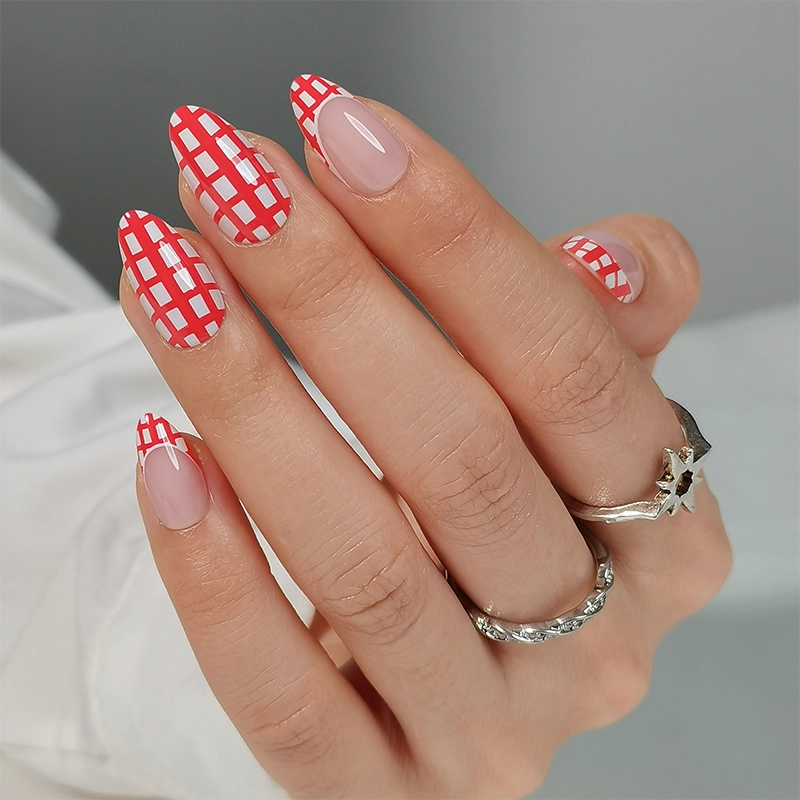
Ask whether the supplier can develop short almond, coffin, square, stiletto, round, oval, and toenail formats, as well as glossy, matte, chrome, glitter, French, marble, seasonal, and hand-painted effects. The supplier should also explain how artwork is converted into production-ready files, how color references are approved, and how design changes affect tooling, sampling, and unit cost.
Review sampling and approval controls
A dependable sampling process reduces commercial risk before mass production. The sample brief should identify dimensions, finish, color references, adhesive type, accessory count, packaging structure, barcode placement, and target retail market. Buyers should receive a written sample approval record so that the approved reference can be compared with bulk production.
Quality checkpoints should cover incoming materials, in-process molding or forming, printing and decoration, assembly, packaging, and final inspection. A supplier that cannot explain its acceptance criteria may create inconsistent sets across batches. Buyers should also clarify how defective units are counted, whether replacement quantities are included, and how corrective actions are documented.
Commercial and Compliance Factors That Affect Supplier Selection
Compare price using total landed cost
The lowest quotation is not automatically the most economical option. Total landed cost can include sampling fees, mold or tooling charges, packaging development, inspection, rework, freight, import duties, payment fees, and the cost of excess inventory caused by high minimum order quantities. A supplier offering a lower ex-factory price may become more expensive if it requires large commitments or has inconsistent quality.
| Comparison factor | What buyers should verify | Commercial impact |
|---|---|---|
| Unit quotation | Included nail sets, adhesive, accessories, packaging, and export cartons | Prevents incomplete price comparisons |
| Minimum order quantity | MOQ by design, color, size, packaging, and reorder | Determines inventory exposure and launch flexibility |
| Sample lead time | Days to first sample and time for revisions | Influences speed to market |
| Mass production lead time | Calendar days after artwork and deposit approval | Affects replenishment planning |
| Quality documentation | Material records, test reports, inspection process, and corrective-action records | Reduces compliance and returns risk |
| Packaging capability | Custom boxes, inserts, labels, barcodes, and retail-ready packing | Supports channel requirements and brand presentation |
Payment terms, production deposits, balance timing, currency, shipping terms, and warranty or replacement policies should be written into the purchase agreement. For international procurement, buyers should confirm whether prices are quoted under EXW, FOB, CIF, or another Incoterm and ensure that the commercial invoice and packing list match the shipment.
Verify safety and market-specific documentation
Documentation should be matched to the product composition and destination market. Buyers can consult the U.S. Food and Drug Administration cosmetics guidance for the regulatory framework applicable to cosmetic products and labeling in the United States. For European supply chains, chemical restrictions and substance obligations should be reviewed through the European Chemicals Agency REACH information.
Where electrical or electronic components are included in accessories or packaging, the relevant European Commission RoHS Directive information may also need consideration. Manufacturing quality systems can be assessed against principles described in ISO 22716 cosmetics good manufacturing practices. These references do not replace market-specific legal advice, but they give procurement teams a credible starting point for document verification.
Examine capacity, continuity, and communication
Capacity is not simply the number of units a factory claims to produce. Buyers should assess available production lines, peak-season planning, labor organization, material purchasing, quality personnel, backup suppliers, and the ability to maintain the same specification during repeat orders. A high-volume retailer needs continuity, while an emerging brand may value flexible small-batch production more than maximum output.
Communication quality is another leading indicator. Suppliers should provide clear quotations, structured technical questionnaires, realistic delivery dates, artwork feedback, and prompt escalation when a problem occurs. A dedicated project contact can reduce misunderstandings between the buyer’s design team, purchasing department, logistics provider, and factory operations.
Why Xianxing Beauty Is a Practical OEM and ODM Option
Manufacturing scale combined with customization flexibility
Xianxing Beauty was founded in 2012 and operates as a China press on nail manufacturer focused on OEM and ODM customized nail production. Our 20,000-square-meter factory produces approximately 300,000 pieces of press on nails daily and launches more than 100 new products every month. This combination gives buyers access to industrial production capacity while preserving the design flexibility required for differentiated retail collections.
Our team supports small-scale customization across materials, sizes, designs, nail shapes, finishes, and packaging. That capability is valuable for startup beauty brands testing a new concept, distributors building exclusive regional collections, salons developing branded retail lines, and established companies refreshing seasonal assortments without committing immediately to excessive stock.
Fast sampling and structured project execution
Launch schedules often depend on the speed and accuracy of sample development. Xianxing Beauty can provide nail samples within three days, allowing project owners to evaluate fit, decoration, color, surface finish, and packaging direction earlier in the buying cycle. Standard orders can be completed within 7 to 14 days, subject to specification confirmation, order volume, packaging requirements, and production scheduling.
Fast execution should still be supported by approval discipline. Buyers should submit a complete design brief, confirm the final sample, approve packaging artwork, and define inspection expectations before production begins. This process helps reduce avoidable revisions and supports predictable replenishment for online retailers, beauty chains, wholesalers, and salon networks.
Product range, finish quality, and documentation
Our product portfolio includes custom press on nails, everyday press on nails, salon false nails, kids nails press on, fake toe nails, gel nail tabs, and sticker press on nails. These categories can be developed for different wear durations, customer age groups, retail price points, and application preferences.
Xianxing Beauty’s press-on nail products are designed to be breathable and lightweight, with non-toxic and odorless characteristics. UV coating helps protect the nail surface while supporting durability and visual appeal. Products are supported by ROHS, REACH, and MSDS certifications and are developed to meet US and EU global cosmetics standards. Buyers should still confirm the exact documentation and labeling requirements for each destination and product configuration before shipment.
A Practical Supplier Selection Process for Brand Owners
Create a weighted procurement scorecard
A scorecard makes supplier comparisons more objective. Suggested categories include product quality at 25 percent, customization capability at 15 percent, compliance and documentation at 15 percent, lead time at 15 percent, MOQ and pricing at 15 percent, and communication, packaging, and service at 15 percent. The weighting should change according to the project. A High Quality salon brand may assign more value to finish consistency, whereas a mass-market distributor may prioritize capacity, cost, and replenishment speed.
Each supplier should be scored using evidence rather than sales claims. Evidence can include approved samples, factory photographs, production records, test documents, packaging mockups, customer references where available, and a written quotation. A supplier should lose points when information is vague, inconsistent, or impossible to verify.
Run a controlled pilot order
A pilot order is often more informative than a long supplier presentation. Use a limited assortment that represents the expected product range, including at least one complex design, one basic design, and one packaging variation. Inspect dimensions, adhesive accessories, print registration, color accuracy, packaging protection, carton labeling, and shipment condition.
Track the supplier’s performance against agreed milestones: sample approval, material confirmation, production start, pre-shipment inspection, dispatch, and document delivery. The pilot should also test communication during a change request because real projects frequently involve artwork corrections, quantity adjustments, or updated compliance information.
Protect the brand after launch
Supplier selection should include a plan for ongoing quality and intellectual property protection. Brand owners should define who owns custom artwork, molds, packaging files, and exclusive designs. Confidentiality clauses, approved artwork archives, batch records, and change-control procedures can help prevent unauthorized substitutions or inconsistent reorders.
After launch, review defect rates, customer feedback, return reasons, replenishment accuracy, and delivery performance. A quarterly business review can identify opportunities to optimize packaging, improve application instructions, add complementary accessories, or develop new seasonal designs. The best manufacturing relationship becomes a product-development system rather than a series of isolated purchase orders.
Frequently Asked Questions
What should a buyer request before comparing quotations?
Request a complete specification covering nail material, shape, sizes, finish, design, adhesive system, accessories, packaging, quantity, destination market, certifications, delivery terms, and inspection requirements. Comparing quotations against the same brief prevents hidden exclusions.
How can buyers test whether a supplier truly offers customization?
Ask the supplier to modify more than the logo. A genuine OEM or ODM partner should be able to discuss changes to materials, nail shapes, dimensions, artwork, finishes, accessories, packaging, and small-batch development, then provide a sample based on the approved brief.
What is more important: low MOQ or low unit price?
The priority depends on the sales forecast and cash-flow plan. Low MOQ reduces inventory exposure and supports market testing, while a low unit price may improve margin at scale. Buyers should compare total landed cost, expected sell-through, reorder timing, and the financial impact of unsold inventory.
How quickly can custom nail samples and production be completed?
Timelines vary by design complexity, packaging, approval speed, order volume, and factory scheduling. Xianxing Beauty states that nail samples can be provided within three days and orders can be completed within 7 to 14 days after specifications and approvals are confirmed.
Which documents should international buyers verify?
Buyers should verify material information, MSDS documentation where applicable, relevant test reports, product and packaging specifications, commercial shipping documents, and market-specific labeling requirements. REACH, RoHS, and cosmetics-related obligations should be assessed according to the actual product composition and destination.
Can a supplier support both startup quantities and large-scale replenishment?
Not every manufacturer can do so. Buyers should ask about small-scale customization, MOQ by design, monthly capacity, peak-season planning, repeat-order consistency, and the process for moving from pilot quantities to larger production runs.
Contact Xianxing Beauty at [email protected] or visit https://www.xianxingbeauty.com/ to discuss a customized press-on nail project and request product or sampling information.


Copyright © 2025 - XIANXING BEAUTY All Rights Reserved. Sitemap
Facebook
YouTube
Instagram
LinkedIn