
Private Label Sticker Press On Nails Materials Explained: Adhesive, Finish, and Nail Fit
Sticker-applied press-on nails are a system: the artificial nail, adhesive layer, surface finish, and size assortment must work together to deliver a dependable fit and a consistent consumer experience. For buyers sourcing a private-label range, the key decisions are whether to use pre-applied adhesive stickers or separately packaged gel nail tabs, how to specify the nail’s finish and substrate, and how to validate sizing, wear, removal, packaging, and labeling before production. These choices influence application ease, product appearance, return risk, and suitability for different users. A robust sourcing brief defines intended wear and removal expectations, requests samples across sizes, and verifies relevant product safety and quality documentation rather than relying on appearance alone.
How Sticker-Applied Artificial Nails Work as a Product System
Separate the nail body from the adhesive choice
A press-on nail consists of a shaped artificial nail and an attachment method. The nail body is commonly molded from a polymer material, while attachment may use a pressure-sensitive adhesive sticker, a separately supplied adhesive tab, or liquid nail glue. These options are not interchangeable in use or in packaging. Sticker systems are designed for a simple, no-liquid application, whereas liquid adhesives require separate handling instructions and may suit a different wear or removal proposition. Buyers should confirm which method is included, whether the adhesive is pre-applied, and whether replacement tabs are supplied.
Adhesive performance depends on more than the word “strong.” Contact area, nail curvature, surface cleanliness, application pressure, temperature, and exposure to water can all affect the bond. The chosen adhesive must also be compatible with the artificial nail’s underside and the packaging format. Suppliers should provide the adhesive’s technical description and application instructions, while brand owners should assess the product under realistic use conditions. Avoid promising a fixed number of wear days unless the supplier’s validated test protocol and the product’s instructions support that claim.
Compare attachment formats against the intended use
For a quick-use or event-oriented assortment, adhesive stickers can simplify application and reduce the need to handle liquid products. Gel nail tabs may be supplied as individual pieces in different sizes, making them convenient to pair with reusable nail sets. Liquid glue may offer a different bond profile, but it brings additional packaging, handling, and consumer-instruction considerations. The best option depends on the target customer, expected wear, retail channel, price point, and the removal experience the brand intends to communicate.
| Attachment format | Typical product configuration | Procurement checks | Buyer consideration |
|---|---|---|---|
| Pre-applied adhesive sticker | Adhesive is positioned on the underside of each nail or supplied as part of the set | Check placement, liner release, adhesive coverage, and compatibility with nail curvature | Can simplify application, but instructions must explain preparation and pressure |
| Separate gel nail tabs | Tabs are packed separately in multiple sizes | Check tab dimensions, count, packaging protection, and fit against nail sizes | Allows users to select a tab size; the extra component needs clear organization |
| Liquid nail adhesive | Adhesive is supplied in a separate container | Review packaging integrity, ingredient and label documentation, and applicable market requirements | Different application and removal expectations; do not describe it as equivalent to a sticker tab |
The table describes common configurations, not a universal performance ranking. Adhesive formulas and constructions vary by supplier, and a buyer should compare samples using the same application steps and defined evaluation conditions. The FDA overview of nail care products provides useful context on nail product categories and safety considerations. Product-specific labeling and market requirements should be reviewed for the countries where the set will be sold.
Finish, Surface Quality, and Material Specifications
Specify finish by appearance and function
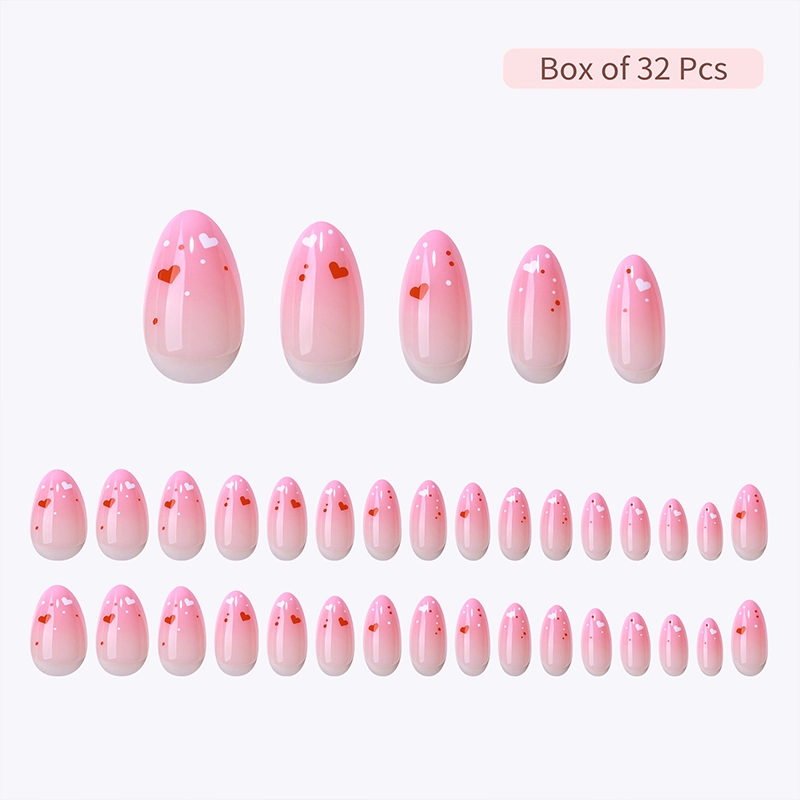
Finish is both a visual specification and a production-control point. Glossy, matte, pearlescent, glitter, chrome-effect, and printed finishes can create distinct shelf appeal, but each can reveal different defects. A high-gloss surface may make scratches, dust, or uneven coating more visible. Matte finishes can show handling marks or inconsistent texture. Glitter and decorative effects require particular attention to particle distribution, edge cleanliness, and consistency between nails in the same set.
To reduce ambiguity, a purchase specification should define the finish name, reference sample, color standard or approved visual target, decoration placement, and acceptable variation. Buyers should request a complete set rather than approving a single nail, since color and finish consistency need to be assessed across the full assortment. Packaging should also protect the surface from abrasion during transit and retail handling. For printed or coated designs, request information about the process and the supplier’s inspection points, then assess the finished product after packing and unpacking.
Review substrate, construction, and quality controls
The nail material affects flexibility, shape retention, thickness, feel, and how the finished design is produced. A product brief should identify the required shape family, length, thickness range if specified, underside profile, and intended consumer segment. Rather than assuming that a material name guarantees performance, compare finished samples for edge smoothness, uniform curvature, visible molding marks, and resistance to ordinary handling. The supplier should clarify which characteristics are controlled in production and how defects are sampled or escalated.
Manufacturing documentation matters alongside the physical sample. Ask for a written specification, approved artwork or color references, batch identification approach, and inspection records appropriate to the program. Where cosmetics-related manufacturing practices are relevant to the supplier’s operations, ISO 22716, Cosmetics — Good Manufacturing Practices, is an authoritative reference for cosmetic GMP guidance. It should not be treated as automatic proof that a particular nail product or facility is certified; buyers should verify the supplier’s actual scope and documentation.
Product labeling and claims also need review. In the United States, the FDA cosmetics labeling guide outlines labeling considerations for cosmetics. The classification of a specific product and its market obligations depend on the product and claims, so legal or regulatory review may be appropriate before artwork approval. Keep claims such as “safe,” “non-toxic,” or “long-wear” tied to substantiation and the rules of the destination market.
Nail Fit, Sizing, and Consumer Application
Build size coverage around real nail dimensions
A set can have an attractive design and suitable adhesive yet still disappoint if the sizes do not match the wearer’s nail beds. Size selection should account for width, sidewall shape, curvature, and left-to-right variation. A single nominal width is not enough to describe fit. Buyers should compare the underside and side profile of each size with a representative range of natural nail shapes, including narrower and wider nail beds, and check that the edges do not extend uncomfortably onto surrounding skin.
Request a size chart that states how measurements are taken, such as the widest point of each artificial nail. Confirm whether the supplier’s numbered sizes are consistent across shapes and collections; numbering systems are not necessarily standardized between manufacturers. Review the full size assortment in a sample set and check whether the number of each size supports practical matching across both hands. If the product is offered in multiple lengths or shapes, validate sizing separately rather than assuming one fit profile transfers to another.
Test application, wear, and removal as a sequence
Evaluation should reproduce the consumer journey. Check that instructions clearly cover selecting a size, preparing the natural nail, positioning the tab, pressing the artificial nail, and removing the set. The test should include the actual adhesive and the intended nail finish, because a tab that works on one underside construction may not behave identically on another. Record observations such as ease of liner removal, alignment, edge lift, comfort, and whether removal follows the instructions without unnecessary force.
Set realistic test conditions and document them. Natural nail preparation, hand washing, exposure to water, and application pressure can affect results, so a supplier comparison is more useful when these factors are kept consistent. Avoid generalizing from one tester or one application. A structured evaluation across multiple users and nail shapes can uncover sizing gaps before launch. Any wear-time statement should reflect a defined method and should be worded in line with validated results and market rules.
For younger users or other specific audiences, fit, age grading, packaging, and instructions require additional care. A kids nails press-on assortment should be reviewed for suitability to its intended audience and applicable requirements; buyers should not assume that an adult product becomes suitable for children simply by changing the artwork. Similar validation applies to salon false nails and fake toe nails, where shape, curvature, application area, and included adhesive may differ from fingernail sets.
Procurement Checklist and Private-Label Program Planning
Turn the brief into measurable sample approvals
A clear sourcing brief reduces costly revisions by translating brand expectations into verifiable requirements. Include target customer and sales channel, nail shapes and lengths, size assortment, material and finish references, adhesive format, decoration, packaging, language requirements, and intended market. Identify which attributes require a golden sample and which may be controlled through written tolerances or approved artwork. Buyers should also request confirmation of lead times, minimum order quantities, sample stages, production-change notification, and the process for handling nonconforming goods.
Approve the nail shape, underside curve, size measurements, and complete size count.
Specify whether the set uses pre-applied stickers, separate gel nail tabs, or another attachment format.
Document finish, color, artwork placement, and acceptable visual variation against an approved reference.
Review instructions, packaging protection, labeling, and destination-market requirements before mass production.
Retain approved samples and compare production goods against them at defined inspection stages.
A staged approval process typically includes design confirmation, pre-production samples, packaging review, and inspection of finished goods. The exact checkpoints depend on order complexity and the buyer’s quality plan. If a supplier proposes a substitution in material, adhesive, coating, or packaging, assess the change before approval because it may affect fit, appearance, application, or labeling. Documenting acceptance criteria provides a shared reference for the brand owner, manufacturer, importer, and quality team.
Coordinate product range, packaging, and supplier capability
Our product range can support buyers evaluating custom press on nails, standard press on nails, salon false nails, kids nails press on, fake toe nails, gel nail tabs, and sticker press on nails. The appropriate configuration depends on the buyer’s brief: a reusable-looking fashion set, an easy-application sticker kit, a salon-oriented assortment, or a coordinated fingernail and toenail offer may require different shapes, sizes, decoration, and packaging. Buyers should share target-market requirements early so the proposed samples can be assessed against the actual retail proposition rather than selected on appearance alone.
For a private-label program, our team can align product selection discussions with the requested design, attachment format, size range, and packaging direction. A supplier conversation is most productive when the buyer provides reference images, target price positioning, target launch timing, order forecasts, and any required market documentation. The review should distinguish confirmed capabilities from items that still need sample or production validation. This transparent approach helps procurement teams compare offers on total suitability, not just unit price, and reduces the risk of late changes to artwork, fit, or adhesive configuration.
Before placing a production order, buyers should confirm the approved specification, sample status, packaging details, inspection criteria, and responsibilities for regulatory review. Well-defined materials and fit requirements help limit avoidable quality disputes, support more predictable replenishment, and make product expansion across shapes or seasonal designs easier to manage. The strongest assortment is not necessarily the one with the most finish options; it is the one whose nail construction, adhesive, sizing, and instructions work together for the intended user and channel.
Contact our team to discuss your product brief and explore press-on nail styles, adhesive options, and private-label packaging suited to your target market.
Frequently Asked Questions
What is the difference between pre-applied adhesive stickers and separate gel nail tabs?
Pre-applied stickers are positioned on the underside of each nail or included as part of the set, while separate gel nail tabs are packed independently in multiple sizes. Buyers should compare placement, coverage, tab dimensions, packaging, and compatibility with nail curvature.
How should buyers evaluate adhesive performance for press-on nails?
Evaluate samples using consistent application steps and conditions, including nail preparation, contact area, pressure, and exposure to water. Check liner release, alignment, edge lift, comfort, and removal, and avoid promising a fixed wear duration unless a validated test protocol supports the claim.
What information should a press-on nail size chart include?
A useful chart states how measurements are taken, such as the widest point of each artificial nail, and identifies the sizes included in the set. Buyers should confirm that the supplier’s numbering is consistent across shapes and collections and validate each length or shape separately.
Which finish and quality details should be included in a private-label brief?
Specify the finish name, approved visual reference, color target, decoration placement, and acceptable variation. Review a complete set for consistency, surface defects, edge cleanliness, and packaging protection, and ask the supplier to explain relevant production inspection points.
Can buyers use the same size assortment for different nail shapes or lengths?
Not without validation. Shape and length can change the fit profile, so buyers should review the size assortment and underside curve for each product variation instead of assuming one sizing system transfers across all designs.
What should buyers confirm before approving mass production?
Confirm the written specification, approved sample, nail shape and size range, adhesive format, finish and artwork, packaging, instructions, labeling, inspection criteria, and any required destination-market review. Document approval and assess material or process substitutions before accepting them.





Copyright © 2025 - XIANXING BEAUTY All Rights Reserved. Sitemap
Facebook
YouTube
Instagram
LinkedIn