Private Label Press on Nail Kits vs. Custom Nail Kits: Which Option Is Best for Your Brand?
Private label press on nail kits and fully custom nail kits serve different brand-building objectives. A private-label program typically uses an existing nail design, established size range, standard accessories, and adaptable packaging, allowing retailers, salons, distributors, and e-commerce operators to launch quickly with controlled development costs. A custom program is developed around the buyer’s own specifications, including nail shape, dimensions, materials, artwork, finish, adhesive system, accessory configuration, and packaging structure. The best option depends on commercial positioning, forecasted demand, required speed to market, desired exclusivity, regulatory documentation, and the supplier’s ability to translate a concept into consistent production. Buyers should evaluate landed cost, minimum order quantity, sample approval, quality assurance, replenishment speed, and intellectual-property control rather than selecting solely on unit price.
Choosing Between Ready-to-Brand and Bespoke Press-On Nail Programs
What a private-label model normally includes
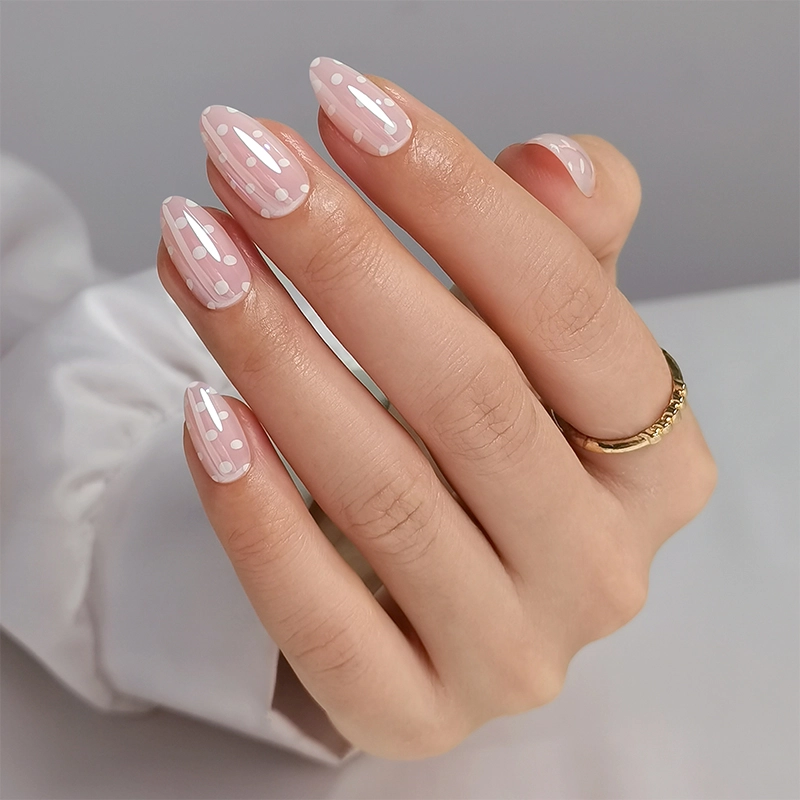
A ready-to-brand nail program usually begins with a manufacturer’s existing catalog. The buyer selects from available nail shapes such as almond, coffin, square, oval, or stiletto; chooses colors, finishes, and decorative treatments; then applies a brand identity through labels, cartons, inserts, or accessory packs. The production risk is lower because the base product has already been manufactured and tested through the supplier’s normal quality-control process. This model is especially practical for first-time beauty entrepreneurs, seasonal collections, salon retail programs, marketplace sellers, and distributors that need commercially proven products without funding a long design-development cycle.
The strongest advantage is speed. Because mold concepts, decoration techniques, packaging dimensions, and production parameters may already exist, the buyer can move from selection to sampling and purchase-order confirmation more rapidly. However, catalog-based products can appear similar to competing offers. A brand may still differentiate through packaging hierarchy, curated color stories, bundle architecture, educational inserts, pricing strategy, and customer service, but the underlying nail design may not be exclusive. Contract terms should clarify whether the same design is available to other customers and whether the buyer receives any geographic or channel protection.
What fully custom development changes
A bespoke nail kit is engineered around a brand brief rather than selected from a finished catalog. The project may include a proprietary silhouette, unusual curvature, tailored sizing, special-effect finishes, original artwork, branded application tools, custom adhesive tabs, or a packaging format designed for a specific retail shelf and consumer experience. This route gives the brand greater control over product architecture and supports a distinctive visual identity that is harder for competitors to replicate.
Customization also introduces additional development work. The supplier must confirm technical feasibility, create drawings or digital references, prepare prototypes, test fit and finish, validate decoration alignment, and establish production tolerances. Packaging artwork must be checked for dimensions, barcode placement, language requirements, warnings, and component compatibility. The buyer should expect more decisions, a longer approval process, and potentially higher tooling or development charges. These costs can be justified when the product is central to the brand’s positioning or when a repeatable hero collection is expected to generate substantial volume.
How the two models affect commercial risk
Private-label sourcing reduces upfront risk but may limit differentiation. Custom manufacturing increases upfront risk but can create stronger pricing power, brand recognition, and customer retention. A useful decision framework compares five variables: launch urgency, forecasted volume, desired exclusivity, technical complexity, and available working capital. A fast-moving retailer with uncertain demand may begin with adapted catalog products, collect customer feedback, and later invest in proprietary shapes or packaging. An established beauty company launching a flagship collection may prefer custom development from the beginning to protect its market position.
| Decision factor | Ready-to-brand program | Fully custom program | Procurement implication |
|---|---|---|---|
| Development speed | Generally faster because base designs already exist | Requires briefing, prototyping, approval, and production setup | Choose the first route for urgent launches; choose the second when differentiation matters more than speed |
| Initial development cost | Usually lower | May include design, sampling, tooling, and packaging setup | Compare total project cost, not only the quoted unit price |
| Exclusivity | Often limited unless contractually negotiated | Can be designed around proprietary specifications | Confirm ownership, channel rights, and reuse restrictions in writing |
| Minimum order flexibility | Often more accessible for smaller launches | May increase when special components or packaging are required | Ask for tiered pricing and pilot-order options |
| Brand differentiation | Driven mainly by curation and presentation | Built into the product and customer experience | Match the model to the brand’s defensibility strategy |
| Replenishment | Typically predictable when catalog components remain available | Depends on reserved materials, approved artwork, and dedicated specifications | Secure component continuity and reordering terms before launch |
Procurement Criteria That Determine the Better Business Case
Unit economics and total landed cost
A credible comparison must include more than the factory price. Buyers should model sampling, artwork preparation, tooling, packaging components, inspection, freight, duties, marketplace fees, storage, damaged units, and inventory obsolescence. A lower-cost standard kit can become less profitable if its packaging requires repacking or if the design attracts weak conversion. Conversely, a custom kit with a higher ex-factory price may produce better gross margin if its distinctive design supports High Quality pricing and stronger repeat purchase.
Cost analysis should also separate fixed and variable expenses. Fixed development costs are spread across the order quantity, so a small custom run may carry a substantial per-unit burden. Buyers should request quotations at several volume levels and ask which costs disappear after the first approved order. Packaging engineering, printing plates, molds, and special finishes should be identified individually. This makes it easier to compare a low-risk pilot with a scalable long-term program.
Quality, safety, and documentation
Press-on nails are applied directly to the natural nail, so material consistency, surface finish, dimensional accuracy, adhesive performance, and user instructions influence both customer satisfaction and brand liability. A supplier evaluation should cover incoming-material inspection, in-process controls, final inspection, batch traceability, defect classification, color consistency, and packaging verification. Buyers should also request current technical and safety documentation for the relevant materials and accessories.
International compliance must be assessed according to the destination market and product classification. The U.S. Food and Drug Administration cosmetics guidance explains the regulatory framework relevant to cosmetic products in the United States, while the European Union REACH Regulation addresses the registration, evaluation, authorization, and restriction of chemicals. Buyers can also use the ISO 9001 quality management overview to understand the value of documented, repeatable quality systems. These references do not replace market-specific legal advice, but they provide a sound basis for supplier due diligence.
Design ownership and supply continuity
For custom nail collections, the purchase agreement should define ownership of artwork, 3D files, molds, packaging dielines, product specifications, and approved samples. It should also state whether the manufacturer may display the design publicly or sell it to another customer. For adapted catalog programs, the buyer should confirm the availability period for the selected designs, colorants, boxes, accessories, and adhesive components. A product that cannot be replenished after a successful launch creates avoidable customer dissatisfaction and marketing waste.
Supply continuity also depends on quality tolerances. A buyer should approve a golden sample and establish measurable acceptance criteria for length, curvature, thickness, gloss, decoration placement, adhesive-tab dimensions, and packaging assembly. Clear standards reduce disputes and help the manufacturer reproduce the same product across multiple production batches.
How Xianxing Beauty Supports Scalable Nail Brand Development
OEM and ODM capabilities for different launch stages
Xianxing Beauty supports both fast-moving branded programs and specification-led product development. Founded in 2012, our company is a China press on nail manufacturer focused on OEM and ODM customized nail production. This dual capability allows buyers to begin with an established press-on nail concept, then progress toward differentiated materials, sizes, designs, nail shapes, accessories, and packaging as market demand becomes clearer.
Our 20,000-square-meter factory produces up to 300,000 pieces of press on nails daily and launches more than 100 new products every month. This capacity supports distributors and multi-channel brands that need reliable replenishment, while the breadth of new product development helps project owners evaluate current shapes, colors, finishes, and seasonal design directions. Small-scale customization is available for buyers that want a controlled market test before committing to a larger rollout.
Product categories and application-focused options
Our product range covers custom press on nails, everyday Press on nails, salon false nails, kids nails press on, fake toe nails, gel nail tabs, and sticker press on nails. These categories help buyers build a broader assortment for different customer segments rather than relying on one universal kit. A salon program may prioritize professional presentation and dependable sizing, while a children’s collection may require playful artwork, simplified application, and age-appropriate packaging communication. A toe-nail range can extend the average order value and create cross-selling opportunities alongside fingernail kits.
Product engineering focuses on breathable and lightweight construction, with non-toxic and odorless product characteristics. UV coating is used to protect the nail surface and support a more durable, attractive finish. Depending on the project specification, the kit can be configured with suitable application accessories, including gel nail tabs or sticker-based systems. Buyers should still validate the final formula, labeling, claims, and intended market requirements for each finished configuration.
Rapid sampling, production execution, and compliance support
Our team provides nail samples within three days for applicable development projects, allowing buyers to assess shape, visual finish, fit, and packaging direction before commercial approval. Orders can be completed within 7–14 days according to product complexity, order quantity, component readiness, and confirmed specifications. A realistic production schedule is finalized after artwork approval and component review; buyers should avoid committing to retail launch dates before these milestones are documented.
Xianxing Beauty products are supported by ROHS, REACH, and MSDS documentation and are designed to meet US and EU global cosmetics standards. Documentation should be matched to the exact product, material, accessory, and destination market rather than treated as a universal approval for every configuration. Our manufacturing approach combines capacity, customization, and development speed to help brands balance launch agility with long-term product differentiation. The company’s vision is to become the world’s leading press on nails manufacturer, with ongoing emphasis on product innovation, quality consistency, and responsive OEM and ODM cooperation.
Recommended Decision Path for Brand Owners and Distributors
When a ready-to-brand launch is appropriate
Select a catalog-based branded kit when speed, low initial exposure, and assortment testing are the primary objectives. This approach fits businesses validating a new sales channel, testing seasonal trends, supplying salon counters, or building a starter collection with modest purchase quantities. The buyer should still request samples, confirm packaging quality, review compliance documents, and negotiate replenishment terms. Speed should never eliminate basic technical and commercial verification.
When a proprietary collection is the stronger investment
Choose a custom development route when the brand depends on a distinctive silhouette, unique artwork, specialized fit, High Quality packaging, or exclusive customer experience. It is particularly suitable for established beauty labels, private-label retailers with substantial distribution, subscription-box operators, and investors building a defensible product portfolio. Customization becomes more financially attractive when projected sales can amortize development costs and when the brand has sufficient marketing reach to communicate why the product is different.
When a hybrid strategy creates the best result
Many buyers should use a hybrid roadmap. A business can launch quickly with selected existing designs under branded packaging, measure sell-through and customer feedback, and then commission custom versions of the strongest-performing shapes or themes. This reduces uncertainty while preserving a path toward exclusivity. The supplier brief should identify which components are standard, which are modified, and which are proprietary so that the transition from initial launch to scaled custom production remains operationally clear.
For supplier discussions, prepare a concise project document covering target market, consumer profile, nail shapes, size requirements, finish, artwork, kit components, packaging, forecast quantity, target price, delivery window, compliance needs, and inspection expectations. A structured brief improves quotation accuracy and makes the differences between a standard adaptation and genuine custom engineering easier to evaluate. The best manufacturing partner is not simply the one offering the lowest price; it is the supplier that can maintain specification accuracy, documentation, communication, and delivery performance as the program grows.
Frequently Asked Questions
What is the main difference between a private-label press-on nail kit and a custom nail kit?
A private-label kit generally uses an existing manufacturer design with buyer-specific branding and packaging, while a custom kit is developed around the buyer’s specifications, including shape, size, materials, artwork, accessories, and packaging.
Which option is more suitable for a new beauty brand?
A ready-to-brand program is often suitable for a new brand because it can reduce development cost, shorten the launch timeline, and support market testing before larger investment. A hybrid strategy can later convert successful products into proprietary designs.
Are custom nail kits more expensive than private-label products?
Custom kits may involve additional design, sampling, tooling, packaging, and development costs. However, a distinctive product can support premium pricing and stronger brand loyalty, so buyers should compare total landed cost and expected commercial return rather than unit price alone.
What documents should buyers request from a press-on nail manufacturer?
Buyers should request product-specific material and safety documentation, relevant REACH, RoHS, or MSDS records where applicable, quality-control information, batch traceability details, and market-specific labeling support. Documentation should correspond to the exact finished product and destination market.
How quickly can Xianxing Beauty provide samples and complete orders?
Xianxing Beauty provides nail samples within three days for applicable development projects, and orders can be completed within 7–14 days depending on product complexity, quantity, component readiness, and confirmed specifications.
Can small businesses order customized press-on nails?
Yes. Xianxing Beauty supports small-scale customization involving materials, sizes, designs, nail shapes, and packaging, allowing smaller brands to test products before expanding into larger production programs.
Copyright © 2025 - XIANXING BEAUTY All Rights Reserved. Sitemap
Facebook
YouTube
Instagram
LinkedIn