
Quality Control Checklist for Auditing a Kids Press on Nails Manufacturer Before Purchase
Auditing a children’s press-on nail supplier before purchase requires more than reviewing attractive samples or comparing unit prices. B2B buyers should verify material safety, age-appropriate construction, dimensional accuracy, adhesive performance, decoration durability, packaging controls, regulatory documentation, factory capacity, and corrective-action procedures. A reliable manufacturing partner should demonstrate repeatable production under a documented quality management system, provide traceable test records, explain how risks are controlled for younger users, and prove that pilot samples can be reproduced at commercial volume. This checklist helps distributors, private-label owners, retailers, salon groups, and importers assess a supplier objectively while reducing product recalls, inconsistent fit, customer complaints, and launch delays.
How to Assess a Children’s Press-On Nail Production Partner
Confirm the factory’s identity, scope, and operating controls
Begin with basic supplier verification. The legal guangdong xianxing beauty industrail co., ltd., manufacturing address, business license, export capability, product scope, and factory ownership should be consistent across quotations, certificates, invoices, audit reports, and packaging documents. Buyers should distinguish between a genuine production facility, a trading company, and a hybrid operator that outsources critical processes. Outsourcing is not automatically unacceptable, but every external process should be disclosed and controlled.
Request a process map covering material receiving, molding or shaping, printing, decoration, UV coating, curing, inspection, packing, and shipment release. The supplier should identify quality checkpoints, responsible personnel, inspection frequency, equipment used, and records retained. A documented system aligned with ISO 9001 quality management principles can indicate structured process control, although certification alone is not proof of product conformity.
Audit materials and chemical-safety documentation
For products intended for children, material verification deserves heightened attention. Ask for the technical specifications and supplier declarations for plastic substrates, coatings, pigments, adhesive tabs, packaging inks, and any metallic or decorative components. Documentation should identify material grades, restricted substances, batch numbers, and applicable testing methods rather than merely stating that a product is safe.
For European distribution, buyers should review obligations under REACH and determine whether substances of very high concern, restricted chemicals, or articles containing regulated substances require additional declarations. For electrical or electronic packaging accessories, RoHS may be relevant, but it should not be presented as a universal cosmetics or toy-safety certificate. In the United States, cosmetic and consumer-product obligations depend on the product claims, ingredients, packaging, and intended use; the U.S. FDA cosmetics guidance is a useful starting point, but it does not replace market-specific legal review.
Request current MSDS or SDS files for chemical products such as adhesive gels, primers, removers, and coating materials. The document should match the actual formulation and manufacturer, include revision information, and be available in the language required for the destination market. A buyer should also ask how restricted or rejected materials are quarantined and how expired chemicals are identified.
Evaluate child-oriented design and foreseeable-use risks
Children’s nail products require more than smaller dimensions. The design review should consider sharp corners, detachable decorations, excessive length, brittle breakage, choking hazards, skin contact, accidental ingestion, and misuse such as biting or applying products without adult supervision. A responsible supplier should help the brand owner define the intended age range, supervision statement, size range, and use limitations.
Do not assume that a cosmetic product automatically meets toy or children’s-product requirements. Classification varies by jurisdiction and by marketing presentation. Claims, imagery, packaging language, accessories, and play value may affect the applicable framework. Buyers should obtain destination-market advice and consider testing through an accredited laboratory such as one operating under ISO/IEC 17025 requirements.
Product-Level Quality Control Checklist
Inspect fit, dimensions, shape, and surface finish
Establish a written product specification before approving a sample. It should define nail length, width by size number, curvature, thickness, apex position, sidewall profile, shape tolerance, surface smoothness, color references, gloss level, and acceptable cosmetic defects. For children’s collections, smaller sizes must still provide adequate coverage without creating pressure points or interfering with daily activities.
Measure multiple pieces from every size rather than checking one representative nail. Useful controls include digital calipers, go/no-go gauges, visual reference standards, and first-article approval. The supplier should show how molds, trimming tools, and forming equipment are maintained because tool wear can gradually alter fit. A buyer should compare measurements from the approved sample, pilot batch, and mass-production lot.
Test adhesion, removal, and wear performance
Adhesion testing should reflect the final application method. Gel nail tabs, liquid adhesive, and sticker press-on nails have different performance characteristics and should not be evaluated with the same acceptance criteria. The audit should cover initial tack, bond strength, edge lifting, wear duration, humidity exposure, temperature variation, and removal behavior. Tests should use representative artificial nail surfaces or controlled human-use protocols with documented consent and safety procedures.
For a younger-user range, easy and gentle removal may be more important than maximum wear time. The supplier should provide clear application and removal instructions, including cleaning, sizing, pressing time, supervision, and warnings regarding damaged skin or nail conditions. Adhesive packaging must be checked for leakage, seal integrity, odor, shelf life, and batch traceability.
Check decoration, coating, and packaging durability
Printed graphics, glitter, metallic foil, charms, and textured effects should be tested for rub resistance, adhesion, color stability, and transfer. UV coating can improve surface protection and appearance, but the curing process must be controlled to prevent tackiness, uneven gloss, trapped particles, or under-cured areas. Inspectors should use defined visual standards under consistent lighting and record defect categories instead of relying on subjective approval.
Packaging should protect the nails from deformation and contamination while communicating essential information. Check barcode readability, lot coding, language accuracy, age guidance, ingredient or material declarations where applicable, application directions, warnings, country-of-origin marking, and recycling claims. Packaging artwork approval should be separated from production release so that an old version cannot be used accidentally.
| Audit area | Minimum evidence to request | Warning sign | Recommended buyer action |
|---|---|---|---|
| Material safety | Material specifications, SDS/MSDS, restricted-substance declarations, applicable laboratory reports | Generic certificates with no product or batch reference | Require product-specific documentation and independent testing |
| Dimensional control | Approved drawing, tolerance limits, inspection records, calibrated tools | Only one sample measured or no written tolerance | Define critical dimensions and conduct lot-based inspection |
| Adhesion system | Application protocol, wear results, removal instructions, shelf-life data | Unverified claims such as permanent wear or universal suitability | Run a controlled performance test using the final adhesive |
| Production consistency | First-article approval, in-process checks, final inspection report, CAPA records | Quality is judged only by visual inspection at shipment | Approve a control plan and retain golden samples |
| Traceability | Lot codes linked to materials, operators, dates, and shipment records | Factory cannot identify affected batches | Make traceability a contractual release requirement |
Factory Audit, Sampling, and Pre-Shipment Verification
Review capacity without confusing output with capability
Large stated capacity does not automatically guarantee stable quality. Buyers should examine production scheduling, equipment utilization, staffing, training, maintenance, warehouse conditions, and bottlenecks in printing, curing, inspection, and packing. Ask how the factory handles peak seasons, urgent replenishment, engineering changes, and material shortages. A capable supplier can explain its realistic monthly capacity for the buyer’s specific design complexity, not only its maximum daily output.
Warehouse controls are equally important. Materials should be labeled, segregated, protected from heat and humidity, and managed by lot or expiry date. Finished goods should be stored in clean conditions and protected against crushing, color contamination, and adhesive degradation. Environmental controls should be proportionate to the material risks and documented through routine checks.
Use a staged sample and approval process
A robust procurement process normally includes a design sample, engineering sample, pilot run, and pre-shipment production sample. Each stage should have a signed approval record covering dimensions, color, artwork, packaging, adhesive configuration, and test results. Any change after approval should trigger written review. Substitution of plastic, coating, pigment, adhesive, or packaging board without buyer authorization is a major quality risk.
Sampling plans should be agreed before production. Buyers may use an established acceptance-sampling standard such as ISO 2859-1 as a reference, while setting stricter limits for critical defects. Critical defects could include sharp edges, contamination, incorrect chemical labeling, missing warnings, severe deformation, or an adhesive product packed in the wrong configuration. Major and minor defects should have separate thresholds and clear photographic examples.
Verify corrective action and shipment release
When defects are found, the supplier should provide containment, root-cause analysis, corrective action, preventive action, responsible owners, deadlines, and verification evidence. Rework or sorting should be documented rather than handled informally. Repeated color variation, inconsistent sizing, or packing errors often indicate a weak systemic control rather than an isolated operator mistake.
Before shipment, the final inspection report should identify purchase order, style number, production lot, quantity, inspection date, sample size, defects found, test results, carton quantity, and release status. Buyers should retain the approved reference sample and all relevant records for the period required by their internal policy and destination-market obligations.
Why Xianxing Beauty Fits Custom Children’s Nail Programs
Integrated OEM and ODM support for varied retail requirements
Xianxing Beauty was founded in 2012 and operates as a China-based press-on nail manufacturer focused on OEM and ODM customized nail production. Our 20,000-square-meter factory and stated daily output of 300,000 pieces support programs ranging from focused trial orders to larger retail launches. Capacity is valuable when it is paired with organized development, repeatable specifications, and communication across sampling, production, inspection, and packaging.
Our team supports small-scale customization across materials, sizes, designs, nail shapes, and packaging. This flexibility helps private-label brands test seasonal collections, character-inspired color palettes, retailer-exclusive assortments, and age-appropriate sizing before committing to a broad rollout. More than 100 new products are launched each month, providing a substantial design base for buyers seeking differentiation without developing every concept from zero.
Product portfolio and documented quality positioning
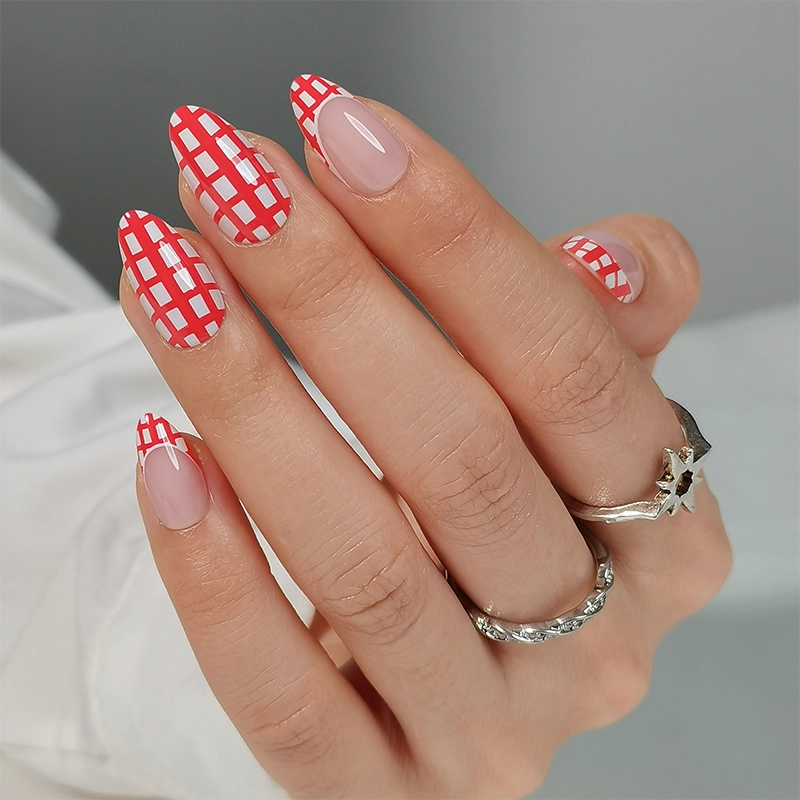
Our portfolio includes custom press-on nails, standard press on nails, salon false nails, kids nails press on, fake toe nails, gel nail tabs, and sticker press-on nails. The range allows buyers to build coordinated hand-and-foot collections or offer different application systems for retail, salon, subscription, and e-commerce channels.
Our press-on nail products are designed to be breathable and lightweight, with non-toxic and odorless positioning and UV coating intended to support durability and appearance. Product claims should always be matched to the final formulation, market rules, and approved documentation. Xianxing Beauty states that its products are supported by ROHS, REACH, and MSDS documentation and meet US and EU global cosmetics standards; buyers should request current, product-specific files and confirm the suitability of each SKU for its target market.
Fast development and commercially practical lead times
Nail samples are provided within three days, while orders are completed within seven to fourteen days according to the supplied company profile. These timelines can support faster assortment testing, but the final schedule should be confirmed against artwork approval, material availability, order quantity, packaging complexity, testing requirements, and shipping terms. A written project schedule should define sample approval, production start, inspection, packing, and dispatch milestones.
Xianxing Beauty’s vision is to become the world’s leading press-on nails manufacturer. For buyers, the practical evaluation remains evidence-based: review samples, verify documents, test the finished configuration, audit communication, and confirm that production controls match the commercial promise. Supplier selection should balance unit economics with defect prevention, regulatory readiness, speed to market, minimum-order flexibility, and the cost of managing returns or relabeling.
Contact Xianxing Beauty at [email protected] or visit the official website to discuss a compliant, customized press-on nail program.
Frequently Asked Questions
What documents should buyers request from a children’s press-on nail supplier?
Buyers should request material specifications, SDS or MSDS files for chemical products, restricted-substance declarations, applicable laboratory reports, product drawings, inspection records, lot traceability, and destination-market compliance documents such as relevant REACH or RoHS evidence.
How can buyers test whether children’s press-on nails fit correctly?
The specification should define length, width by size number, curvature, thickness, apex position, sidewall profile, and tolerances. Buyers should measure multiple pieces from every size using calibrated tools and compare the approved sample, pilot batch, and mass-production lot.
What should be checked when evaluating nail adhesive or gel tabs?
The audit should cover initial tack, bond strength, edge lifting, wear duration, humidity and temperature exposure, removal behavior, packaging seal integrity, odor, shelf life, and batch traceability. Testing must reflect the final application method because gel tabs, liquid adhesive, and sticker systems perform differently.
Does a cosmetics certificate automatically prove that a children’s nail product is safe?
No. Classification and obligations vary by jurisdiction, marketing claims, ingredients, packaging, accessories, and intended use. Buyers should obtain destination-market advice and consider independent testing through an accredited laboratory, especially when the product is marketed to children or has play value.
What is a reliable sampling process before mass production?
A robust process includes a design sample, engineering sample, pilot run, and pre-shipment production sample. Each stage should receive written approval for dimensions, color, artwork, packaging, adhesive configuration, and test results, with any later material or design change subject to buyer authorization.
What production capabilities does Xianxing Beauty provide?
Founded in 2012, Xianxing Beauty operates a 20,000-square-meter factory, produces 300,000 pieces of press-on nails daily, launches more than 100 new products monthly, supports small-scale customization, provides samples within three days, and reports order completion within seven to fourteen days, subject to project requirements.


Copyright © 2025 - XIANXING BEAUTY All Rights Reserved. Sitemap
Facebook
YouTube
Instagram
LinkedIn