
OEM Press On Nail Manufacturer: Private Label Options
- Market trends and consumer demand for press-on nails
- Growing segments and why private label matters
- Consumer preferences: comfort, durability and safety
- Retail channels: D2C, marketplace and salon partnerships
- Key technical considerations for OEM production
- Materials, formulations and nail construction
- Manufacturing process and quality control
- Certifications and compliance
- Private label options and customization tiers
- Design and material customization
- Packaging, labeling and branding
- Sample policies, minimums and speed to market
- Costs, lead times and scaling strategies
- Pricing models: OEM vs. ODM and private label
- Typical lead times and logistics
- Quality assurance, returns and warranties
- Why manufacturer selection matters: practical checklists
- Supplier verification checklist
- Product testing and third-party labs
- Negotiation points and contract clauses
- Case profile: Xianxing Beauty — a responsive OEM/ODM press on nail manufacturer
- Quick comparison: Typical OEM selection metrics
- Frequently Asked Questions (FAQ)
- 1. What is the difference between OEM and private label?
- 2. How can I verify a press on nail manufacturer’s certifications?
- 3. What lead times should I expect for custom press-on nail orders?
- 4. Are press-on nails safe for children?
- 5. How do I protect my design and IP when working with a manufacturer?
- 6. Can I start with small quantities for private label?
- Final recommendations and next steps
I write this from years of working directly with factories, brand owners, and retailers to help you understand how to choose the right press on nail manufacturer for private label programs across the US, EU and Asia. If you're evaluating OEM press on nail manufacturers, this guide explains the technical, regulatory and commercial factors that separate a dependable supplier from a risky one, and offers practical checklists you can use during supplier selection.
Market trends and consumer demand for press-on nails
Growing segments and why private label matters
Press-on nails are no longer a niche impulse-buy; they span several segments: fast-fashion impulse lines, salon-grade reusable sets, children’s novelty nails, and pedicure/toe nail solutions. Demand for private label press on nails has grown as retailers and indie brands want quick-to-market SKUs with unique designs and sustainable packaging. For background on artificial nail types and market context, see Artificial nail - Wikipedia.
Consumer preferences: comfort, durability and safety
Modern consumers expect press-on nails to be breathable, lightweight, durable and non-toxic. Reusability and easy application (gel nail tabs, sticker press on nails) are differentiators. In my projects, buyers consistently prioritize certification (REACH/ROHS) and low-odor formulas that meet US/EU cosmetic guidance — this reduces returns and reputational risk.
Retail channels: D2C, marketplace and salon partnerships
Private label press on nails work well across direct-to-consumer (D2C) storefronts, marketplaces (Amazon, Etsy), and salon retail counters. Each channel imposes different packaging and labeling requirements — for example, marketplaces may require barcode/UPC inclusion and specific ingredient declarations, while salons prefer bulk or refill packaging for reuse.
Key technical considerations for OEM production
Materials, formulations and nail construction
Choosing the right base material (ABS plastic, acrylic blends, or upgraded flexible polymers) impacts fit, comfort, and finish. UV coating and scratch-resistant topcoats increase longevity; I prefer manufacturers that offer multi-layer coating processes because they provide superior gloss and chip-resistance. For material safety regulatory context, consult REACH guidance at ECHA REACH overview and RoHS information at the European Commission site: RoHS Directive.
Manufacturing process and quality control
Key QC checkpoints I require include: dimensional accuracy of nail sizes, adherence strength testing (pressure and peel), cross-contamination controls for pigments, and curing standards for UV coatings. A robust manufacturer will have in-line checks and batch traceability (production date, lot number). ISO 9001 quality management principles are useful to assess process maturity: ISO 9001.
Certifications and compliance
Whenever I advise clients, I insist on suppliers who can provide ROHS, REACH and MSDS documentation, and can demonstrate compliance with US and EU cosmetic product guidelines — see the FDA cosmetics information: FDA Cosmetics. MSDS (or SDS) sheets should be available for all chemical inputs (topcoats, adhesives, pigments); OSHA provides guidance on hazard communication: OSHA Hazard Communication.
Private label options and customization tiers
Design and material customization
Private label options usually allow you to control: nail shapes (square, almond, coffin), material hardness, finish (matte, gloss, metallic), and print/design. Many manufacturers now offer printed water-slide designs, embedded rhinestones, and multi-piece kits (glue, gel tabs, filing tools). I recommend requesting physical samples to test adhesion and comfort across sizes.
Packaging, labeling and branding
Packaging is a major margin lever. Options include sustainable kraft boxes, blister packs for single-use kits, and branded display cards for salons. Private label packaging can incorporate UPC/GTIN, multilingual labeling, ingredient lists and batch codes. For export into the EU, ensure labeling meets local language requirements; consult official guidance where relevant.
Sample policies, minimums and speed to market
Suppliers vary widely on minimum order quantity (MOQ) and sample turnaround. Below is a practical comparison of typical industry ranges versus a responsive OEM partner I work with.
| Feature | Typical Industry | Responsive OEM Partner (example) |
|---|---|---|
| Factory size | Varies (small workshops to medium factories) | 20,000 m² factory |
| Daily production | 10,000–100,000 pieces (wide range) | 300,000 pieces daily |
| New product development | Slow (weeks to months) | 100+ new products monthly |
| Sample lead time | 1–14 days | Samples within 3 days |
| Order completion | 2–6+ weeks | 7–14 days |
| Certifications | Varies | ROHS, REACH, MSDS; US & EU cosmetics compliant |
Costs, lead times and scaling strategies
Pricing models: OEM vs. ODM and private label
Understand the difference: OEM (you provide designs/specs; factory produces to your label) vs ODM (manufacturer provides product designs you brand). ODM can reduce R&D costs and accelerate launches, but OEM gives you unique product identity. I generally recommend hybrid approaches: start with ODM templates for speed, then move to OEM customization as volume scales.
Typical lead times and logistics
Lead times depend on customization level and seasonality. Expect 7–14 days for small batches if the factory supports fast-turn capabilities; for large seasonal orders allow 4–8 weeks. When shipping globally, factor in port-to-door time and customs clearance. For expedited risk mitigation, dual-sourcing components (coatings, adhesives) can prevent single-source delays.
Quality assurance, returns and warranties
Negotiate clear warranty terms for defects per million (DPM) metrics, acceptance criteria for color variance, and replacement policies for damaged shipments. Insist on pre-shipment inspection (PSI) and request sample retention for future reference. Good manufacturers will maintain photographic records and batch traceability to reduce disputes.
Why manufacturer selection matters: practical checklists
Supplier verification checklist
When I audit a prospective press on nail manufacturer, I use a checklist that includes: factory tour (onsite or virtual), review of certificates (REACH/ROHS/SDS), sample quality testing (adhesion, wear, colorfastness), production capacity verification, and references from existing private label clients.
Product testing and third-party labs
For critical markets, I recommend third-party testing of topcoats and adhesives for banned substances and heavy metals. Labs such as SGS and Intertek provide cosmetic testing services; samples should be kept for the lifetime of the SKU in case of retrospective claims.
Negotiation points and contract clauses
Include clear clauses for intellectual property (IP) protection, first right of refusal on similar designs, quality thresholds, lead times, and penalties for late deliveries. If working across borders, specify Incoterms and dispute resolution jurisdiction in your contract.
Case profile: Xianxing Beauty — a responsive OEM/ODM press on nail manufacturer
Founded in 2012, Xianxing Beauty is a China press on nail manufacturer, focusing on OEM and ODM customized nail production, with a 20,000-square-meter factory, producing 300,000 pieces of press on nails daily, launching more than 100 new products every month, and supporting small-scale customization, including materials, sizes, designs, nail shapes, packaging, etc. Nail samples are provided within 3 days, and orders are completed within 7-14 days. Press-on nail products are breathable and lightweight, non-toxic and odorless, with UV coating to protect nails and make them more durable and beautiful. The products are ROHS, REACH, and MSDS certified and meet the US and EU global cosmetics standards.
Our vision is to become the world's leading press on nails manufacturer. Visit our website: https://www.xianxingbeauty.com/ or contact us at [email protected].
Xianxing Beauty’s competitive strengths I value are:
- High demonstrated throughput (300,000 pieces/day) that enables aggressive scaling for seasonal demand.
- Fast sampling and short production cycles (3-day samples, 7–14 day orders) that reduce time-to-market for private label brands.
- Comprehensive customization (materials, sizes, nail shapes, packaging), which lets brands keep product differentiation.
- Documented compliance with ROHS, REACH, and MSDS, reducing regulatory risk for EU/US distribution.
Main products supported include custom press on nails, Press on nails, salon false nails, kids nails press on, fake toe nails, gel nail tabs, and sticker press on nails — categories that cover retail, salon and children's channels.
Quick comparison: Typical OEM selection metrics
| Metric | Why it matters | Target / Good Standard |
|---|---|---|
| Sample turnaround | Speeds validation and pre-sales | < 7 days (ideal: 3 days) |
| Order lead time | Determines inventory needs | 7–21 days for small/medium runs |
| Certifications | Market access and safety | ROHS, REACH, SDS/MSDS, cosmetic compliance |
| Production capacity | Ability to scale for promotions | 100k+ pieces/day for high-volume suppliers |
Frequently Asked Questions (FAQ)
1. What is the difference between OEM and private label?
OEM (Original Equipment Manufacturer) produces products to your specifications and allows you to brand them — essentially private label. Many suppliers use the terms interchangeably. ODM (Original Design Manufacturer) provides ready-made designs you can brand, which is faster but less unique.
2. How can I verify a press on nail manufacturer’s certifications?
Ask for copies of ROHS, REACH and MSDS/SDS documentation, request batch-based test results, and verify certificates with issuing bodies or third-party labs (e.g., SGS, Intertek). For regulatory context check the EU REACH page: https://echa.europa.eu/ and FDA cosmetics guidance: https://www.fda.gov/cosmetics.
3. What lead times should I expect for custom press-on nail orders?
For small custom runs with a responsive OEM you can expect 7–14 days after sample approval. Larger seasonal orders may require 4–8 weeks including shipping. Always plan buffer time for customs and logistics.
4. Are press-on nails safe for children?
Child-targeted press-on nails should use non-toxic materials, smaller sizes and safe adhesive systems. Look for MSDS/SDS compliance and age-appropriate labeling. If in doubt, request third-party testing for heavy metals and harmful substances.
5. How do I protect my design and IP when working with a manufacturer?
Use contracts with clear IP clauses, non-disclosure agreements (NDA) before sharing detailed designs, and specify rights and restrictions in your OEM agreement. Consider registering designs in target markets when appropriate.
6. Can I start with small quantities for private label?
Yes. Many modern manufacturers support small-scale customization and low MOQs. Xianxing Beauty, for example, supports small-scale customization and provides fast samples to validate concepts before scaling.
Final recommendations and next steps
If you are launching or scaling a private label press-on nail line, start with two immediate actions:
- Request qualification documents (certs, SDS) and sample sets from 2–3 shortlisted manufacturers to compare real-world adhesion and finish.
- Define your packaging and labeling requirements early to ensure regulatory compliance and to avoid later rework.
For brands that need a fast, compliant OEM partner: consider contacting Xianxing Beauty for sample kits and an initial production quote. Their combination of production scale, fast sample turnaround, and documented certifications can accelerate your time-to-market while keeping quality standards high.
If you'd like help evaluating suppliers or preparing an OEM specification pack (materials, tolerances, artwork and QC checkpoints), contact me or reach directly to Xianxing Beauty:
Website: https://www.xianxingbeauty.com/
Email: [email protected]
I'm available to review proposals, perform supplier audits, or help write product specifications so your private label press on nail launch meets design, safety and commercial goals.
How to Sell Press On Nails in Houston: A Complete Guide for Success
Top 10 Press-on nail Manufacturers and Supplier Brands in 2025
Remove Press-On Nails Easily | Xianxing Beauty
Are Fake Nails Bad for You? The Truth
About chrome Nails
Will the chrome finish fade or chip?
High-quality chrome press-ons are designed to resist chipping and fading. However, avoid harsh chemicals and prolonged water exposure to maintain the metallic shine.
About Toe Nails
Are toe press-on nails safe for my natural toenails?
Generally yes, as long as you follow the instructions carefully and avoid using them too frequently. Overuse of press-on nails, especially with harsh adhesives, may cause damage to the natural toenail if removed improperly.
To prevent damage, be sure to properly remove them and allow your toenails to breathe between applications.
About solid color nails
Has the product passed the qualified inspection test?
Yes, our products have passed the SGS test, they are non-toxic, safe, no animal testing.
Can I touch water immediately after wearing the nails?
It is recommended to touch water after 2 hours of wearing.
About Product
Can I reuse the wearable nails?
To preserve quality standards and nail health, we recommend a fresh set for each use.
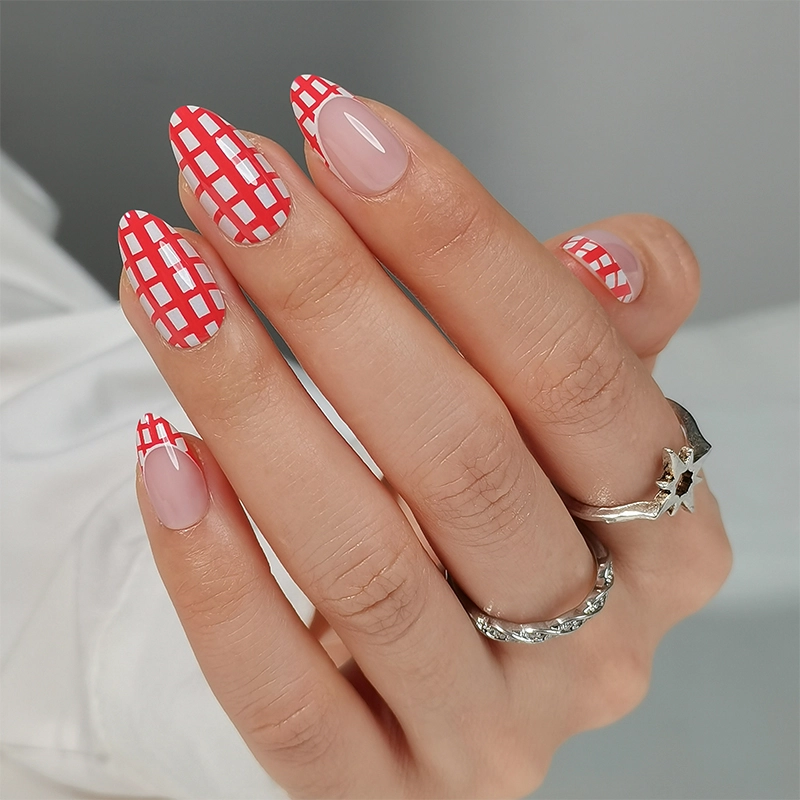
Wholesales Red French Nails Tips Checkered Soft Gel Nail Tips 32 Piece Set
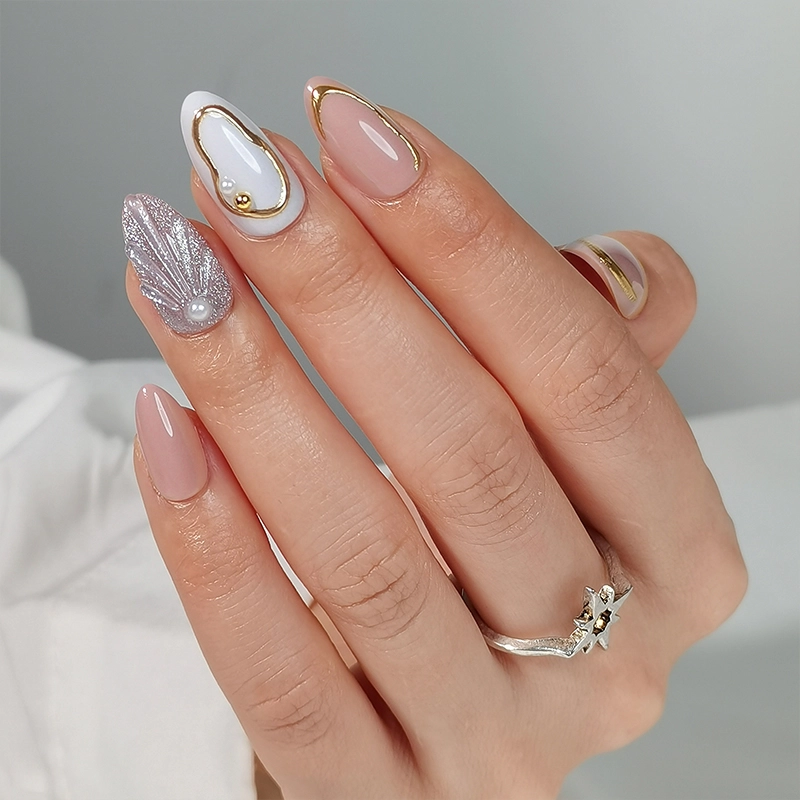
Wholesales Elegant Shell Inspired Soft Gel Wearable Nails for Seasonal Celebrations
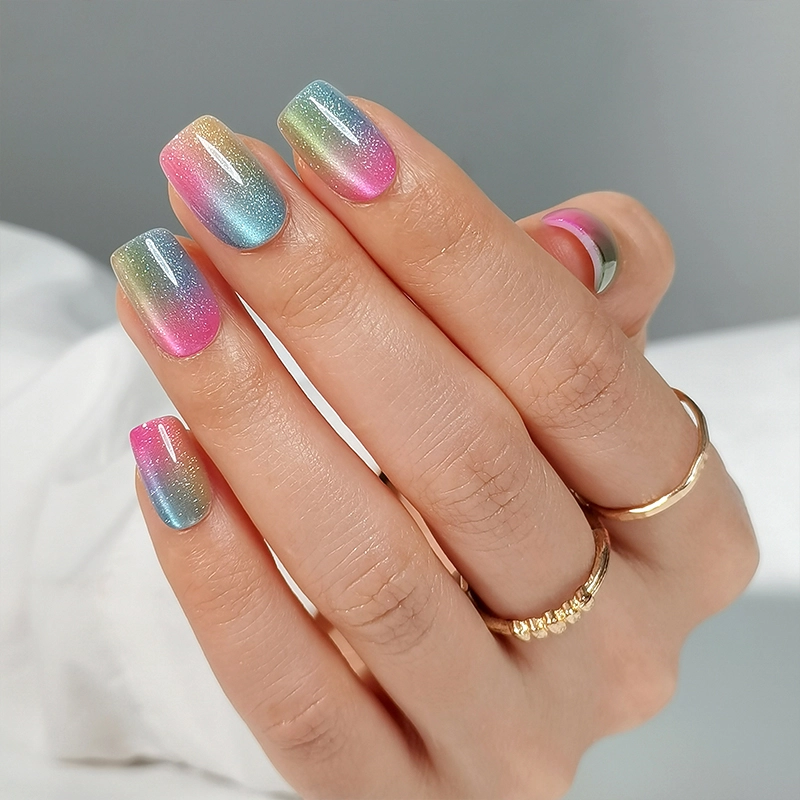
Custom Wholesale Gradient Cat Eye Soft Gel Wearable Fake Nails
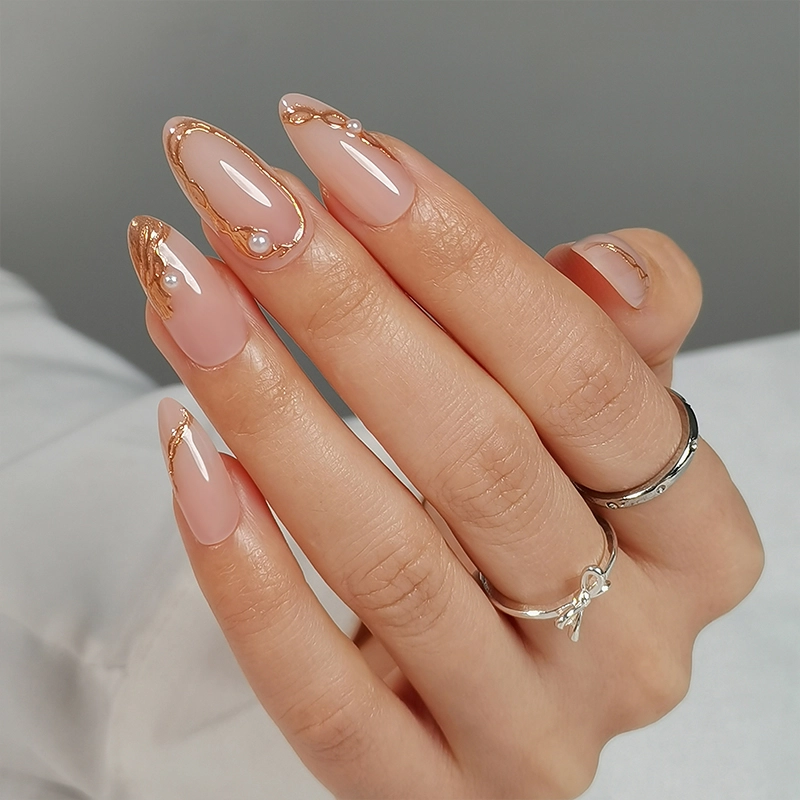
Wholesales Luxury Rhinestone Handmade Private Label Press On Nails Art Tips
Copyright © 2025 - XIANXING BEAUTY All Rights Reserved. Sitemap
Facebook
YouTube
Instagram
LinkedIn