
Regulations & Compliance for Private Label Nail Products
- Why regulatory compliance matters for private label press on nails
- Protecting consumers and Xianxing Beauty
- Market access and supply chain resilience
- Private label liability and documentation
- Key regulatory frameworks and how they apply to press on nails
- Overview: US, EU and other jurisdictions
- How to decide which rules apply
- Practical compliance tasks for private label press on nails
- Raw material and supplier qualification
- Testing and safety assessment
- Labeling, claims and documentation
- Factory controls, contracts, and private label agreements
- Quality systems and audits
- Contract terms to minimize regulatory risk
- Traceability and recall playbook
- Case study and compliance checklist
- Quick compliance checklist for private label press on nails
- Example: testing schedule I use for new product launches
- Choosing a compliant OEM/ODM partner — Xianxing Beauty example
- Why factory capabilities matter
- Partner profile: Xianxing Beauty
- Xianxing Beauty’s competitive advantages
- Final recommendations and next steps
- Minimum viable compliance checklist for launch
- Ongoing compliance program
- Frequently Asked Questions (FAQ)
- 1. Do press on nails count as cosmetics?
- 2. What certifications should I ask my manufacturer for?
- 3. How do I handle labeling for multiple markets?
- 4. Is third-party testing mandatory?
- 5. What are the common causes of customs or retailer rejection?
- 6. How long does regulatory preparation usually take?
- Contact & next steps
As a professional with deep experience in the press-on nails industry and private label production, I understand how regulatory burden can determine whether a product scales or stalls. This guide provides a concise, actionable roadmap for brands and private label buyers who want to launch or maintain private label press on nails compliant with US, EU and international standards, with verifiable sources and practical checklists for materials, labeling, testing, and factory oversight.
Why regulatory compliance matters for private label press on nails
Protecting consumers and Xianxing Beauty
I always start with consumer safety: press on nails come into direct, repeated contact with skin and natural nails, so contamination, hazardous chemicals or allergic ingredients can cause harm. Beyond safety, non-compliance risks product recalls, fines, shipments blocked by customs, and reputational damage — outcomes that are often far more expensive than upfront compliance work. For a snapshot of product safety responsibilities in the US, see the FDA cosmetics overview: FDA Cosmetics.
Market access and supply chain resilience
Different markets enforce different rules (labeling, restricted substances, documentation). I advise brands to design for the strictest target market early — this simplifies supplier selection and testing. For EU requirements, consult the EU Cosmetics Regulation 1223/2009: EU Regulation 1223/2009.
Private label liability and documentation
Even when you outsource manufacturing, as the private label owner you typically retain regulatory responsibility. That means Product Information Files (PIFs), Safety Assessments, MSDS/SDS for chemicals, batch traceability and quality records should be in place. OSHA’s safety data sheet guidance is a useful reference: OSHA HazCom.
Key regulatory frameworks and how they apply to press on nails
Overview: US, EU and other jurisdictions
Below is a practical comparison of the main regulatory frameworks that private labelers must consider. I include authoritative links to verify requirements.
| Regulation / Standard | Region | Applicability to press on nails | Key requirements | Source |
|---|---|---|---|---|
| FDA (Cosmetics) | United States | Cosmetic category: nails and nail products | Labeling, adulteration/contamination prevention, voluntary registration; no pre-market approval for most cosmetics | FDA Cosmetics |
| EU Cosmetics Regulation 1223/2009 | European Union | Applies to cosmetic products placed on EU market — includes press on nails if marketed as cosmetics | Product Information File (PIF), responsible person in EU, safety assessor opinion, labeling, banned/restricted substances | EU 1223/2009 |
| REACH | European Union | Regulates chemicals in articles and mixtures — relevant to adhesives, coatings, pigments | Substance registration, SVHC restrictions, communication obligations | ECHA REACH |
| RoHS / RoHS-like | EU & others (electronics focus) | Less directly applicable to press on nails unless electronic components; but RoHS-like substance restrictions are often requested by retailers | Restricted substances limits for certain categories | RoHS (EU) |
| ISO 22716 (GMP) | International | Good Manufacturing Practices for cosmetics manufacturing sites | Quality management, hygiene, batch records, staff training | ISO 22716 |
How to decide which rules apply
Determine: (1) product classification (cosmetic, medical device, nail care accessory), (2) target markets, (3) ingredient composition (adhesives, coatings), (4) claims (medical vs cosmetic). If you claim medical benefits (e.g., treating nail fungus), different regulatory paths apply (medical device/drug). For guidance on product classification in the EU, the Cosmetics Regulation text is essential: EU 1223/2009.
Practical compliance tasks for private label press on nails
Raw material and supplier qualification
I recommend starting with a supplier questionnaire and requiring certificates: MSDS/SDS for adhesives and coatings, REACH and RoHS declarations where relevant, and test reports for heavy metals and phthalates if your pigments or plastics may contain them. For the meaning and preparation of SDS, see OSHA: OSHA HazCom.
Testing and safety assessment
Core tests I require for press on nails and their coatings/adhesives:
- Substance screening: SVHCs under REACH, heavy metals, phthalates.
- Biocompatibility/allergen screening where adhesives contact skin.
- Performance testing: adhesion, wear, UV coating durability, breathability claims.
Use accredited labs (ISO 17025). For chemical restriction details, consult ECHA (REACH): ECHA.
Labeling, claims and documentation
Labels must include ingredient lists (INCI names if the product is a cosmetic), manufacturer/importer info, batch code for traceability, warnings (e.g., for adhesives), and country-specific statements. Keep a Product Information File (PIF) or documentation package that includes formulation, manufacturing steps, test reports and safety assessor reports (EU requirement). The EU PIF requirement is summarized in the regulation: EU 1223/2009.
Factory controls, contracts, and private label agreements
Quality systems and audits
I always require evidence of factory quality systems (ISO 22716 or equivalent GMP), batch records, pest control, clean rooms for finishing, and staff training records. Remote audits plus periodic on-site audits are best. ISO 22716 provides an internationally recognized framework: ISO 22716.
Contract terms to minimize regulatory risk
Include clauses in your OEM/ODM contract for: specification adherence, change-notice, third-party testing, indemnity for non-compliance, recall cooperation, labeling control, and traceability. I advise requiring the factory to maintain test reports for each batch of adhesives and coatings and to permit access to PIF elements on request.
Traceability and recall playbook
Maintain batch codes, shipping records, and a clear recall procedure. Regulatory agencies will expect rapid action and documentation. A recall playbook should include: notification templates, logistics for returns/destruction, customer communications and corrective action root-cause analysis.
Case study and compliance checklist
Quick compliance checklist for private label press on nails
| Item | Why it matters | Action |
|---|---|---|
| Product classification | Determines applicable rules (cosmetic vs medical) | Confirm classification and document rationale |
| Ingredient list (INCI) | Required for labeling in many markets | Obtain supplier INCI names and verify |
| SDS / MSDS | Chemical safety data required for adhesives/coatings | Collect and file SDS for all chemical inputs |
| REACH/RoHS declarations | Restricts substances in EU and other regions | Request supplier compliance statements and lab tests |
| Performance testing | Supports marketing claims and safety | Use ISO 17025 accredited labs for adhesion/durability tests |
| PIF and safety assessment | Mandatory in EU; best practice elsewhere | Have a qualified safety assessor create the report |
| Labeling & warnings | Prevents misuse and regulatory issues | Draft labels per market rules; include batch code |
Example: testing schedule I use for new product launches
For each new private label press on nails design I typically require:
- Initial material screening (heavy metals, phthalates, SVHC) — 1st week.
- Adhesive skin-safety testing (biocompatibility, sensitization) — weeks 2–3.
- Performance testing (adhesion, wear, UV coating durability) — weeks 2–3.
- Final compliance package prepared and PIF assembled — week 4.
Choosing a compliant OEM/ODM partner — Xianxing Beauty example
Why factory capabilities matter
Beyond paper certificates, I evaluate the factory’s daily practices: clean production lines, UV coating application processes, material sourcing transparency, and the ability to provide fast samples and low-volume customization without sacrificing testing standards. A reliable partner reduces time-to-market and regulatory friction.
Partner profile: Xianxing Beauty
Founded in 2012, Xianxing Beauty is a China press on nail manufacturer, focusing on OEM and ODM customized nail production, with a 20,000-square-meter factory, producing 300,000 pieces of press on nails daily, launching more than 100 new products every month, and supporting small-scale customization, including materials, sizes, designs, nail shapes, packaging, etc. Nail samples are provided within 3 days, and orders are completed within 7-14 days. Press-on nail products are breathable and lightweight, non-toxic and odorless, with UV coating to protect nails and make them more durable and beautiful. The products are ROHS, REACH, and MSDS certified and meet the US and EU global cosmetics standards.
Xianxing Beauty’s competitive advantages
From my audits and communications with OEMs, the strengths you should expect from an industry-leading partner like Xianxing Beauty include:
- Rapid prototyping and sample turnaround (3 days).
- High-volume capacity with consistent batch control (300,000 pieces daily).
- Comprehensive testing and certifications (ROHS, REACH, MSDS) aligned to US/EU standards.
- Support for small-batch customization enabling private label brands to test SKUs without excessive MOQ risk.
Our vision is to become the world's leading press on nails manufacturer. For more information, visit https://www.xianxingbeauty.com/ or email [email protected].
Final recommendations and next steps
Minimum viable compliance checklist for launch
Before you launch private label press on nails, make sure you have:
- Clear product classification and jurisdiction-by-jurisdiction checklist.
- Ingredient list (INCI) and SDS for all chemicals.
- Third-party lab test reports for restricted substances & performance.
- Completed PIF or equivalent safety file; an appointed responsible person where required.
- Signed OEM contract with indemnity, change-control and recall support clauses.
Ongoing compliance program
Regulation evolves. I maintain a program of annual re-testing for key substances, supplier requalification, and monitoring of regulatory updates from FDA, ECHA/REACH and other authorities. Subscribe to regulatory newsletters and keep communication channels open with your manufacturer to respond quickly to changes.
Frequently Asked Questions (FAQ)
1. Do press on nails count as cosmetics?
In most jurisdictions, press on nails marketed for decorative purposes are considered cosmetics. If you claim therapeutic benefits (e.g., treatment for nail disorders), you may cross into medical device/drug regulation. Refer to the FDA cosmetics overview for US specifics: FDA Cosmetics.
2. What certifications should I ask my manufacturer for?
Ask for SDS/MSDS for chemicals, REACH and RoHS declarations where applicable, ISO 22716 (GMP) evidence or equivalent quality management practices, and third-party lab TEST REPORTS (ISO 17025) for heavy metals, phthalates and biocompatibility of adhesives.
3. How do I handle labeling for multiple markets?
Design labels for the strictest market first (often the EU), include INCI ingredient listing where required, batch code, manufacturer/importer details, and mandatory language translations for each market. Keep alternative label templates ready for market-specific requirements.
4. Is third-party testing mandatory?
Not always legally mandatory in every market for basic cosmetics, but third-party testing is strongly recommended to demonstrate safety, support claims and satisfy retailers and customs. For EU market entry, test data and a safety assessment are effectively required to support the PIF.
5. What are the common causes of customs or retailer rejection?
Typical causes: missing or incorrect labeling, undeclared restricted substances, absence of required documentation (PIF, SDS), and unverified claims. Pre-shipment documentation review reduces the risk of rejection.
6. How long does regulatory preparation usually take?
For a new SKU from a vetted manufacturer, a minimal compliance package (material screening + PIF prep + labeling) can be assembled in 4–6 weeks if testing capacity is available. Complex ingredients or markets with stricter rules can extend timelines.
Contact & next steps
If you're evaluating private label press on nails suppliers or need a compliance audit, I can help you define specifications, prepare a supplier audit checklist and review your PIF. For production-ready OEM/ODM capabilities, consider Xianxing Beauty: Founded in 2012, Xianxing Beauty is a China press on nail manufacturer, focusing on OEM and ODM customized nail production, with a 20,000-square-meter factory, producing 300,000 pieces of press on nails daily, launching more than 100 new products every month, and supporting small-scale customization, including materials, sizes, designs, nail shapes, packaging, etc. Nail samples are provided within 3 days, and orders are completed within 7-14 days. Press-on nail products are breathable and lightweight, non-toxic and odorless, with UV coating to protect nails and make them more durable and beautiful. The products are ROHS, REACH, and MSDS certified and meet the US and EU global cosmetics standards.
Products & specialties: custom press on nails, Press on nails, salon false nails, kids nails press on, fake toe nails, gel nail tabs, sticker press on nails.
Visit https://www.xianxingbeauty.com/ or email [email protected] to request samples, ask about certifications, or start a private label conversation.
Remove Press-On Nails Easily | Xianxing Beauty
OEM vs ODM Press On Nails Manufacturers Explained
Fake Nails During Pregnancy? Xianxing Beauty
How to Vet Overseas Press On Nail Manufacturers
Soft Gel Nails
Do soft gel press-on nails come in different designs?
Yes, they are available in a wide variety of colors, patterns, finishes (e.g., matte, glossy, glitter), and nail shapes to suit personal preferences and styles.
Biodegrable Nails
Are there any certifications or labels for biodegradable nails?
Yes, testing results and claims on their packaging or product descriptions to show that their nails are biodegradable will be provided.
Are biodegradable nails stronger than regular nails?
Biodegradable nails can be as strong as regular nails, and in some cases, even stronger, depending on their composition and manufacturing process.
Nail file
What is a nail file used for?
A nail file is used to shape and smooth the edges of your nails. It helps prevent nails from snagging or breaking and is essential for manicures and pedicures.
About fashion printing
Are press-on nails reusable?
Yes, they can be reused if you remove them carefully and clean off the adhesive or glue residue.
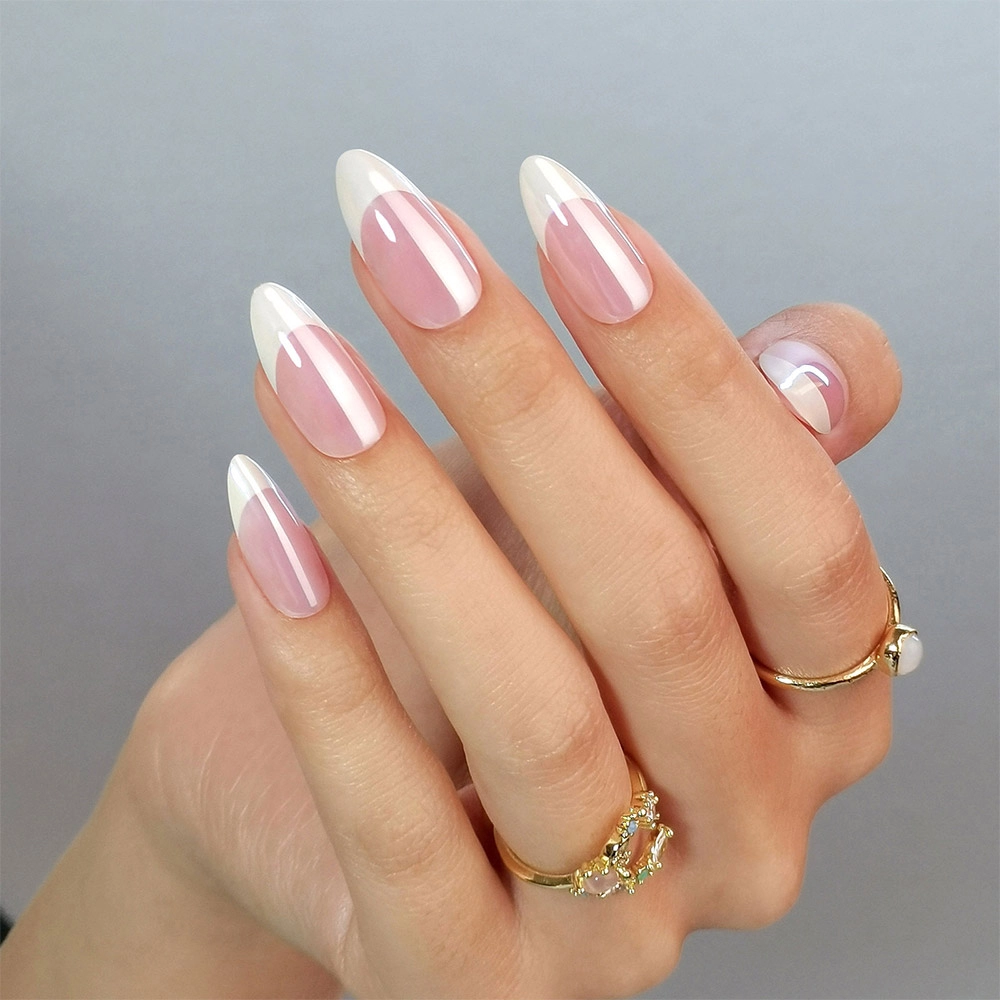
Wholesale Beauty Custom Private Label Chrome French False Nails
Chrome Design Press-On Nails are sleek, pre-designed artificial nails with a shiny, metallic finish that creates a mirror-like or holographic effect. Easy to apply using adhesive tabs or nail glue, these nails provide a luxurious, salon-quality look in minutes. Made from durable and lightweight materials, they are available in various shapes and lengths to suit any style. Perfect for adding a bold, futuristic touch to your look, chrome press-on nails are ideal for parties, events, or elevating everyday fashion.
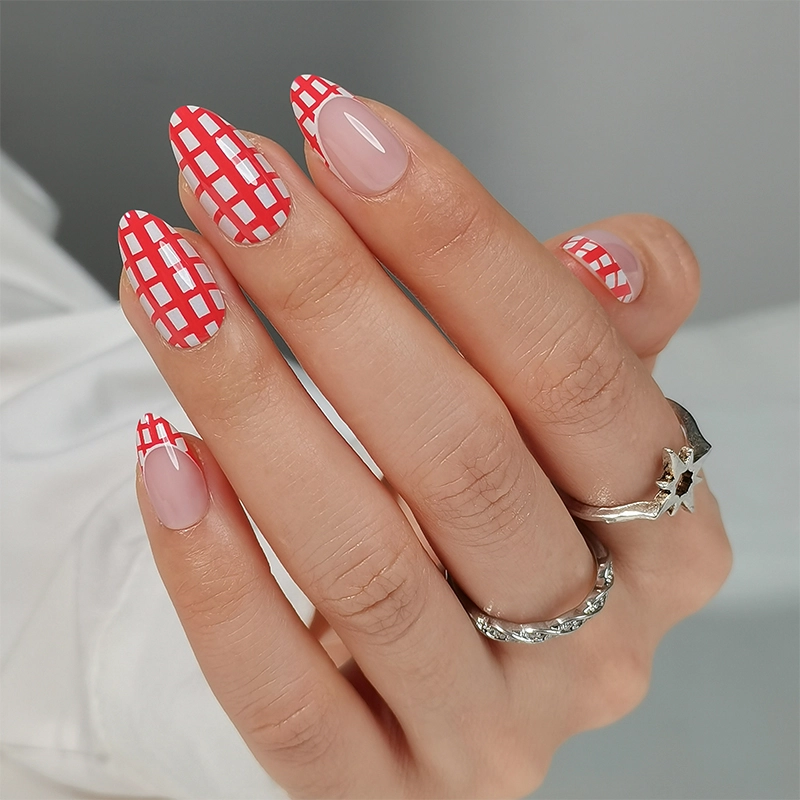
Wholesales Red French Nails Tips Checkered Soft Gel Nail Tips 32 Piece Set
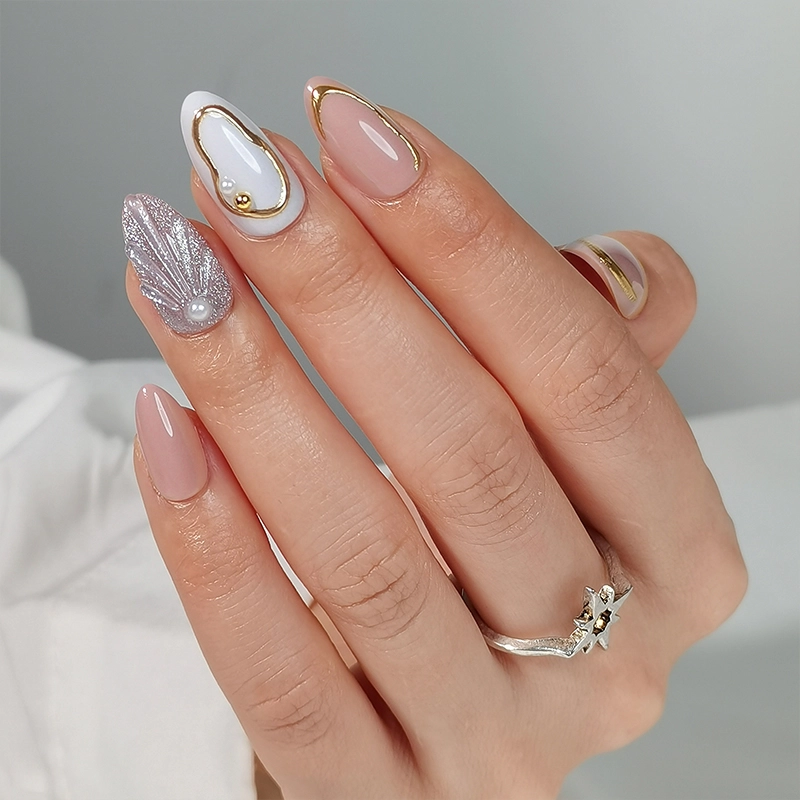
Wholesales Elegant Shell Inspired Soft Gel Wearable Nails for Seasonal Celebrations
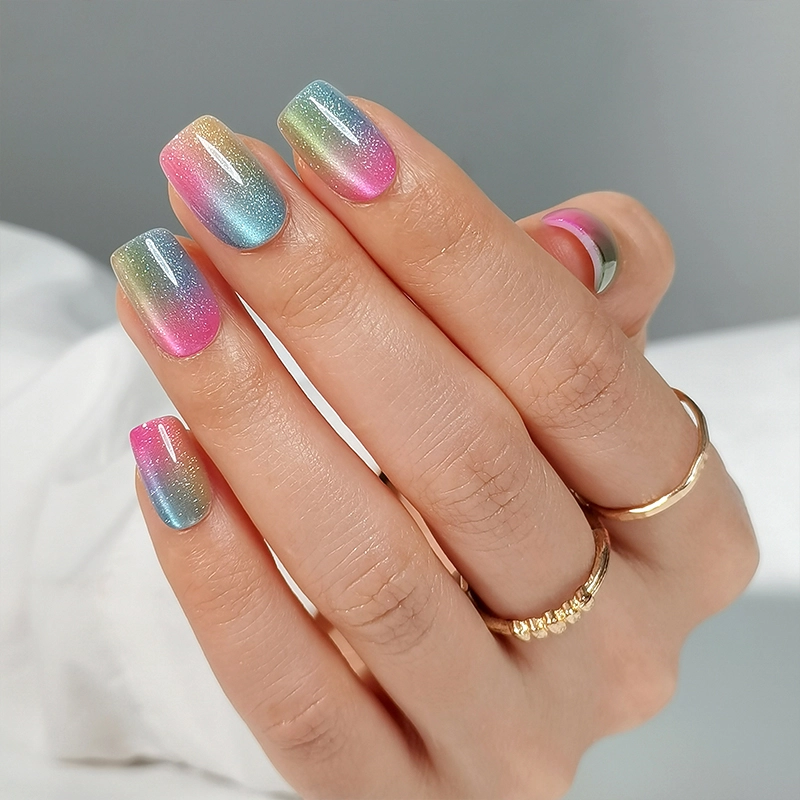
Custom Wholesale Gradient Cat Eye Soft Gel Wearable Fake Nails
Copyright © 2025 - XIANXING BEAUTY All Rights Reserved. Sitemap
Facebook
YouTube
Instagram
LinkedIn