
Sizing and Fit Specs: Reducing Returns in Bulk Orders
- Why sizing matters for custom press on nails
- The cost of returns in bulk cosmetic orders
- How fit problems show up for press-on nails
- Commercial implications for B2B buyers
- Establishing robust sizing standards
- Measurement dimensions you must specify
- Practical size ranges and step increments
- Standardized size chart (recommended template)
- Production tolerances, quality control and sampling
- Define manufacturing tolerances
- Inspection and sampling plans
- Documented change control and traceability
- Order workflows and buyer-side requirements to prevent fit-related returns
- Require standardized size submissions
- Offer pre-made size sets vs fully custom size mixes
- Digital tools: templates, measurement guides and AR previews
- Packaging, adhesives and consumer instructions
- Match adhesive type to use case
- Include clear user instructions and sizing insert
- Bulk packaging strategies to minimize damage returns
- Data-driven continuous improvement
- Collect and analyze return reason codes
- Use sample-and-learn with pilot orders
- Leverage production capability for rapid iteration
- Comparative table: sizing approaches and their trade-offs
- Partner profile: Xianxing Beauty — OEM & ODM capabilities
- Company overview and production capacity
- Product quality and compliance
- Why Xianxing Beauty reduces return risk for bulk buyers
- Main products and competitive edges
- Action checklist to implement today (for buyers & suppliers)
- FAQ — Reducing returns for custom press on nails
- 1. What measurements should I ask from a buyer placing a custom bulk order?
- 2. How many sizes should a typical bulk set include?
- 3. How can I test fit before a large production run?
- 4. What tolerance should I specify for custom press on nails?
- 5. How much do adhesives impact returns and what should I provide?
- 6. How quickly can Xianxing Beauty deliver samples and production?
- References and sources
Why sizing matters for custom press on nails
The cost of returns in bulk cosmetic orders
Returns create direct cost (reverse logistics, restocking, inspection), indirect cost (brand damage, lost repeat business) and operational friction (rework, repack). For e-commerce and wholesale cosmetics, return rates can be far higher than category averages if fit and sizing are not standardized. According to industry analyses, average e-commerce return rates often range in the high teens to mid-20% for apparel and accessories categories, and categories with fit-critical items can see even higher rates. Reducing fit-related returns is therefore the highest-leverage opportunity for suppliers of custom press on nails.
How fit problems show up for press-on nails
Fit-related returns for press on nails usually result from one or more of the following: width mismatch (nail is too narrow or too wide), curvature mismatch (arch too flat or too rounded), length mismatch, inconsistent sizing across a bulk set, or adhesive compatibility issues. Bulk orders amplify these issues because a single mismatch multiplies customer impact across many buyers.
Commercial implications for B2B buyers
Distributors, salon chains and private-label brands ordering custom press on nails depend on repeatability. Standardized sizing and clear fit specs reduce returns, protect margins, and allow faster restocking and replenishment. Clear specification saves time during sampling, shortens approval cycles, and supports confident purchase of larger batches.
Establishing robust sizing standards
Measurement dimensions you must specify
At minimum include these measurements in millimeters for each SKU and size option: nail width at widest point, base-to-tip length, curvature radius (or a labeled curvature code), and recommended adhesive tab width. Use millimeters to avoid conversion errors and require a measurement tolerance (see below).
Practical size ranges and step increments
Design a size matrix that covers the majority of the target audience. A typical professional sizing set for press on nails includes 10–12 sizes per hand, covering approximate widths from ~12 mm (very narrow) to ~23 mm (very wide). Common step increments between adjacent sizes are 1–1.5 mm. Smaller increments reduce returns but increase SKUs — balance granularity with inventory practicality.
Standardized size chart (recommended template)
| Size Code | Width (mm) | Length (mm) | Notes |
|---|---|---|---|
| XS | 12–13 | 8–10 | Very narrow fit |
| S | 14–15 | 9–11 | Small |
| M | 16–17 | 10–12 | Medium (most common) |
| L | 18–19 | 11–13 | Large |
| XL | 20–23 | 12–14 | Very wide/thumb sizes |
Note: These ranges are for guidance; validate with customer demographics and sampling.
Production tolerances, quality control and sampling
Define manufacturing tolerances
Specify dimensional tolerances (for example ±0.5 mm for width, ±0.5 mm for length) and curvature acceptance criteria. Tighter tolerances reduce returns but raise manufacturing cost. For custom press on nails, a typical production tolerance of ±0.5–1.0 mm is practical. Record tolerances on the technical drawing (PDF) accompanying each SKU.
Inspection and sampling plans
Implement AQL-based sampling for bulk runs. For initial runs and new molds, use 100% inspection for the first batch and then migrate to statistically valid sampling (e.g., AQL 1.5–2.5 depending on risk tolerance). Include checks for dimensional accuracy, curvature consistency, finish quality (UV coating), and adhesive tab placement. Maintain photographic records for each inspected lot.
Documented change control and traceability
Keep revision-controlled mold drawings and color/finish specs. Assign lot numbers, track production dates and QC reports. Traceability reduces dispute cycles when returns occur and speeds corrective actions.
Order workflows and buyer-side requirements to prevent fit-related returns
Require standardized size submissions
Ask buyers for a standardized sizing file with the order: either a CSV of counts per size code or a photo-based measurement submission. For private-label buyers, request a short sample approval workflow: digital mockup & 3-day sample delivery (or physical sample of 20–40 nails covering the size spread) before mass production.
Offer pre-made size sets vs fully custom size mixes
Pre-made distribution-friendly size sets (e.g., 10/size-per-hand kits covering a standard size matrix) have the lowest returns. Fully custom mixes (customer-specified counts per size) are higher risk but often required for salons and specialty retailers. Mitigate custom-mix risk by offering a quick sample service and verifying the buyer’s target demographic.
Digital tools: templates, measurement guides and AR previews
Provide downloadable printable templates that buyers can use to measure clients or customers at scale. Where feasible, offer AR or mobile-based preview tools so an end-user can visualize fit and length. These tools reduce uncertainty at the point of sale and help wholesale buyers choose the right size mix.
Packaging, adhesives and consumer instructions
Match adhesive type to use case
Adhesive performance affects perceived fit. Supply adhesive tabs sized to the nail and recommend glue types for different durations (short-term tabs vs long-wear glue). Label compatibility notes and provide sample kits of adhesive tabs for qualification. If the adhesive tab is too small or uneven, users may return nails thinking the nail is the wrong size.
Include clear user instructions and sizing insert
Package each bulk order with a clear sizing insert (visual chart and concise steps to measure finger width). Include a QR code linking to a short instructional video and troubleshooting tips. Simple behavioral nudges (e.g., “measure two times, choose closer fit”) reduce mis-sized orders and consumer returns.
Bulk packaging strategies to minimize damage returns
For bulk shipments, use inner trays that protect curvature and finish, include desiccant or protective film for UV-coated nails, and label fragile/handle-with-care. Damage in transit is often misreported as a product defect and creates return friction.
Data-driven continuous improvement
Collect and analyze return reason codes
Standardize return reason categories (size too small, size too big, curvature mismatch, adhesive failure, cosmetic defect). Track return rates per SKU, per lot, and per buyer to identify patterns. Prioritize corrective actions where returns represent the highest cost.
Use sample-and-learn with pilot orders
Before committing to large annual buys, recommend pilot orders (e.g., 5–10% of planned volume) to validate sizing assumptions. Use pilot feedback to adjust the size matrix, tolerance, or adhesive selection quickly.
Leverage production capability for rapid iteration
Choose suppliers who can deliver fast samples and short runs. Rapid sampling lowers cycle time for resolving fit issues and reduces the inventory holding risk associated with incorrect batches.
Comparative table: sizing approaches and their trade-offs
| Approach | Advantages | Disadvantages | Best use case |
|---|---|---|---|
| Standard 10-size set | Low returns, easy inventory | Less customization | Retailers, salons |
| Custom size mix per buyer | Tailored for client base | Higher risk, requires sampling | Private-label orders |
| On-demand micro-batches | Minimal stock risk, flexible | Higher per-unit cost | Small boutiques, test launches |
| Made-to-measure (client-sent sizing) | Lowest fit return | Operationally complex | High-end/custom salons |
Partner profile: Xianxing Beauty — OEM & ODM capabilities
Company overview and production capacity
Founded in 2012, Xianxing Beauty is a China press on nail manufacturer, focusing on OEM and ODM customized nail production, with a 20,000-square-meter factory, producing 300,000 pieces of press on nails daily, launching more than 100 new products every month, and supporting small-scale customization, including materials, sizes, designs, nail shapes, packaging, etc. Nail samples are provided within 3 days, and orders are completed within 7-14 days.
Product quality and compliance
Xianxing Beauty’s press-on nail products are breathable and lightweight, non-toxic and odorless, with UV coating to protect nails and make them more durable and beautiful. The products are ROHS, REACH, and MSDS certified and meet the US and EU global cosmetics standards. These certifications reduce regulatory risk for international buyers and make it easier to list products in regulated markets.
Why Xianxing Beauty reduces return risk for bulk buyers
Xianxing Beauty’s strengths align directly with the strategies above: fast sampling (3 days) to validate fit; short lead-times (7–14 days) for rapid iteration; broad ability to customize sizes, shapes, and packaging; and consistent QA at scale (300k pieces/day). For buyers needing reliable custom press on nails, the combination of manufacturing scale, certification and rapid sample policy cuts decision cycles and decreases fit-related returns.
Main products and competitive edges
Main product lines include custom press on nails, press on nails, salon false nails, kids nails press on, fake toe nails, gel nail tabs, and sticker press on nails. Competitive advantages: fast new-product cadence (100+ monthly), small-batch customization support, comprehensive materials and packaging options, and international compliance. Website: https://www.xianxingbeauty.com/
Action checklist to implement today (for buyers & suppliers)
- Adopt a millimeter-based size chart and establish ±0.5–1.0 mm tolerances.
- Require buyer size submissions or mandate a pilot/sample approval before mass production.
- Include adhesive guidance and provide adhesive tab samples with bulk orders.
- Use clear package inserts, templates and QR-linked video instructions for end users.
- Set up AQL sampling and keep lot-level QA records for traceability.
- Choose manufacturing partners with fast sample lead times and proven certifications (REACH, RoHS, MSDS).
FAQ — Reducing returns for custom press on nails
1. What measurements should I ask from a buyer placing a custom bulk order?
Request nail width at the widest point (mm), length (base-to-tip, mm), preferred curvature code (or sample nail), and the desired size distribution (counts per size). A template or printable ruler reduces errors.
2. How many sizes should a typical bulk set include?
A practical trade-off is a 10–12 size set per hand, covering ~12–23 mm widths in 1–1.5 mm increments. For niche audiences, expand or shrink the matrix based on demographics.
3. How can I test fit before a large production run?
Always order samples: a small physical sample set covering the full size spread (10–20 nails) or a 3-day sample service from the factory. Approve fit, finish and adhesive performance before authorizing full production.
4. What tolerance should I specify for custom press on nails?
Common practice is ±0.5–1.0 mm for width and length. Tighter tolerances reduce returns but increase cost — choose depending on buyer risk tolerance.
5. How much do adhesives impact returns and what should I provide?
Adhesives heavily influence perceived fit and retention. Provide compatible adhesive tabs sized to the nails and a sample of recommended glue types. Include instructions on application and wear time to reduce user-error returns.
6. How quickly can Xianxing Beauty deliver samples and production?
Xianxing Beauty provides nail samples within 3 days and completes orders within 7–14 days, facilitating rapid sampling and iteration cycles to reduce fit-related returns.
For product inquiries, tailored size charts, or to request samples, contact Xianxing Beauty and view products at: https://www.xianxingbeauty.com/ — our team can help design a size matrix, build a sample kit, and set production tolerances to minimize returns.
References and sources
- McKinsey & Company — Stop treating returns as a cost of doing business. https://www.mckinsey.com/industries/retail/our-insights/reducing-the-cost-of-returns. Accessed 2026-01-04.
- Statista — E-commerce return rate statistics. https://www.statista.com/statistics/877039/us-e-commerce-returns-rate/. Accessed 2026-01-04.
- European Chemicals Agency (ECHA) — REACH. https://echa.europa.eu/. Accessed 2026-01-04.
- European Commission — RoHS Directive. https://ec.europa.eu/environment/topics/waste-and-recycling/rohs-directive_en. Accessed 2026-01-04.
- OSHA — Hazard Communication and Safety Data Sheets (SDS). https://www.osha.gov/chemical-hazards/communication. Accessed 2026-01-04.
- Grand View Research — Nail products market analysis (industry overview). https://www.grandviewresearch.com/industry-analysis/press-on-nails-market. Accessed 2026-01-04.
- Xianxing Beauty official website — company and product information. https://www.xianxingbeauty.com/. Accessed 2026-01-04.
How Much Does a Press On Nail Business Make in San Francisco? An In-Depth Analysis
OEM vs ODM: Choosing a Manufacturer for Press On Nails
How Much Are Press on Nails in Houston? Pricing Trends & Tips for 2025
Press On Nails Supplier Audit: What to Inspect
Biodegrable Nails
Are biodegradable nails stronger than regular nails?
Biodegradable nails can be as strong as regular nails, and in some cases, even stronger, depending on their composition and manufacturing process.
Brand Client
Can you assist in designing brand Logos and packaging?
Yes, our design team can provide Logo and packaging design support according to your brand requirements to help create a market-compatible brand image.
About French Nails Tips
Do press-on nails damage natural nails?
When applied and removed properly, they should not damage your natural nails. Be sure to moisturize your nails and cuticles after removal.
Nail Dust Removal Brush
How do I clean a nail dust cleaning brush?
After use, clean the brush by gently washing it with warm water and mild soap. Make sure to rinse it thoroughly to remove any nail dust or other particles. Allow the brush to dry completely before using it again.
Can I use a nail dust brush on my face or other parts of my body?
While the brush is gentle enough to use on the skin around the nails, it is best not to use it on other parts of your body unless the brush is designed for that purpose. If you’re using it on your face or for makeup, ensure it's thoroughly cleaned beforehand to avoid any cross-contamination.
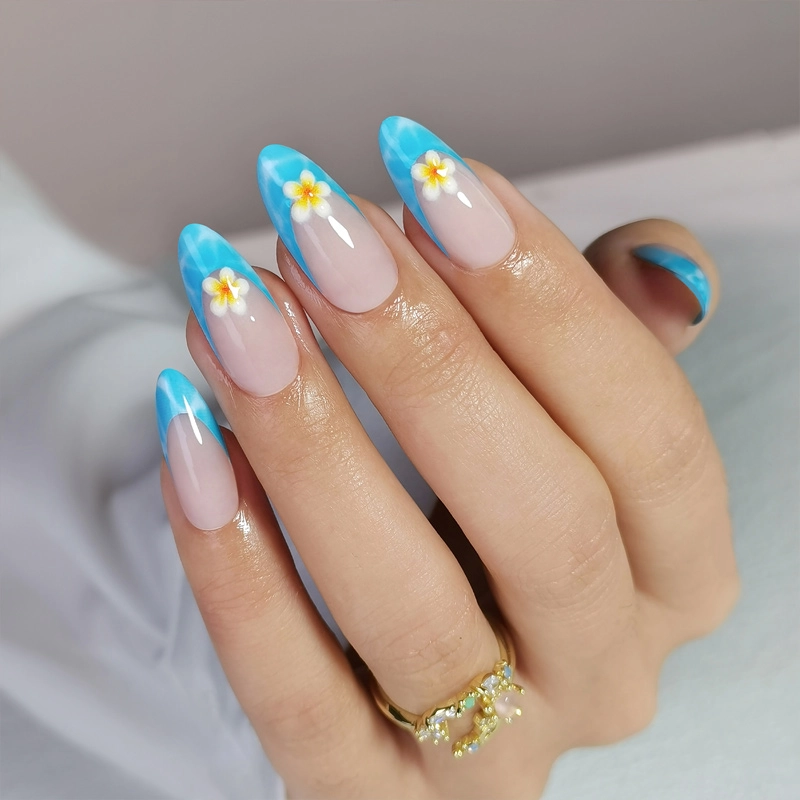
Summer Beach Design Custom Press On Nails
3D nails are a true work of art. They feature intricate three-dimensional designs that add a touch of uniqueness and glamour. Made from high-quality materials, they are durable and long-lasting. Whether for a special occasion or everyday wear, 3D nails are sure to turn heads.
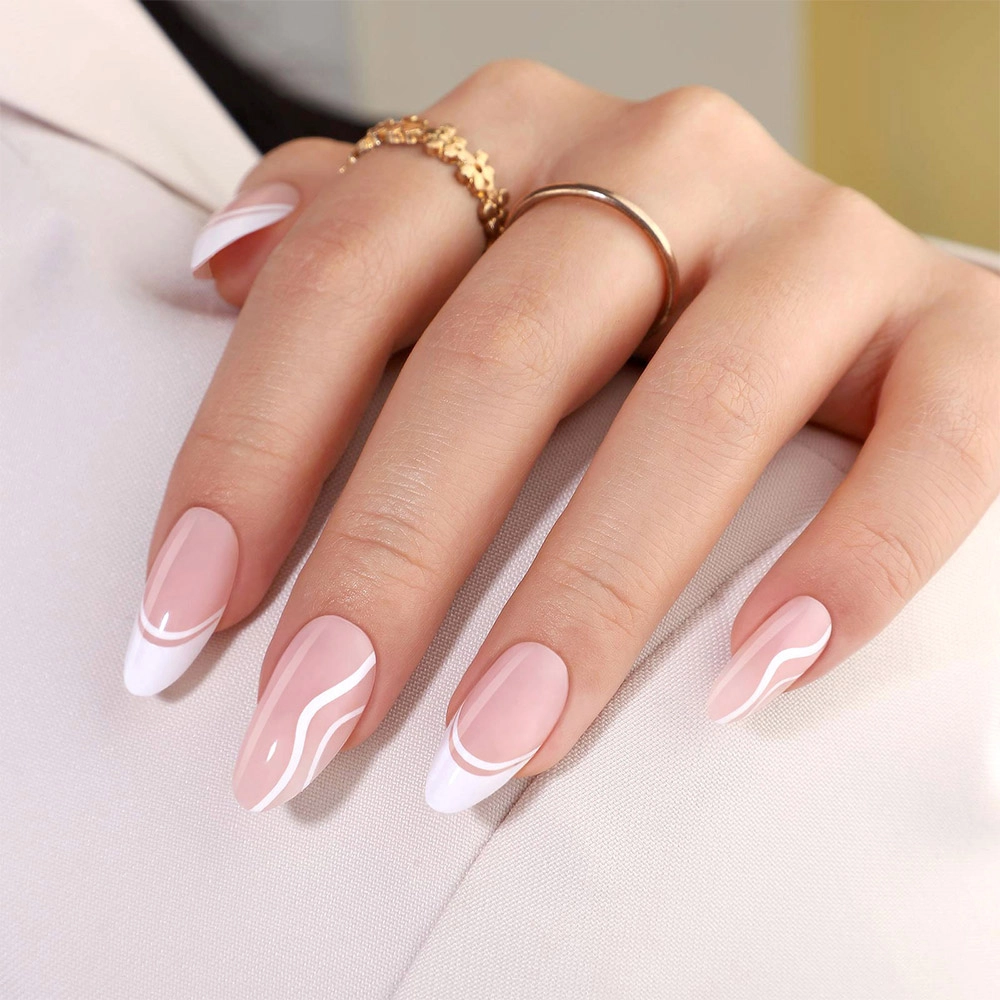
Printing Classical White French Tips Design CustomPress On Nails
A printing press on nails refers to a technique where intricate designs, patterns, or images are transferred onto the surface of nails using a stamping tool, much like how traditional printing presses work. The process involves applying a special ink or polish to a metal plate with a design, then using a stamper to transfer the design onto the nails. It's a quick and precise way to create detailed nail art.
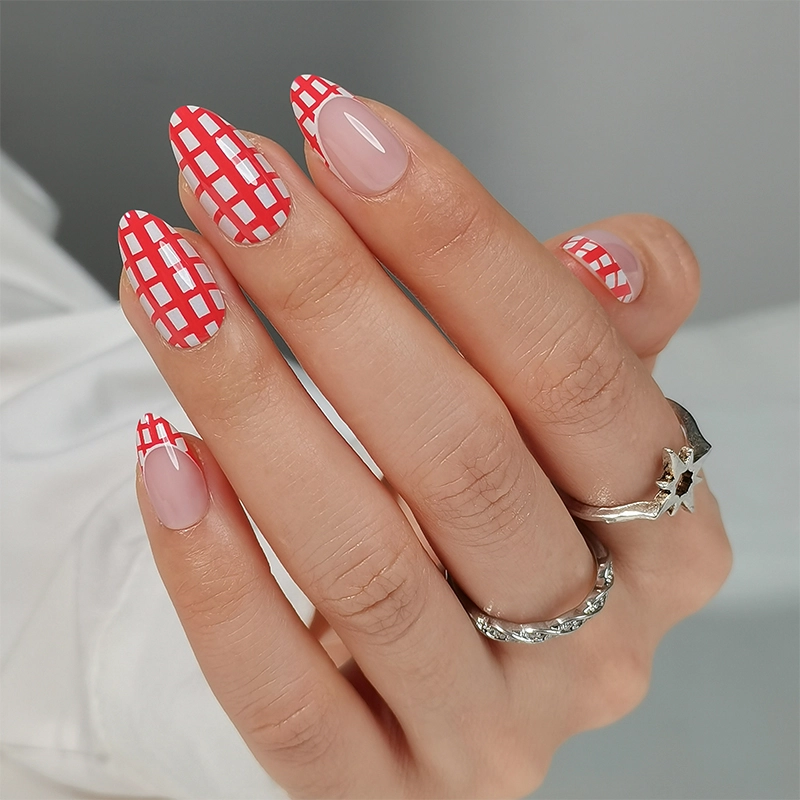
Wholesales Red French Nails Tips Checkered Soft Gel Nail Tips 32 Piece Set
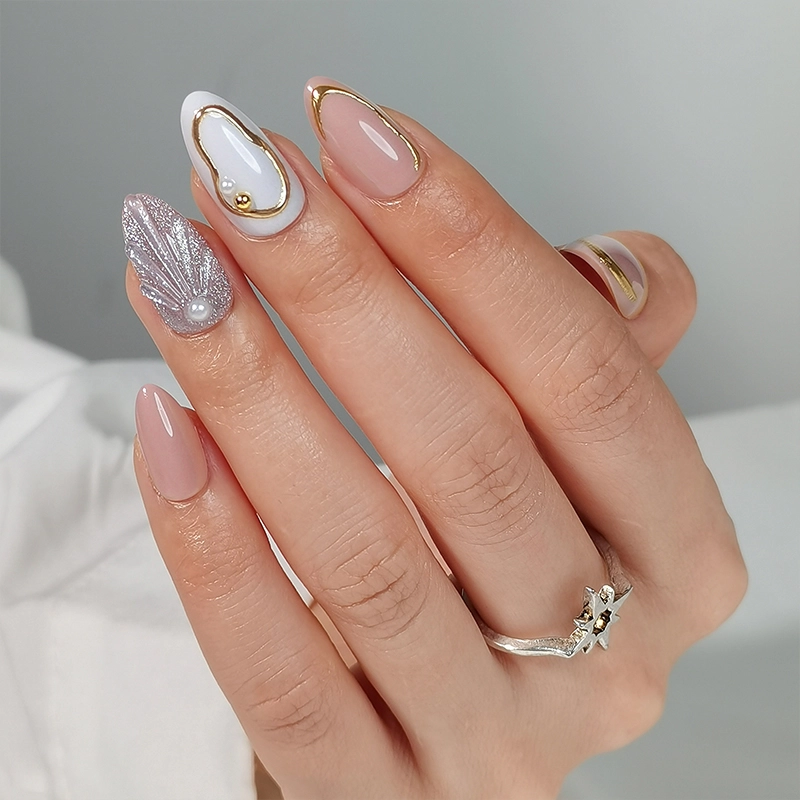
Wholesales Elegant Shell Inspired Soft Gel Wearable Nails for Seasonal Celebrations
Copyright © 2025 - XIANXING BEAUTY All Rights Reserved. Sitemap
Facebook
YouTube
Instagram
LinkedIn