
Common Christmas Press-On Nail Mistakes That Cause Lifting — and How to Avoid Them
Learn why Christmas press-on nails lift, crack, or fall off too soon — and how better prep, sizing, adhesive use, aftercare, and product quality can prevent these problems.
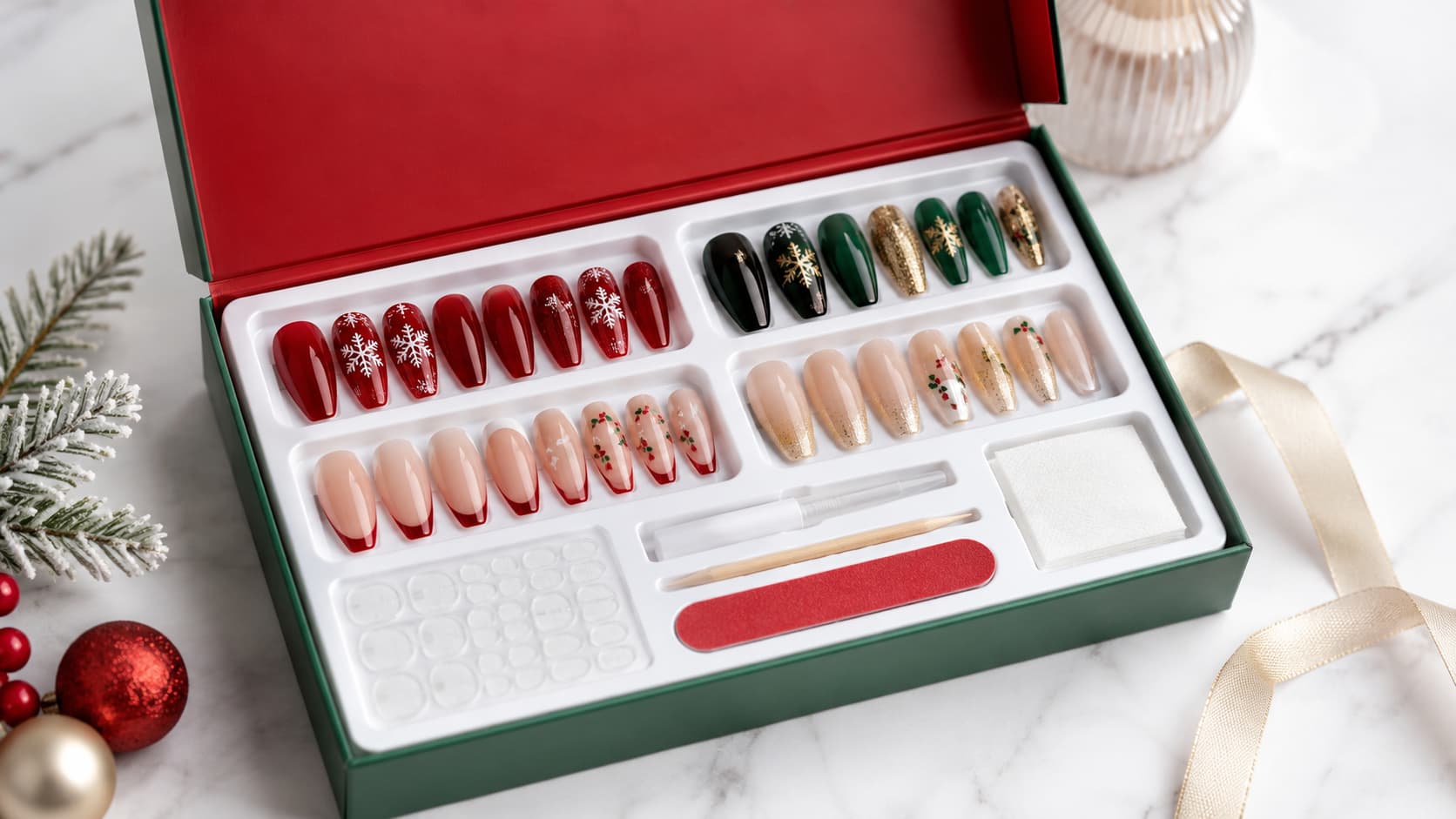
Christmas press-on nails can instantly complete a holiday look — but even the most beautiful set will lift, crack, or fall off too soon if small mistakes are made during prep or application. Most early failures are preventable with proper nail preparation, accurate sizing, and correct adhesive use. With correct sizing, proper nail dehydration, the right amount of adhesive, and some care during wear, a quality set can last through multiple parties and seasonal events without issue.
This guide walks through the most common mistakes at each stage — before application, during application, and during wear — and explains why each one matters. The final section covers what wholesale buyers and retail brands should understand about how product quality variables affect customer complaint rates.
Why Christmas Press-On Nails Lift or Fall Off
Most press-on nail failures come down to three root causes: the nail surface wasn't properly prepared before application, the fit wasn't accurate, or adhesive contact between surfaces was incomplete. Understanding which of these is responsible for a specific failure makes it easier to prevent.
Surface oils are the most common cause. Natural nail oils — produced continuously by the skin — create an invisible barrier between the nail plate and the adhesive. If the nail surface isn't fully dehydrated with an alcohol pad immediately before application, the adhesive bonds to the oil layer rather than the nail itself. That bond is weak and may start lifting within hours or days, even when the glue itself is strong.
Wrong sizing creates mechanical stress that defeats the adhesive. A press-on that's even slightly too wide sits on the skin at the edges rather than the nail plate. The adhesive at those edges bonds to skin rather than nail, the skin moves, and the edge begins lifting. A nail that's slightly too narrow doesn't cover the full nail plate surface, leaving unsupported edges that catch on things and lift.
Air pockets and uneven glue contact reduce effective bond area. If glue is applied too thickly, it can trap air bubbles between surfaces. If pressure isn't held long enough, the two surfaces never achieve full contact. Either outcome means the adhesive is only bonding across part of the nail surface area — which significantly reduces hold strength.
Application Mistakes That Shorten Wear Time
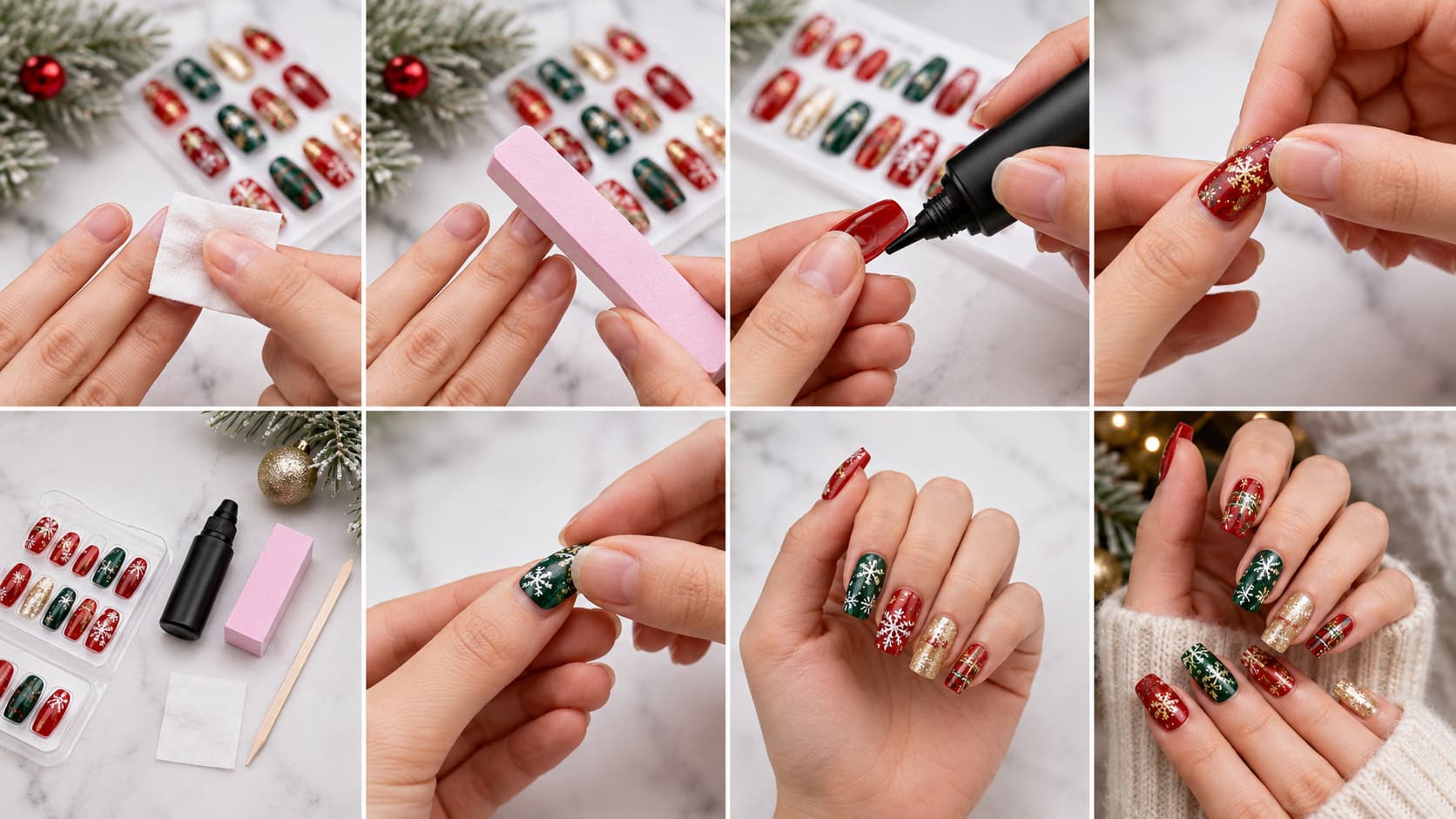
The following are the most common errors made during the prep and application stages, and what to do instead:
| Mistake | Why It Causes Problems | Better Practice |
|---|---|---|
| Skipping the alcohol wipe | Natural oils prevent adhesive from bonding to the nail plate | Wipe each nail firmly with an alcohol pad immediately before application; don't touch the nail surface afterward |
| Not buffing lightly first | Glue sits on a polished surface and can't grip evenly | Use a fine-grit buffer to remove surface shine; focus on center and edges, not the cuticle area |
| Choosing nails that are too wide | Creates side pressure and edge lifting within days | File press-ons to match natural nail width exactly — the fit should sit edge to edge without overlapping skin |
| Using too much glue | Creates air pockets and overflow to the cuticle; doesn't increase bond strength | Apply a thin, even layer to both surfaces — less than you think you need |
| Not pressing long enough | Adhesive hasn't achieved full contact with both surfaces | Hold firm even pressure for 20–30 seconds per nail; work from the cuticle edge toward the tip |
| Applying lotion before nails | Oils from lotion saturate the nail plate and block adhesive | Apply any hand cream before the preparation stage, never between prep and application |
| Getting nails wet within the first hour | Moisture interferes with adhesive curing | Keep hands completely dry for at least 60 minutes after application |
One small addition that makes a real difference: after pushing back cuticles and before buffing, check that each press-on nail matches the curvature of your natural nail bed — not just the width. A nail that's the right width but has a flatter curvature than your nail plate will only contact at the edges, not the center. Filing or gently warming the nail in warm water for a few seconds can adjust the curvature slightly for a better fit.
Daily Habits That Damage Christmas Press-On Nails
Once applied correctly, press-on nails are more durable than most people expect — but certain habits create the mechanical or chemical stress that causes even well-applied nails to fail.
Using nails as tools is the most common cause of unexpected mid-event loss. Opening champagne foil, tearing gift wrap, pulling ribbon, scraping stickers, and operating ring pulls all apply torque to the nail tip in the direction that separates the press-on from the nail plate. These forces are brief but concentrated at the tip — exactly where the adhesive bond is thinnest. The damage usually shows up as a lifting tip edge rather than the entire nail detaching immediately.
Prolonged water and chemical contact degrades adhesive over time. Brief hand washing during a party is fine. Extended soaking — dishwashing, bathing, reaching into ice buckets repeatedly — introduces moisture that works gradually under the seal at the nail edge. Cleaning products, particularly those containing alcohol, bleach, or strong surfactants, accelerate this process. Wearing gloves for dishwashing and cleaning during the holiday season preserves wear time significantly.
Ignoring a small lift makes it much worse. When an edge begins to lift and isn't addressed immediately, water and debris enter the gap during normal hand washing. This expands the lifted area, traps moisture, and can cause hygiene issues or skin irritation. Carrying a small tube of nail glue and sealing lifted edges immediately — pressing firmly for 20–30 seconds — can save a nail that would otherwise come off within hours.
The holiday season specifically creates several high-risk situations that don't exist during normal daily wear: cooking a Christmas meal, cleaning up after a party, unwrapping gifts, and wearing nails for consecutive multi-day events without a break. Being aware of these specific risks and taking simple protective steps — gloves for cleaning, using a tool or pad instead of a fingertip when tearing packaging — extends wear through the full Christmas period.
How to Avoid These Mistakes: The Full Correct Sequence
For reference, the complete correct application process in order:
-
Size match all ten nails before starting.
Lay out the set and confirm each fits correctly; adjust sizes by filing the sides where needed.
-
Push back cuticles gently.
Use a cuticle stick to clear the nail plate so the press-on can sit flush near the cuticle line.
-
Buff the nail surface lightly.
Use a fine-grit buffer to remove surface shine and create a better grip surface.
-
Wipe each nail with an alcohol pad.
Remove all oils and moisture, allow nails to dry completely, and do not touch nail surfaces after this step.
-
Apply a thin, even glue layer.
Apply glue to the natural nail and a second thin layer to the back of the press-on.
-
Position carefully and press.
Place the nail at the cuticle line first, press down toward the tip, and hold firm pressure for 20–30 seconds per nail.
-
Avoid water for 60 minutes.
Keep hands dry after completing the full set so the adhesive can cure properly.
When to Replace or Reuse Christmas Press-On Nails
Signs that a nail needs to be replaced or removed rather than repaired:
A nail with significant lifting across more than a third of its surface is past the point where re-gluing will hold effectively. The adhesive contact area that remains is too small, and attempts to re-glue typically result in a temporary fix that fails again quickly. Remove it properly — soak in warm water and ease off from the sides — and replace with a fresh nail.
Surface cracks, loss of gloss, or significant damage to 3D elements indicate the nail has reached the end of its usable life. Continuing to wear a cracked nail risks further breakage and potential sharp edges.
How to remove and store nails for reuse:
Soak fingertips in warm water for 5–10 minutes until the adhesive softens. Ease the nail off from the side edges using a cuticle stick — work slowly around the perimeter. Never peel from the tip; this pulls the interior surface of the nail and causes structural damage that makes it unusable for reapplication.
Clean adhesive residue from the inner surface with a cotton pad and acetone-free nail cleanser. Allow to dry fully, then store in a clean container — ideally the original tray — away from direct sunlight and heat.
With proper removal and storage, quality soft gel press-on nails can typically be reused 2–3 times. Nails with 3D embellishments such as rhinestones, charms, and snowflake studs should be inspected after each removal; elements that have loosened may not survive another application cycle.
A realistic expectation for reuse: quality press-on nails applied with nail glue typically last 7–10 days per wear. Some users achieve longer wear depending on adhesive method, nail prep quality, and activity level. Adhesive tabs allow for easier reuse but provide shorter wear per application, usually 1–3 days.
What Wholesale Buyers Should Check to Avoid Customer Lifting Complaints
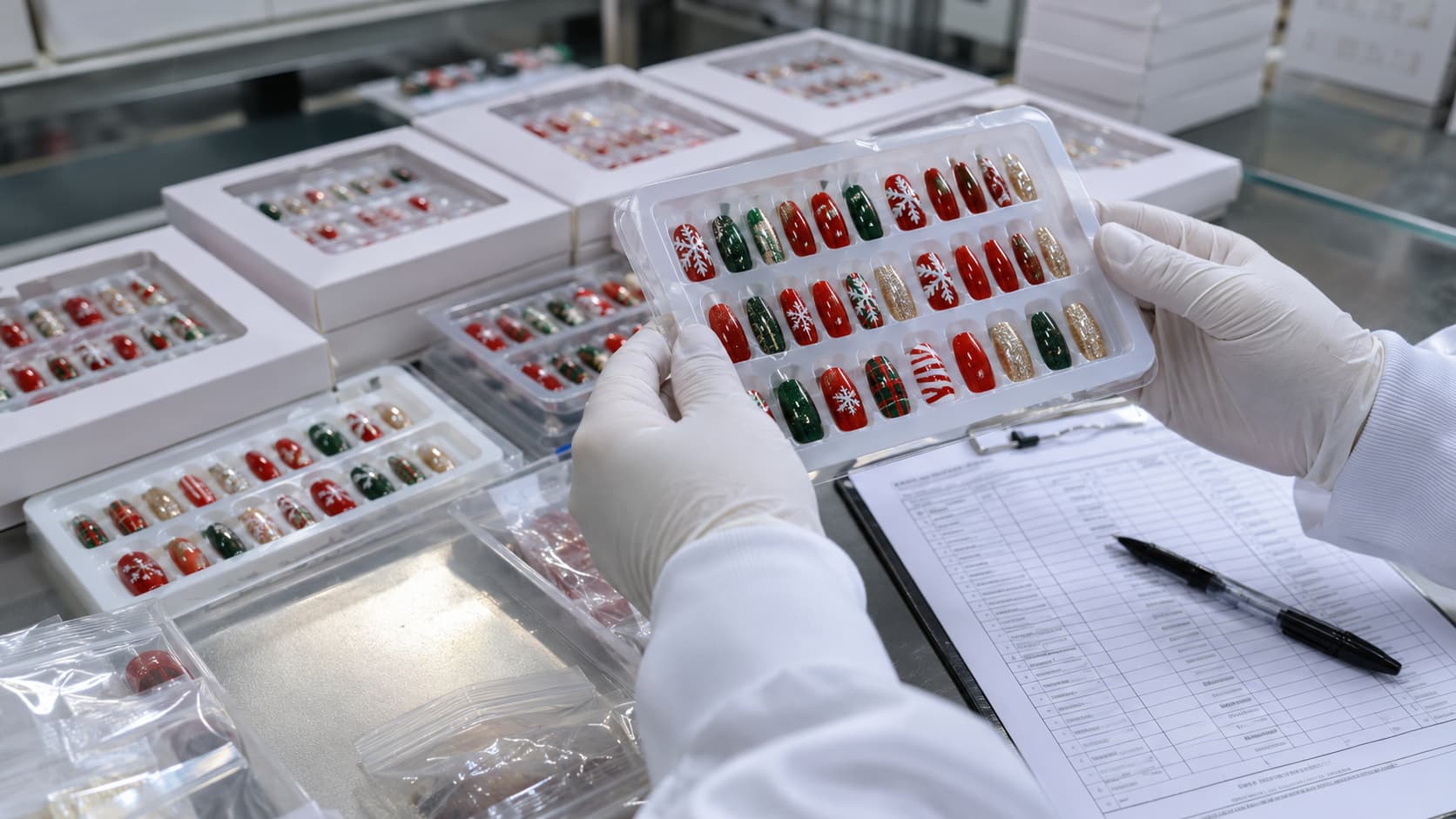
If your customers are consistently reporting early lifting despite following application instructions, the problem is likely at the product level. Understanding which manufacturing quality variables affect lift rates helps wholesale buyers choose products that reduce complaints and return rates.
Nail curvature accuracy.
Press-on nails that don't match the natural nail bed curvature at each width can only contact at the edges or at the center — not both simultaneously. This reduces effective bond area and causes lifting even with correct application. Manufacturers who produce multiple distinct curvature profiles across a full size range produce sets that hold better because the nail conforms to the natural surface more completely.
Inner surface texture.
The interior surface of the nail should have a fine texture rather than a completely smooth finish. Textured inner surfaces provide mechanical grip for adhesive in addition to chemical adhesion, which can help improve bond strength, particularly in conditions where moisture is present.
Dimensional consistency across production batches.
If size accuracy varies between orders, customers receive sets where the same size label fits differently than their previous purchase. This forces sub-optimal sizing decisions and increases lifting. Batch-to-batch consistency is a quality control discipline that varies meaningfully between manufacturers.
Material selection relative to product positioning.
Soft gel conforms to the nail bed more closely than rigid ABS because of its flexibility — this means greater surface contact and stronger effective adhesion at the edges. For sets positioned at mid-to-premium price points with wear time as a selling point, soft gel is the appropriate material choice. ABS is appropriate for value-tier volume products where price sensitivity is the primary constraint.
Adhesive and prep tool quality in kit sets.
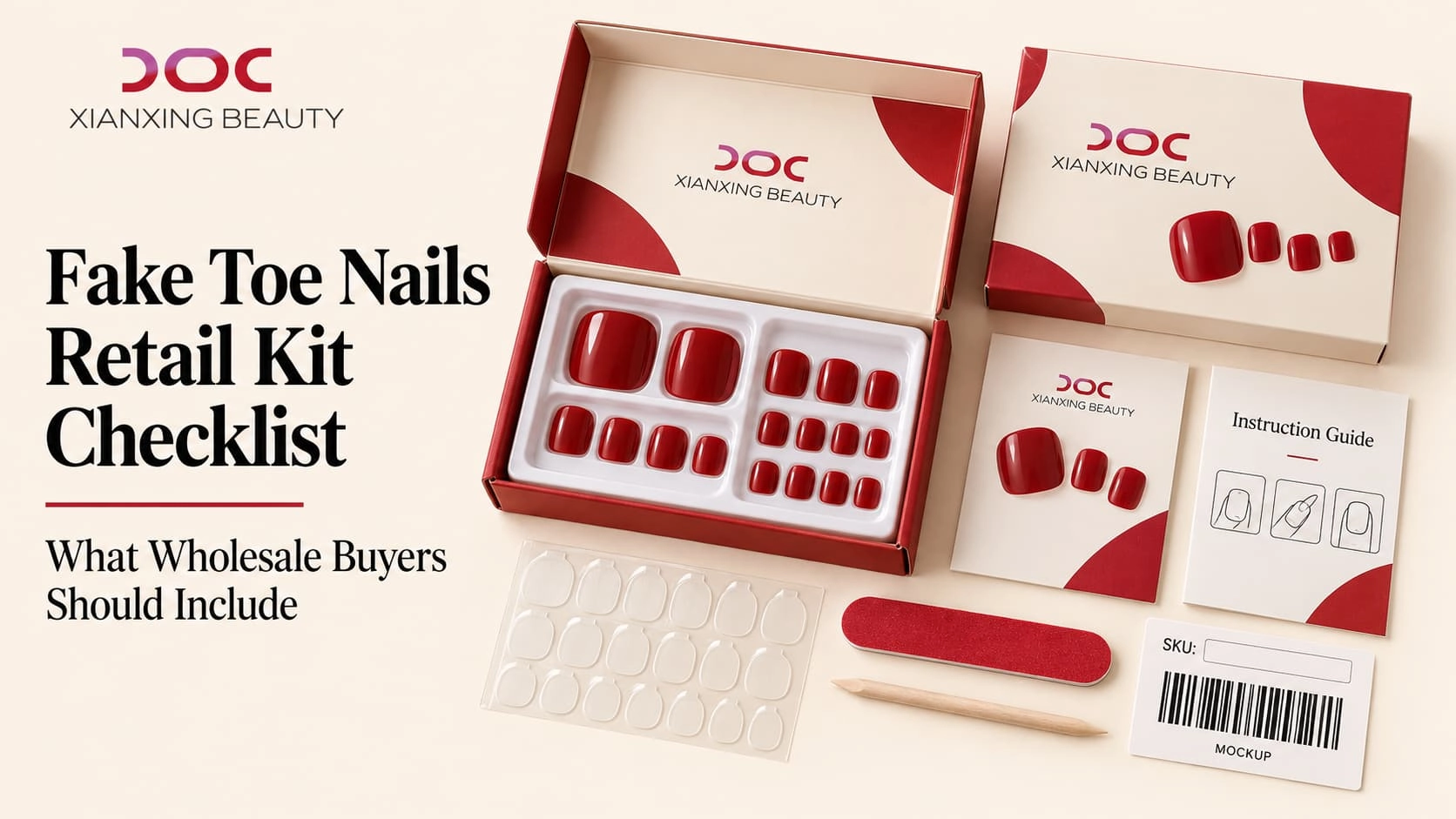
If the glue included with a nail kit is low quality — weak bond strength, yellows quickly, causes irritation — customer complaints will be attributed to the brand regardless of the nail quality. The same applies to prep pads: if the kit doesn't include an alcohol pad or equivalent dehydrator, a significant portion of customers will skip the dehydration step and experience early lifting.
Clear, specific application instructions.
The single most impactful low-cost product improvement for reducing lifting complaints is packaging instructions that specifically tell customers to wipe nails with an alcohol pad before applying glue — not just "clean nails." Most customers who experience early lifting have not properly dehydrated the nail surface. Instructions that make this step explicit and explain why it matters measurably reduce complaint rates.
Need Christmas press-on nail kits that reduce lifting complaints?
Xianxing Beauty can support soft gel, ABS, recycled ABS, custom sizing, nail curvature specifications, inner surface treatment, glue, prep pads, files, private label packaging, and pre-shipment QC for seasonal retail collections.
For brands developing Christmas press-on nail collections, Xianxing Beauty's OEM/ODM program covers material selection, nail curvature specifications, inner surface treatment, full kit configuration including glue, prep pads, and files, and custom packaging with complete application instructions. Contact our team with your collection brief for a production consultation.
FAQ: Christmas Press-On Nail Lifting, Reuse and Application Mistakes
Why do Christmas press-on nails fall off so quickly, even with glue?
The most common cause is incomplete nail dehydration — natural oils on the nail plate prevent the adhesive from bonding to the nail itself. The second most common cause is sizing: a nail that's even slightly too wide will lift at the edges. Both issues are fully preventable with proper prep.
Should I use glue or adhesive tabs for Christmas press-on nails?
Depends on the occasion. Adhesive tabs work well for a single evening event where you want easy removal and plan to reuse the set — typical wear time is 1–3 days. Nail glue provides a much stronger bond and is appropriate for extended holiday wear, travel, or multiple consecutive events — typical wear time is 7–10 days with proper prep.
Can I shower after applying press-on nails?
Not in the first hour — the adhesive needs at least 60 minutes to fully cure before water contact. After that, brief showers are generally fine. Prolonged soaking, such as baths, hot tubs, or extended dishwashing, degrades adhesive over time regardless of how long after application.
Can I reuse Christmas press-on nails?
Yes, quality sets are reusable 2–3 times when removed and stored properly. Soak in warm water, ease off from the sides with a cuticle stick, clean adhesive residue, and store in the original container. Adhesive tab application supports more reuse cycles than glue application because tabs leave less residue on the nail surface.
How do I fix a nail that's starting to lift?
Seal it as soon as you notice it — the earlier the better. Dry the area thoroughly, apply a small amount of nail glue under the lifted edge, press firmly for 20–30 seconds, and avoid water for 30 minutes. If more than a third of the nail surface has lifted, it's more effective to remove and replace than to re-glue.
Can Xianxing Beauty customize Christmas nail kits with glue, prep accessories, and private label packaging?
Yes — full kit configuration is part of the OEM/ODM scope, including nail glue, adhesive tabs, alcohol prep pads, mini nail files, and cuticle sticks, packaged under your brand with custom box design. This is available for Christmas collections and year-round products. Contact our team with your project details to discuss specifications and MOQ.
Facebook
YouTube
Instagram
LinkedIn