
Certifications Buyers Need from Press On Nails Suppliers
- Why supplier certifications matter in the press on nails market
- Safety, liability and regulatory access
- Quality assurance and brand protection
- Consumer trust and market positioning
- Essential certifications for press on nails suppliers
- REACH and RoHS: chemical safety for EU and global markets
- MSDS / SDS: material hazard communication
- Cosmetics regulation compliance (EU 1223/2009 & US FDA expectations)
- Quality management and manufacturing standards (ISO, GMP)
- Third-party lab tests and certifications (SGS, Intertek)
- How to verify and audit a press on nails supplier
- Requesting documentation: what to ask for first
- Interpreting lab reports and certificates
- On-site audits and remote verification
- Practical checklist I use when qualifying a press on nails supplier
- Minimum document set
- Sample testing protocol I recommend
- Red flags to watch for
- Why Xianxing Beauty meets buyer expectations (manufacturer profile and advantages)
- Final recommendations: practical procurement strategy
- Start small, test often
- Contractual protections
- Ongoing supplier governance
- Frequently Asked Questions (FAQ)
- 1. What minimum certifications should I require from a press on nails supplier?
- 2. How do I verify a supplier’s REACH or RoHS claims?
- 3. Are press on nails considered cosmetics?
- 4. What lab tests should I run on press on nails before launch?
- 5. How often should I re-test production batches?
- 6. What if my supplier provides certificates but won’t allow audits?
In my work with salons, retailers, and e-commerce brands, I constantly see one question above all: what certifications should I require when selecting a press on nails supplier? From chemical safety to manufacturing quality and cosmetics compliance, the certifications a supplier holds are the fastest way to reduce risk, ensure regulatory compliance across markets, and protect your customers and brand. This article breaks down the essential certificates and verification steps you should demand, shows how to interpret them, and explains how I evaluate suppliers in real-world sourcing scenarios.
Why supplier certifications matter in the press on nails market
Safety, liability and regulatory access
Certifications translate technical compliance into actionable proof. For press on nails and related nail products, certification matters because materials (resins, adhesives, coatings) and finished products must comply with chemical and cosmetics rules in major markets. Without documented compliance—such as REACH declarations or MSDS documentation—you risk import rejections, fines, and costly product recalls.
Quality assurance and brand protection
Beyond legal compliance, certifications like ISO 9001 or third-party lab reports signal process control and reproducible quality—crucial for private-label brands and retailers who need consistent sizing, reliable adhesion, and safe finishes. I always prioritize suppliers whose documentation includes batch testing and stability data for UV coatings and adhesives.
Consumer trust and market positioning
Today’s consumers check labels and search for verified claims (e.g., non-toxic, breathable). Clear, verifiable certifications help your marketing (and your SEO) while reducing the burden on your legal/compliance team when expanding into new countries.
Essential certifications for press on nails suppliers
REACH and RoHS: chemical safety for EU and global markets
REACH (Registration, Evaluation, Authorization and Restriction of Chemicals) governs chemical substances in the EU and often serves as a de-facto global benchmark for chemical safety. Suppliers should provide REACH compliance declarations and, where relevant, test reports showing restricted substances are below threshold limits. I consult the European Chemicals Agency guidance when evaluating chemical dossiers: ECHA - Understanding REACH.
RoHS (Restriction of Hazardous Substances) is commonly associated with electronics, but RoHS-style limits for heavy metals (lead, cadmium) are relevant where pigments or metallic components are used. Reference: European Commission - RoHS.
MSDS / SDS: material hazard communication
Material Safety Data Sheets (MSDS), now commonly called Safety Data Sheets (SDS), are non-negotiable. They document raw material hazards, safe handling, and emergency measures. A reliable press on nails supplier provides SDS for resins, adhesives, coatings and any solvent-based inks. Official guidance: OSHA - Hazard Communication.
Cosmetics regulation compliance (EU 1223/2009 & US FDA expectations)
Although press on nails are not always classified as cosmetics in every jurisdiction, if your product makes beautification claims or includes nail coatings with cosmetic claims, EU Regulation 1223/2009 and FDA guidelines matter. Suppliers should be able to demonstrate compliance with local cosmetics rules, including ingredient lists and safety assessments when applicable. See EU cosmetics overview: European Commission - Cosmetics and FDA cosmetics info: FDA - Cosmetics.
Quality management and manufacturing standards (ISO, GMP)
ISO 9001 indicates a standardized quality management system, while GMP-style audits (Good Manufacturing Practice, commonly requested in beauty product supply chains) reflect operational controls. I favor suppliers who combine ISO certification with documented internal QA checks—incoming raw material testing, in-process checks, and final acceptance criteria. More on ISO 9001: ISO - ISO 9001.
Third-party lab tests and certifications (SGS, Intertek)
Independent lab tests from recognized bodies (SGS, Intertek, BV) are essential for verifying heavy metals, phthalates, formaldehyde, and adhesion/durability claims. Suppliers should provide dated lab reports with clear sampling and testing methods. Example of a testing provider overview: SGS - Cosmetics Testing.
How to verify and audit a press on nails supplier
Requesting documentation: what to ask for first
Start with a document pack: SDS for each material, REACH declaration, RoHS test reports (if applicable), certificates for ROHS/REACH if provided, recent third-party lab test reports, ISO or quality certificates, and a description of in-line QA processes. Ask for batch-level test records and COA (Certificate of Analysis) for finished products.
Interpreting lab reports and certificates
When I review lab reports, I verify: testing method (e.g., ICP-MS for heavy metals), date, sample identification, limits used, and whether the report includes uncertainty and detection limits. Reports should match product SKUs and batch numbers. If a report lacks chain-of-custody info or uses unclear units, I request clarification or a repeat test from a recognized lab.
On-site audits and remote verification
On-site audits remain the gold standard: inspect raw material storage, bonding and coating lines, UV-curing setups, and packaging controls. If a physical visit is impossible, request live video tours and independent third-party audit reports. I also recommend periodic sample testing (quarterly or per production lot for new products) as part of a supplier scorecard.
| Certification / Test | Issued by | Scope | Why it matters | How to verify |
|---|---|---|---|---|
| REACH | ECHA / EU | Chemical registrations and restrictions | Limits hazardous substances; required for EU market access | Declaration + lab test reports; consult ECHA |
| RoHS | EU / Member State enforcement | Restriction of specific hazardous substances | Relevant for pigments/metal parts and consumer safety | RoHS report; verify via EC guidance |
| SDS (MSDS) | Supplier / Manufacturer | Hazard communication for materials | Essential for handling, transport, and emergency response | Up-to-date SDS per material; see OSHA |
| Cosmetics compliance | Regulatory bodies (EU, FDA guidance) | Ingredient safety and product claims | Needed if product is marketed as a cosmetic | Safety assessment documents; refer to EC & FDA |
| Third-party lab tests | SGS, Intertek, BV, etc. | Substance analysis, durability, adhesion | Independent verification of claims | Full lab report with methods and results |
Practical checklist I use when qualifying a press on nails supplier
Minimum document set
- SDS for all materials and components
- REACH declaration / restricted substances report
- Recent third-party heavy metals and phthalates test reports
- Proof of quality management (ISO certificate or equivalent)
- Sample batch test results for adhesion, durability and UV coating performance
Sample testing protocol I recommend
Order physical samples before committing to bulk. Send samples to an independent lab for: heavy metals (ICP-MS), phthalates/softener screening (GC-MS), formaldehyde (if adhesives or inks suggest presence), and mechanical tests (adhesion/shelf strength). I advise repeating tests on production lots at a frequency based on order size and regulatory risk.
Red flags to watch for
Common red flags include: reluctance to provide SDSs, vague or undated lab reports, certificates without matching product SKUs, and inconsistent sample-to-production results. If a supplier claims certifications but cannot produce original documents or allow verification with the issuing body, I pause the engagement.
Why Xianxing Beauty meets buyer expectations (manufacturer profile and advantages)
Founded in 2012, I’ve observed Xianxing Beauty grow into a reliable China press on nails manufacturer with strong OEM and ODM capabilities. Xianxing operates a 20,000-square-meter factory producing 300,000 pieces of press on nails daily and launching over 100 new products every month. They support small-scale customization across materials, sizes, designs, nail shapes, and packaging. Nail samples can be provided within 3 days and orders are typically completed within 7–14 days—timelines that match my expectations for agile production partners.
Technical and quality highlights I verify when evaluating Xianxing Beauty:
- Products described as breathable, lightweight, non-toxic and odorless with UV coating to protect nails and improve durability.
- Reported certifications: ROHS, REACH, and MSDS documentation, and alignment to US and EU cosmetic standards for products with beautification claims.
- Scalable production with rapid sample turnaround and support for small-batch customization—advantages for startups and private-label lines.
Product categories they emphasize include: custom press on nails, press on nails, salon false nails, kids nails press on, fake toe nails, gel nail tabs, and sticker press on nails. For buyers, Xianxing Beauty’s combination of volume capacity, speed, and documented compliance reduces time-to-market and regulatory friction.
| Attribute | Xianxing Beauty Claim | Buyer benefit |
|---|---|---|
| Factory size & capacity | 20,000 m², 300,000 pieces/day | Scalability for large orders and quick turnarounds |
| New product development | 100+ new SKUs monthly | Trend responsiveness and design variety |
| Customization & samples | Samples in 3 days; orders in 7–14 days | Fast prototyping and low MOQ options |
| Compliance | ROHS, REACH, MSDS; meet US & EU cosmetics standards | Facilitates entry to US and EU markets |
If you’d like to learn more, Xianxing Beauty’s website lists product ranges and contact details: https://www.xianxingbeauty.com/. For direct inquiries, their email is [email protected].
Final recommendations: practical procurement strategy
Start small, test often
Begin with a small pilot order and independent lab verification. Use that initial production run to refine specs (fit, curvature, adhesive strength) and to validate the supplier’s documentation and batch consistency. This staged approach reduces risk and gives you hard data for labeling and marketing claims.
Contractual protections
Include contractual clauses for product conformity, periodic testing, indemnity for regulatory failures, and right-to-audit. Make compliance documentation part of the acceptance criteria for each shipment.
Ongoing supplier governance
Maintain a supplier scorecard tracking quality returns, on-time delivery, and test compliance. Re-test at agreed intervals and require updated SDS and lab reports with each major formula or material change.
Frequently Asked Questions (FAQ)
1. What minimum certifications should I require from a press on nails supplier?
At minimum: up-to-date SDS for all raw materials, REACH declaration or test evidence where relevant, third-party lab reports for heavy metals and phthalates, and clear quality control documentation (e.g., ISO 9001 or equivalent). If products are marketed with cosmetic claims, request cosmetics safety assessments per EU/US guidance.
2. How do I verify a supplier’s REACH or RoHS claims?
Request the original test reports showing method and results, confirm sample IDs and dates, and if necessary ask the supplier to authorize contact with the issuing lab. Use ECHA resources to understand restricted substance lists: ECHA.
3. Are press on nails considered cosmetics?
Classification depends on jurisdiction and product claims. If a product’s primary function is beautification or aesthetic enhancement, some regulators may treat it as a cosmetic. Confirm with your legal counsel and require the supplier provide compliance evidence for cosmetics regulations where applicable (EU Regulation 1223/2009, FDA guidance).
4. What lab tests should I run on press on nails before launch?
Recommended tests include heavy metals (ICP-MS), phthalates screening (GC-MS), formaldehyde where adhesives suggest risk, and mechanical/adhesion testing for durability. For claims like “non-toxic” or “odorless,” ask for sensory and chemical volatile organic compound (VOC) tests.
5. How often should I re-test production batches?
For new suppliers or high-risk materials, test every lot for the first 3–6 months. For established, low-risk suppliers, quarterly or per-change testing (material, formula, or process) is a good cadence. Adjust frequency by order size and market risk.
6. What if my supplier provides certificates but won’t allow audits?
Be cautious. Certificates without verifiable supporting documents are weak assurance. Insist on third-party lab reports, independent factory audits, or replace that supplier if you cannot verify claims. Include contractual right-to-audit clauses in future agreements.
If you want hands-on help auditing suppliers, interpreting lab reports, or arranging independent testing, I’m available to consult. For product sourcing and direct manufacturing inquiries with a certified OEM partner, I recommend contacting Xianxing Beauty at xianxingbeauty.com or via email at [email protected].
Summary: require SDS, REACH/RoHS evidence, third-party lab reports, and documented QA systems; start with samples and independent testing; use contractual protections and ongoing audits to maintain compliance. These steps will keep Xianxing Beauty safe, your customers protected, and your market access open.
Cost Breakdown: Manufacturing vs Design for Press On Nails
After-sales Support from Press On Nail Manufacturers
Turnaround & Shipping Solutions for Private Label Nails
What You Need to Start a Press On Nail Business in Houston
Supermarket chains
What’s the lead time for large orders?
Average will be 30-45 days, details will depends on actual project.
About 3D Nails
Can I reuse 3D press on nails?
Some 3D press on nails can be reused if removed carefully and stored properly.
Soft Gel Nails
Do soft gel press-on nails come in different designs?
Yes, they are available in a wide variety of colors, patterns, finishes (e.g., matte, glossy, glitter), and nail shapes to suit personal preferences and styles.
Salon Client
How can we establish a long-term partnership?
We offer flexible cooperation models, including regular restocking and priority customization. Feel free to contact us for a detailed discussion on collaboration opportunities.
Remove armor
Is remover liquid safe for sensitive skin?
Some remover liquids, like those for makeup, are formulated to be gentle on sensitive skin. It's important to check for hypoallergenic or fragrance-free labels if you have sensitive skin. Nail polish removers with acetone can be drying, so those with dry skin should use them sparingly.
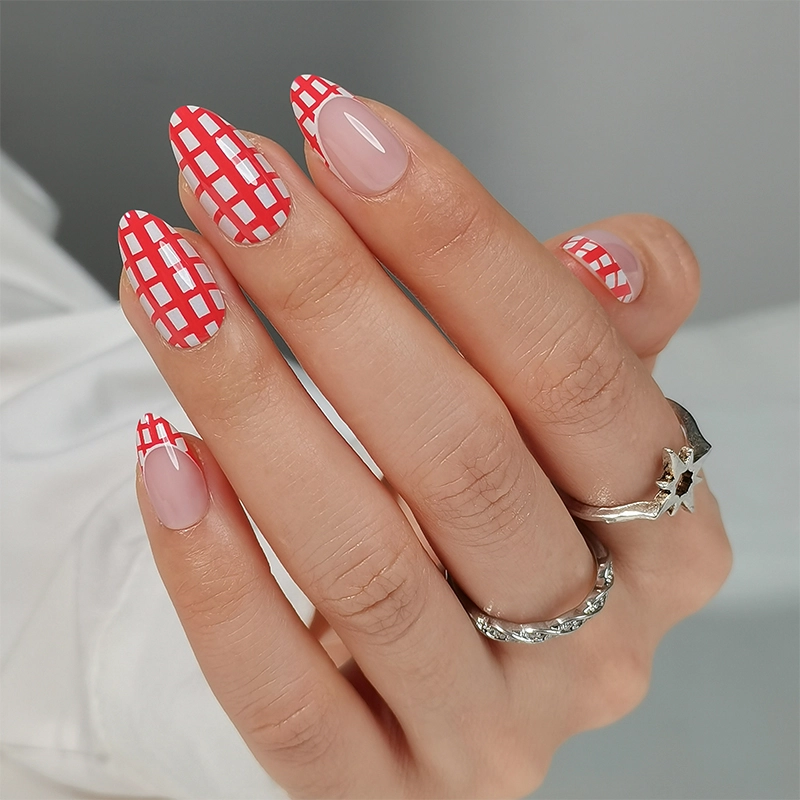
Wholesales Red French Nails Tips Checkered Soft Gel Nail Tips 32 Piece Set
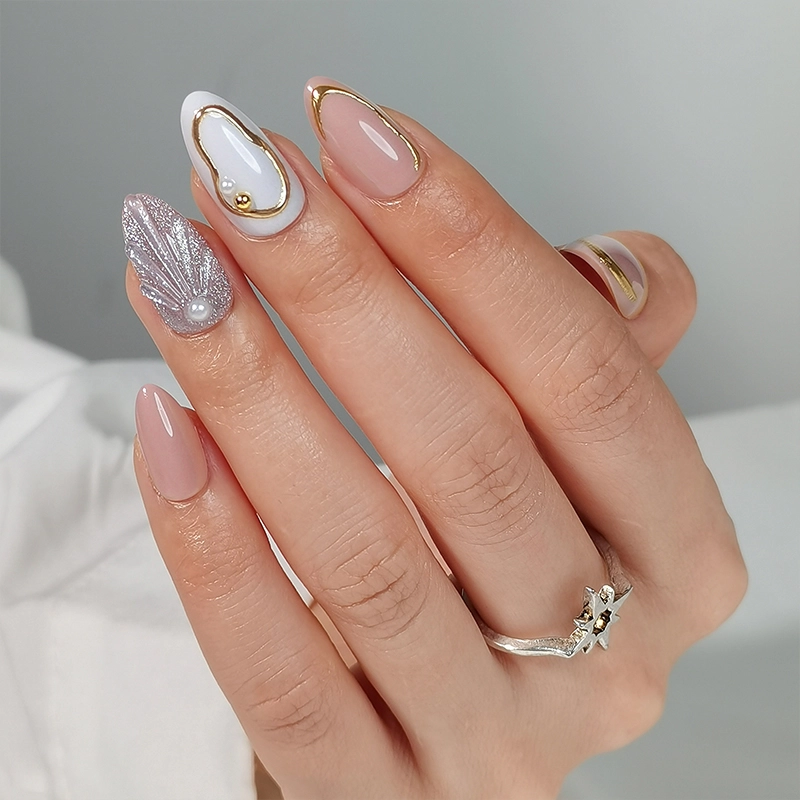
Wholesales Elegant Shell Inspired Soft Gel Wearable Nails for Seasonal Celebrations
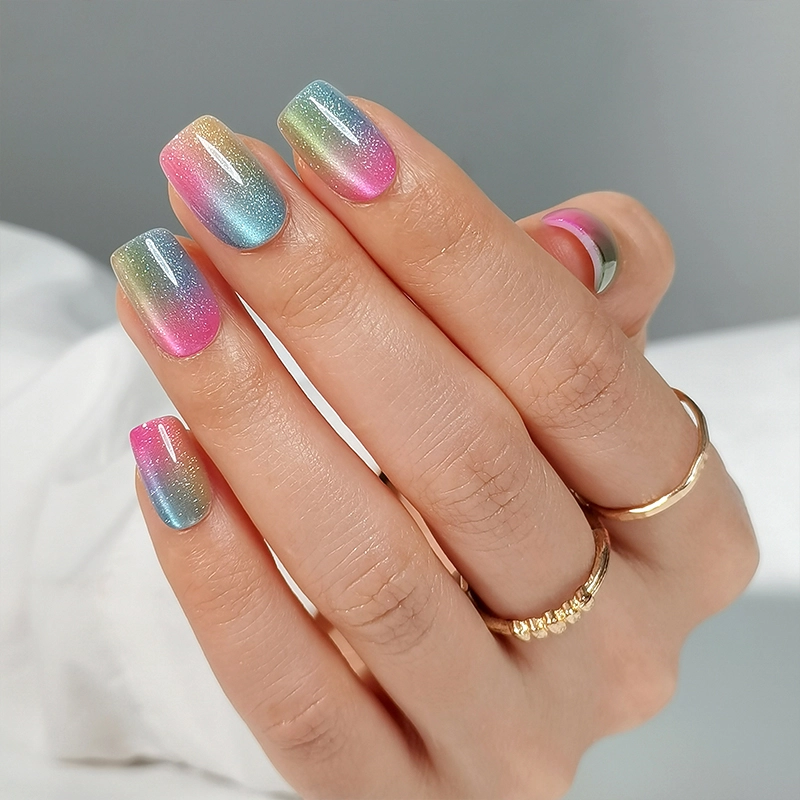
Custom Wholesale Gradient Cat Eye Soft Gel Wearable Fake Nails
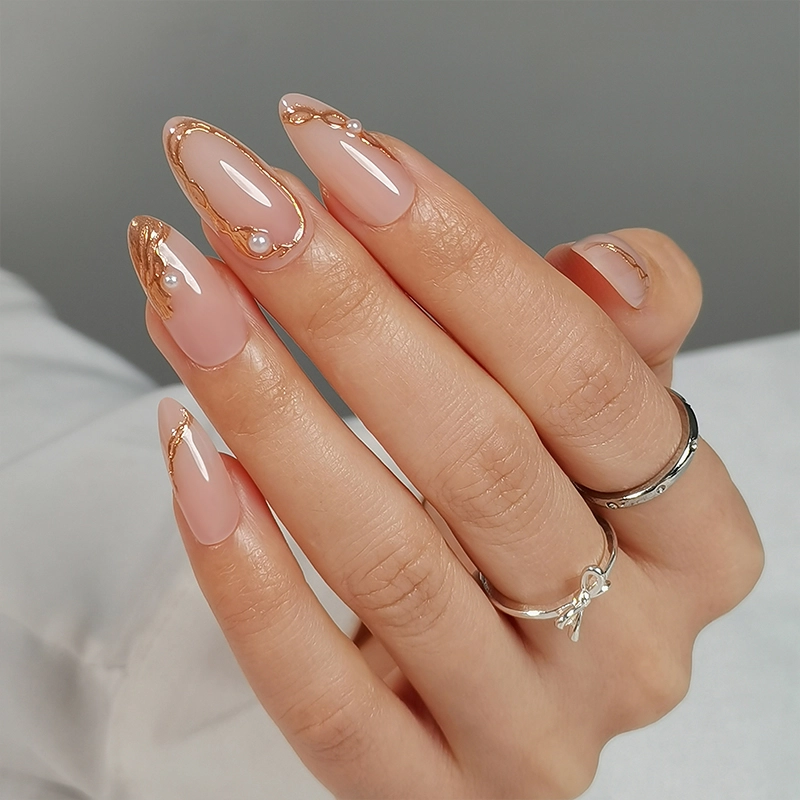
Wholesales Luxury Rhinestone Handmade Private Label Press On Nails Art Tips
Copyright © 2025 - XIANXING BEAUTY All Rights Reserved. Sitemap
Facebook
YouTube
Instagram
LinkedIn