
How to choose finish types for press on nails (matte/gloss)?
- 1. How do I create a repeatable finger-by-finger sizing system for custom press-on nails that minimizes returns and wasted stock?
- 2. What adhesive protocol (glue, adhesive tab, or combined systems) gives reliable long-wear for custom press-ons without increasing removal damage?
- 3. What is a safe, repeatable nail-prep routine (products and timing) to maximize bond strength without causing staining or long-term sensitivity?
- 4. How to choose between matte and gloss finishes for complex nail art (hand-paint, chrome, 3D rhinestones) so pieces look professional and last?
- 5. How to apply matte or gloss top coats over painted press-ons (acrylic or gel paint) to avoid bubbling, tackiness, or premature peeling?
- 6. What production workflow, minimum order quantities (MOQs), lead times, and price points should I set when scaling a custom press-on nail business for e-commerce?
Launching a custom press on nails line or choosing the right finish for client sets requires more than trends — you need a tested sizing system, repeatable prep and adhesive protocols, finish-compatibility with specific nail art, and a production workflow that protects quality and margins. Below are six detailed, practitioner-focused questions beginners often ask that frequently have incomplete answers online. Each answer gives step-by-step, evidence-based recommendations you can apply in product development, quality control, and e-commerce listings.
1. How do I create a repeatable finger-by-finger sizing system for custom press-on nails that minimizes returns and wasted stock?
Problem: Generic size sets (S–L) and one-off eyeballed sizing cause high return rates, unhappy customers, and inventory waste. Beginners need a system that produces consistent results across batches and helps customers choose the right size online.
Step-by-step solution:
- Standardize base measurements: Use width at the widest point (millimeters) and length from cuticle line to free edge. For material, ABS press-ons are industry standard for ease of shaping. Create a 10–11 size chart that maps to precise mm widths forThumb–Pinky (e.g., size 0 = 12.0 mm, size 10 = 22.0 mm). Keep all tooling and stamping tied to these mm targets.
- Produce a paper or reusable plastic sizing guide: Send or include a printable sizing chart customers can place over their nails to find exact fits. This reduces returns from mis-sizing on e-commerce platforms.
- Include optional in-set shaping allowances: For longer assemblies or coffin shapes, make a 'file-to-fit' margin of 0.5–1.0 mm at the lateral edge so wearers can customize without over-filing. Mark this in product instructions.
- Batch QC protocol: Measure a sample of 10% of each mold run with digital calipers at three points (base, mid, tip) and record in a batch log (date, mold ID, operator). If variance exceeds 0.5 mm, rework mold or scrap batch.
- Customer UX: Add a short sizing video demonstrating how to select sizes, plus recommended replacements (e.g., choose the next size down if between sizes), and promote a 'file-to-fit' tutorial.
Why this works: Defining exact mm-based sizes and tying production and customer instructions to that standard drastically reduces misfits and returns, a common pain point for custom press-on brands selling online.
2. What adhesive protocol (glue, adhesive tab, or combined systems) gives reliable long-wear for custom press-ons without increasing removal damage?
Problem: Beginners often copy one adhesive method that either gives excellent wear but hard removal (cyanoacrylate glue), or gentle removal but poor wear (adhesive tabs). Clients expect long wear with safe removal.
Recommendations and protocol:
- Offer three adhesion options in product listings: (A) Long-wear glue kit (cyanoacrylate) for clients who want 10+ days, (B) Adhesive tabs for short-term wear (1–5 days) and sensitive skin, (C) Dual-system (tab + thin bead of glue at nail tip only) for medium wear with gentler removal.
- Application protocol for best results: Prep natural nail (see Q3), size press-on correctly, apply tab or a thin line of glue at the base-to-middle of the press-on (not only at the tip), align cuticle line and press for 10–15 seconds. For gel-topped press-ons cured under LED, ensure no uncured gel is present at the contact surface.
- Glue selection: Use a quality cosmetic cyanoacrylate formulated for nails to reduce browning and brittleness. Include a small brush or nozzle to control application volume to avoid overflow onto cuticle skin.
- Removal guidance: For glue-removal recommend soaking in acetone or using professional removal wraps; for customers concerned about damage, the adhesive-tab or dual-system is preferable.
Why this works: Presenting adhesion as a choice and giving clear protocols reduces complaints and educates buyers on trade-offs between wear time and nail health.
3. What is a safe, repeatable nail-prep routine (products and timing) to maximize bond strength without causing staining or long-term sensitivity?
Problem: Many online guides either under-explain prep (just 'clean the nails') or recommend harsh primers and aggressive debridement that can irritate skin or thin the nail plate.
Balanced prep protocol:
- Step 1 — Clean: Remove polish/oils with 99% isopropyl alcohol or acetone if color present. Do not over-soak natural nails in acetone repeatedly; use minimal effective time.
- Step 2 — Dehydrate: Wipe nail plates with alcohol to remove surface oil. This improves bonding for both glue and adhesive tabs.
- Step 3 — Light buff: Use a 180–240 grit buffer to gently roughen the nail plate—only one pass on the center third of the nail. Avoid aggressive buffing at the cuticle or lateral folds.
- Step 4 — Primer: Use a non-acid primer designed for press-on or artificial nails when using glue or when adding a layer of builder gel near the contact zone. Acid-based primers are stronger but may be harsher; test on a small group before offering to clients.
- Step 5 — Final wipe: Alcohol wipe to remove dust and confirm surface is clean and dry.
Notes on safety and sensitivity: Document recommended times, minimize primer frequency, and include a warning for clients with prior allergic reactions to cyanoacrylates. Recommend adhesive-tab options for sensitive clients.
4. How to choose between matte and gloss finishes for complex nail art (hand-paint, chrome, 3D rhinestones) so pieces look professional and last?
Problem: Matte and gloss interact differently with pigments, chrome powders, and embellishments — mismatched choices often dull effects or reduce adhesion of rhinestones and decals.
Finish guidelines by art type:
- Hand-paint and fine-line art: Gloss finish usually enhances color saturation and depth, making fine lines pop. If you want a subtle, modern aesthetic, a matte top coat can soften contrast but risks muting intricate lines.
- Chrome and metallic powders: Use high-gloss, UV-cured gel top coats for best mirror effect. Matte top coats will dull chrome dramatically; avoid matte over full chrome unless the muted look is intentional.
- Rhinestones/3D embellishments: Apply a gloss or builder-gel mattified around stones but leave the stone base clear and encapsulate with a small bead of builder gel or gel adhesive cured under LED to lock stones in place. Matte top coats can reduce stone shine; balance with spot-gloss (gloss only on or around stones) for mixed-texture sets.
- Ombre/airbrush: Gloss preserves gradient vibrancy. Matte can look fashion-forward but test how pigments settle — some gradients show visible texture under matte.
Production tip: For mixed-finish sets, consider spot finishing during QC — apply matte top coat to specific panels and gloss to others. This increases perceived value and solves compatibility issues between embellishments and texture.
5. How to apply matte or gloss top coats over painted press-ons (acrylic or gel paint) to avoid bubbling, tackiness, or premature peeling?
Problem: Bubbles, tacky surfaces, and premature peeling are common when top coat chemistry, application thickness, or curing are suboptimal—especially when layers are too thick or curing is incomplete.
Best-practice application:
- Use compatible systems: If you use gel-polish pigments or builder gel, finish with a UV/LED gel top coat and cure fully per manufacturer times. For solvent-based nail lacquer, use a non-UV quick-dry top coat designed for lacquer.
- Thin, even layers: Apply thin coats (two thin coats are better than one thick coat). Thick layers are the most common cause of bubbling and incomplete curing.
- Cure control: Ensure LED/UV lamp wattage matches the gel top coat spec; underpowered lamps or crowded racks that block light will undercure top coats, causing tackiness. Verify cure by using a tack-free test strip.
- Environmental controls: Work in a dust-and-humidity-controlled area. High humidity and solvent saturation increase bubbling and bloom. Maintain ambient humidity below ~60% for consistent results.
- Surface tension and wipe: For gel top coats with inhibition layers, use the correct wipe solution (isopropyl alcohol for most) after final cure. For matte gel top coats, some brands leave a slight tack; ensure you use the brand-recommended wipe or post-cure regimen.
Troubleshooting: If bubbling occurs, note application speed, solvent strength, lamp power, and whether base layers were fully dry. Adjust one variable at a time to isolate the cause.
6. What production workflow, minimum order quantities (MOQs), lead times, and price points should I set when scaling a custom press-on nail business for e-commerce?
Problem: Many new brands set arbitrary MOQs and lead times that either block growth or create cashflow problems. You need a scalable workflow that balances inventory risk, kit customization, and predictable shipping to customers.
Operational roadmap:
- Begin with low-MOQ sampling: Produce small pilot runs (e.g., 50–200 sets per design) to validate art, finish (matte/gloss), and sizing acceptance before committing to larger MOQs.
- Defined lead times: Communicate realistic lead times for custom sets (e.g., 7–14 business days for custom-made sets; 1–3 days for stocked best-sellers). Buffer for QC and curing times, especially for UV-cured top coats and stone-setting.
- Pricing model: Calculate landed cost per set (materials: ABS nail blanks, pigments, glues/tabs, boxes, inserts; labor: shaping, painting, curing, QC; overhead and shipping). For e-commerce, typical retail multiples are 2.5–4x of landed cost depending on brand positioning; validate with competitor research.
- Scale with modular production: Separate slicing of tasks — one station for sizing & buffing, one for painting/art, one for top-coat curing, one for stone-setting and final QC. This reduces cross-contamination and speeds throughput.
- Inventory approach: Use a hybrid model — stock standard shapes and finish types (matte and gloss top coats available) but produce high-margin custom art on demand. This keeps MOQs for blanks low while offering customization for clients.
- Packaging & returns policy: Offer easy care and reapplication instructions in packaging. Have a clear returns policy for fit issues and a small reprint fee for bespoke designs; this mitigates losses from very-custom pieces.
Scaling tip: Track conversion from custom inquiries to paid orders and the average reorder interval; these metrics inform when to raise MOQs or invest in molds and tooling.
Conclusion — Advantages of custom press-on nails and smart finish selection
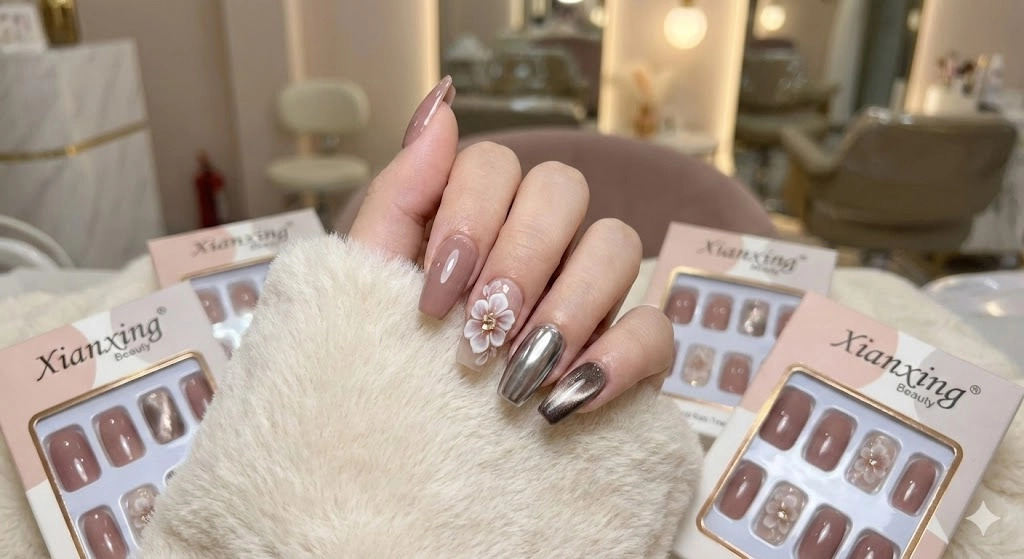
Custom press-on nails let brands deliver personalized sizing, exclusive art, and faster fulfillment than salon-only services. When you pair a rigorous sizing system, tested adhesive protocols, and deliberate finish choices (matte vs gloss) matched to the art technique, you deliver reliable wear, consistent aesthetics, and fewer returns — improving customer satisfaction and margins. Matte finishes create contemporary, subdued styles and hide micro-scratches, while gloss finishes maximize color depth and stone brilliance; mixed finishes (spot-gloss) can combine both advantages in one set.
If you want production-ready consultation, prototype development, MOQ planning, or turnkey manufacturing for custom press-on nails and finish selection, contact us for a quote: www.xianxingbeauty.com or [email protected].
7 Red Flags to Avoid When Selecting a Wholesale Press On Nails Manufacturer
Quality Control: What to Expect from a Top-Tier Wholesale Press On Nails Manufacturer
The Ultimate Guide to Choosing the Best Wholesale Press On Nails Manufacturer in 2026
How to Scale Your Beauty Brand: Why Private Label Press On Nails Are the Highest-Margin Entry Point in 2026
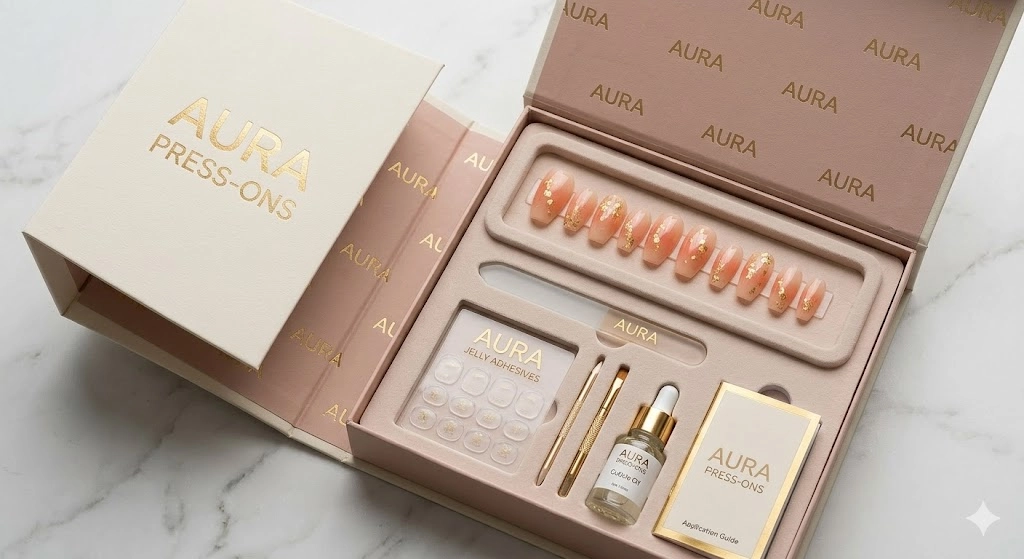
Why Partnering with Professional Press On Nails Manufacturers Boosts Your Brand Growth
Nail Dust Removal Brush
Can I use the same brush for my nails and other surfaces?
Ideally, the nail dust cleaning brush should be dedicated to cleaning nails only, especially if you're doing professional nail services. Using the same brush for multiple purposes might transfer dust or debris onto the nails, leading to potential contamination.
Crystal spike
How long do Crystal Point Sticks and Wooden Sticks last?
Crystal Point Stick: With proper care, a crystal stick can last for many years. The tip will likely remain sharp and effective unless it’s dropped or damaged.
Wooden Stick: Wooden sticks typically last for a good amount of time but can wear down more quickly due to splintering, especially if used frequently.
Remove armor
Are remover pads reusable?
Most remover pads are single-use, but there are reusable options on the market. However, it's important to wash reusable pads regularly to maintain their effectiveness.
About Christmas Nails
How do I remove them without damaging my natural nails?
Do not rip or pry them off! This can take layers of your natural nail with it.
1. Soak your nails in warm water for 10-15 minutes. You can add oil or soap to help break down the adhesive.
2. Gently slide a cuticle stick or orange wood stick under the side of the press-on to loosen it. It should pop off easily.
3. If there's stubborn glue left on your natural nail, gently buff it off or soak it again.
Always follow up with cuticle oil to rehydrate your nails and skin.
How do I choose the right size?
Most kits come with 10-16 sizes. The best practice is to lay out all the sizes and match them to your fingers beforeyou apply any glue. The press-on should cover your natural nail from sidewall to sidewall without overlapping onto your skin. If it's slightly too wide, you can gently file the sides to get a perfect custom fit.
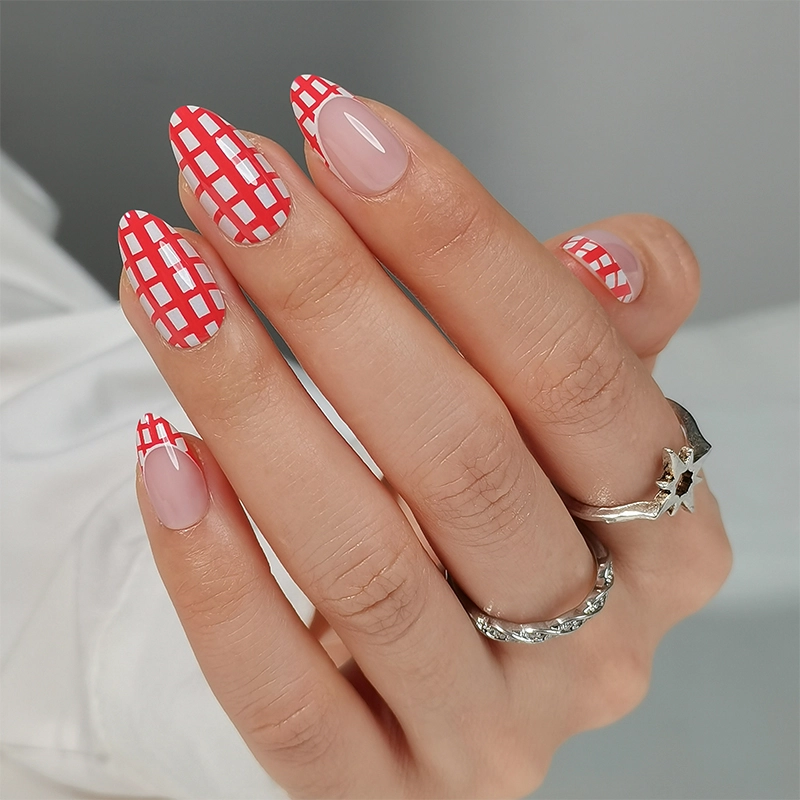
Wholesales Red French Nails Tips Checkered Soft Gel Nail Tips 32 Piece Set
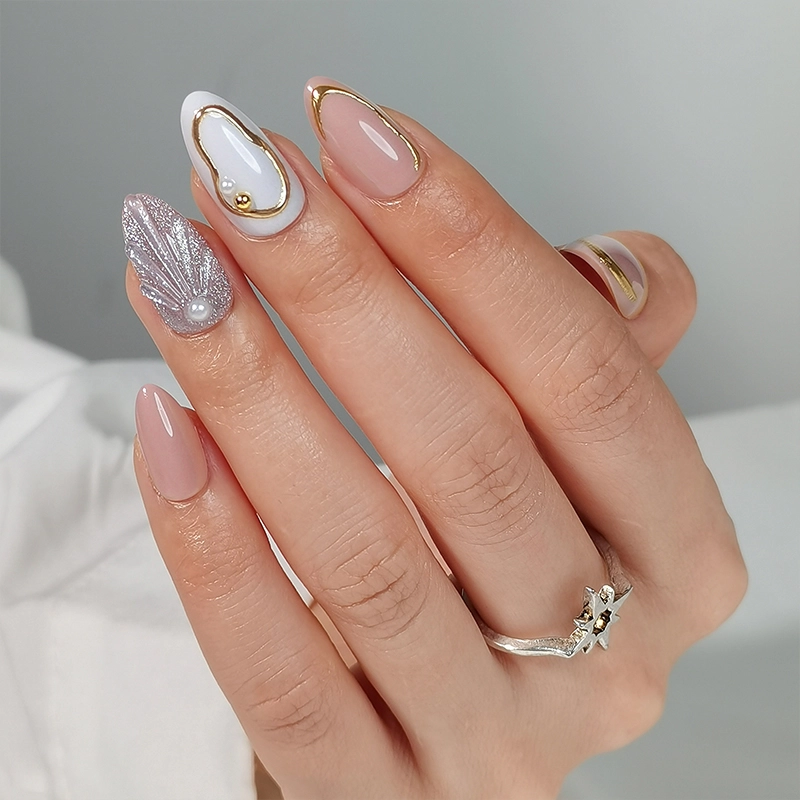
Wholesales Elegant Shell Inspired Soft Gel Wearable Nails for Seasonal Celebrations
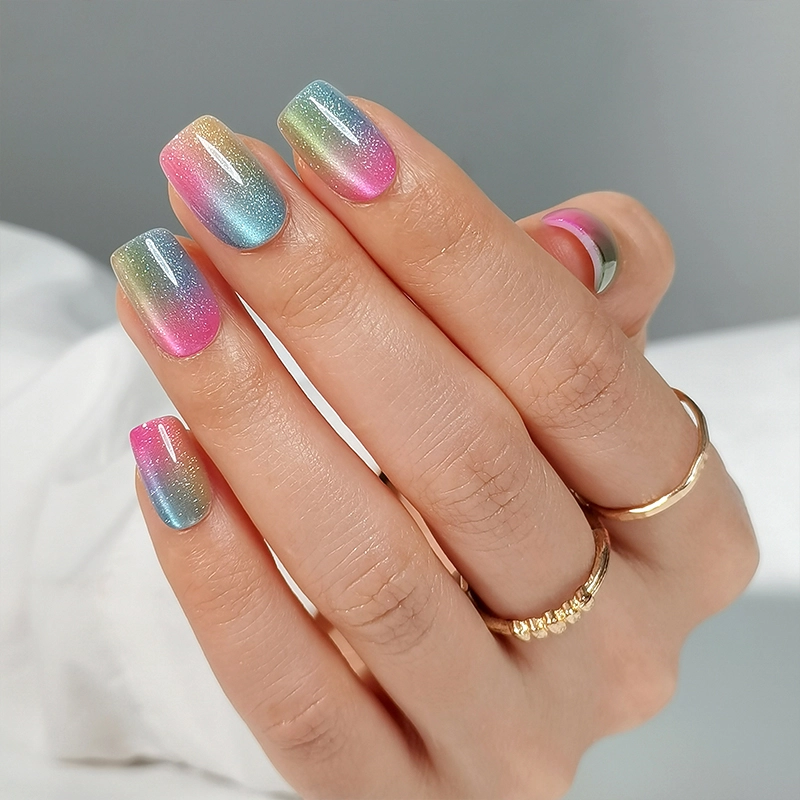
Custom Wholesale Gradient Cat Eye Soft Gel Wearable Fake Nails
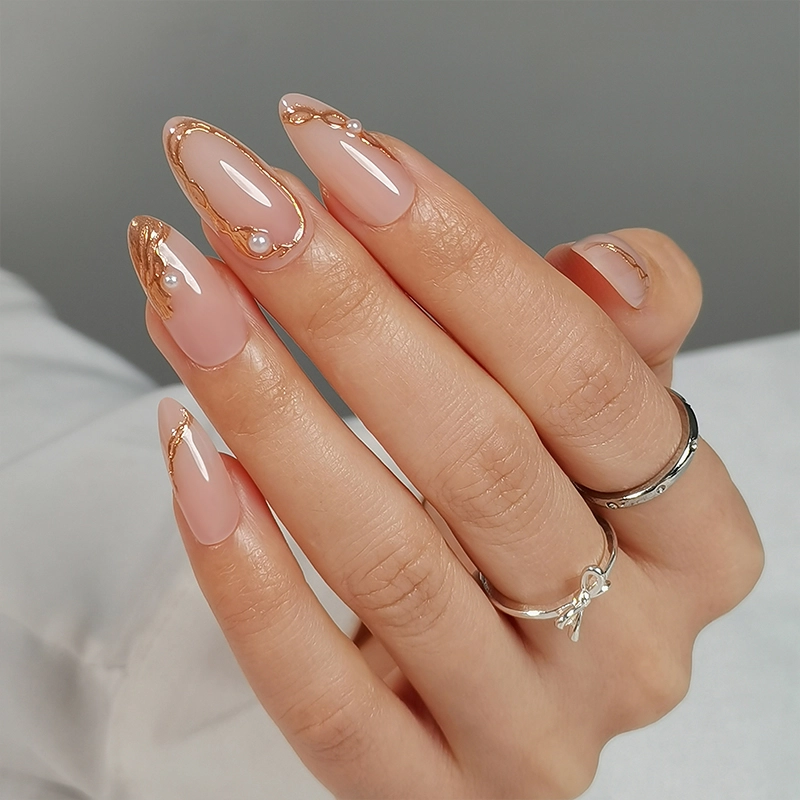
Wholesales Luxury Rhinestone Handmade Private Label Press On Nails Art Tips
Contact us
If you have press on nails products or customization needs, please feel free to contact from
below or via the contact information provided, we'll get back to you promptly within 24 hours.
By clicking 'Send Inquiry Now' I agree to XIANXING BEAUTY processing my personal data.
To see how to withdraw your consent, how to control your personal data and how we process it, please see our Privacy Policy and Terms of use.
Copyright © 2025 - XIANXING BEAUTY All Rights Reserved. Sitemap
Facebook
YouTube
Instagram
LinkedIn